Control Plans for GCC Process Stability
November 3, 2026
Like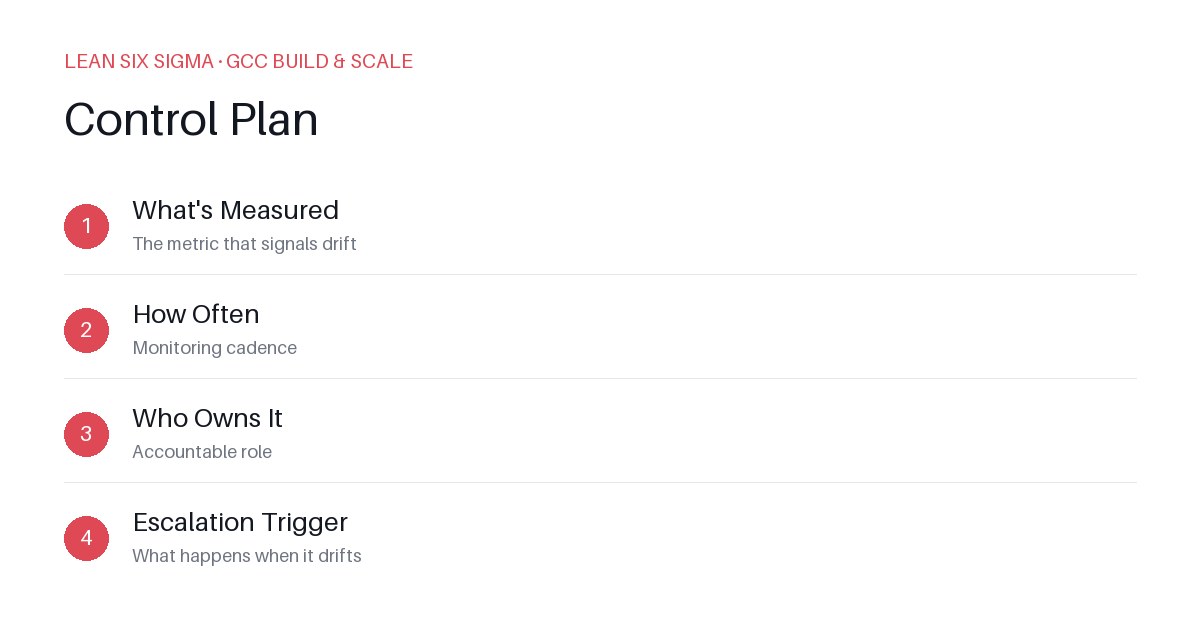
Downloadable templates
Move from reactive firefighting to proactive control with a structured GCC control plan framework.
Why Your GCC Needs a Control Plan
Most Global Capability Centers (GCCs) fail not because of talent gaps, but because of process drift. You build a process, it works for three months, then it degrades. Without a formal control plan, you’re guessing what broke and why.
A control plan is your GCC’s operating system. It defines how you monitor, measure, and maintain process stability across time zones and teams.
Define Critical Process Parameters
Start by identifying the 3–5 metrics that directly impact GCC outcomes. Examples:
- Cycle time: Time from request intake to delivery
- First-pass yield: Percentage of work completed without rework
- Defect escape rate: Errors found by clients vs. internal QA
- Utilization rate: Billable hours vs. available capacity
Document these in a living Control Plan document. Assign an owner for each metric. No metric without an owner is just a number.
Set Control Limits and Triggers
For each metric, define:
- Target value: What “good” looks like
- Upper/Lower control limits: When to investigate vs. when to act
- Response protocol: Who does what within what timeframe
Example: If first-pass yield drops below 85% for two consecutive weeks, trigger a root-cause analysis within 48 hours. Assign the process owner to lead.
Embed Monitoring into Daily Workflows
Control plans fail when they live in a folder. Integrate monitoring into your GCC’s rhythm:
- Daily standups: Review top 3 metrics. Flag exceptions.
- Weekly control board: Deep dive on trends, not just snapshots.
- Monthly control plan review: Update limits, protocols, and owners.
Use visual management. Whiteboards, dashboards, or even simple spreadsheets work. The key is visibility.
Respond to Out-of-Control Events
When a metric breaches its control limit:
- Pause and verify: Confirm the data is accurate.
- Contain: Stop the bleeding. Reroute work, add resources, or adjust scope.
- Investigate: Use 5 Whys or fishbone to find the root cause.
- Adjust: Update the process or control limits as needed.
- Document: Log the event, actions, and outcomes.
Repeat until the metric returns to control.
Iterate and Refine
Control plans aren’t set-and-forget. Review them quarterly. Ask:
- Are the metrics still relevant?
- Are the limits realistic?
- Are the response protocols being followed?
- What new risks have emerged?
Treat your control plan like a living document. The GCC that adapts survives. The one that doesn’t, becomes a cost center.
Next Steps
- Pick one GCC process to pilot a control plan.
- Define 3 critical metrics and their targets.
- Assign owners and response protocols.
- Run a 30-day trial. Measure the impact.
- Scale what works.
Stability isn’t luck. It’s engineered through control plans.
Comments
Be the first to comment on this post.
Sign in to leave a comment.