Control Plans for GCC Process Stability
August 25, 2026
Like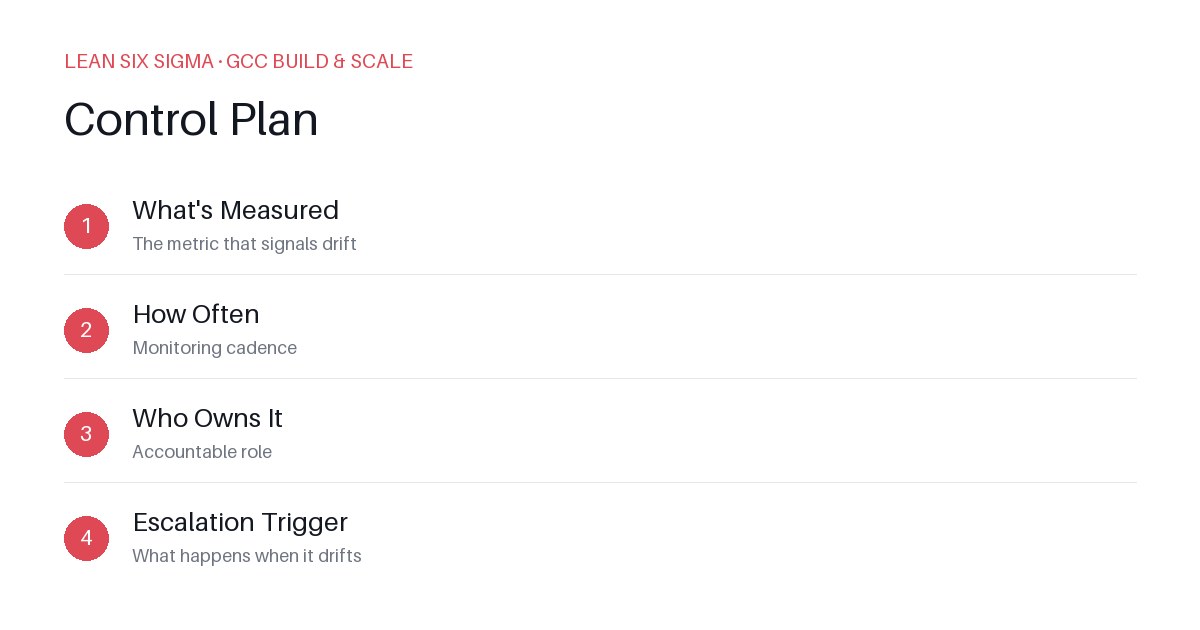
Downloadable templates
Implement data-driven control plans to stabilize GCC processes, reduce variation, and maintain continuous improvement.
Why Control Plans Matter in GCCs
Global Capability Centers (GCCs) thrive on consistency. But without structured control plans, processes drift, defects creep back in, and teams waste time firefighting instead of innovating.
A control plan is not a one-time document. It’s a living blueprint that locks in gains from your Lean Six Sigma initiatives and keeps them there.
Define Critical Process Parameters
Start by identifying what truly moves the needle. Use your previous DMAIC projects to pick 3–5 critical process parameters (CPIs) that directly impact quality, cycle time, or cost.
Example: For a GCC handling software defect resolution, CPIs might include:
- Mean time to resolution (MTTR)
- First-pass yield on code reviews
- Percentage of defects caught in QA vs. production
Document these clearly. Vague metrics lead to vague accountability.
Set Control Limits with Real Data
Avoid arbitrary targets. Use historical process data to calculate control limits.
If you’ve run an X-bar/R chart during your pilot, pull the process mean (X̄) and average range (R̄). Apply standard formulas:
- UCL = X̄ + 3(R̄/2)
- LCL = X̄ - 3(R̄/2)
These limits reflect what your process can consistently achieve, not what you wish it could do.
Assign Ownership and Response Actions
Every CPI needs an owner and a defined response plan.
Example structure:
- CPI: MTTR ≤ 48 hours
- Owner: Process Lead, Global Support
- Control Action: If MTTR exceeds UCL for 3 consecutive days, trigger root-cause workshop and update SOPs
Without clear ownership, control plans become decorative.
Integrate Control Plans into Daily Operations
A control plan fails if it lives in a drawer. Embed it into your GCC’s daily rhythm.
- Review control plan status in daily huddles (5 minutes max)
- Log CPI performance in a shared dashboard updated hourly
- Tie control plan compliance to team KPIs and performance reviews
Review and Refine Quarterly
Processes evolve. Your control plan must too.
Schedule quarterly reviews to:
- Assess if CPIs are still relevant
- Update control limits based on new data
- Retire actions that no longer add value
- Add new CPIs as the GCC scales
Treat control plans as part of your continuous improvement cycle, not a final deliverable.
Common Pitfalls to Avoid
- Too many CPIs: Focus on the vital few. More metrics dilute focus.
- Static control limits: Revisit them as process capability improves.
- No escalation path: Define what happens when limits are breached.
- Ignoring people: Control plans work only if teams understand and own them.
Start Small, Scale Fast
Pick one high-impact process. Build a control plan. Run it for 30 days. Measure results. Then replicate across your GCC.
Stability isn’t the end goal. It’s the foundation for faster innovation, higher quality, and predictable delivery. Control plans make that foundation real.
Comments
Be the first to comment on this post.
Sign in to leave a comment.