Control Plans for GCC Process Stability
August 27, 2026
Like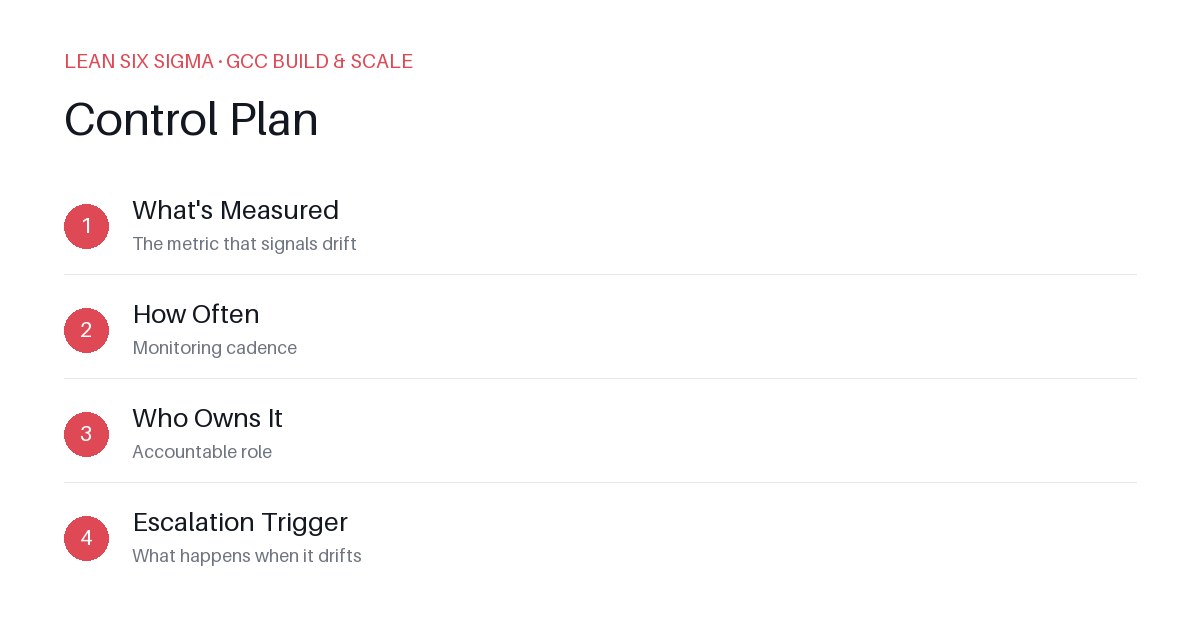
Downloadable templates
A practical walkthrough of applying Control Plan to real GCC build-and-scale work.
Control Plans for GCC Process Stability
Why Control Plan Matters for GCC Teams
Scaling a Global Capability Center (GCC) means standardizing work across sites, handoffs, and teams that have never worked together before. Without clear guardrails, variation creeps in — deadlines slip, quality dips, and stakeholders lose confidence. Control Plan gives you a shared vocabulary and a repeatable sequence for doing that. It turns ad-hoc fixes into predictable processes, enabling teams to operate with confidence even when members rotate, locations change, or workload spikes.
The Control Plan Sequence
A Control Plan is not a static document — it’s a living operating rhythm. Each control should be designed around four core elements:
-
What's Measured — The metric that signals drift
This must be specific, observable, and tied to business outcomes. Examples include: “Average ticket resolution time,” “Defect escape rate,” or “On-time delivery percentage.” Avoid vanity metrics; focus on indicators that directly impact service quality or client satisfaction. -
How Often — Monitoring cadence
Frequency should match the criticality and volatility of the metric. High-risk processes may require daily or real-time dashboards, while stable workflows can be reviewed weekly. Define both the monitoring frequency and the reporting rhythm to avoid alert fatigue. -
Who Owns It — Accountable role
Ownership must be explicit. Assign a named role (e.g., “Process Lead,” “Quality Champion,” or “Site Manager”) responsible for reviewing the metric, acting on deviations, and ensuring corrections are implemented. Shared responsibility dilutes accountability. -
Escalation Trigger — What happens when it drifts
Define clear thresholds that trigger action. For instance: “If defect rate exceeds 5% for two consecutive weeks, escalate to GCC Director and initiate root-cause analysis.” Escalation paths should include who gets notified, what information is shared, and what corrective actions follow.
Applying It
Start small: pick one recurring pain point your GCC team hits every week — whether it’s inconsistent documentation handoffs, delayed sprint reviews, or variable code review turnaround — and walk it through these four steps before rolling the approach out more broadly.
Step-by-Step Implementation
-
Identify the Pain Point
Gather data from recent retrospectives, client feedback, or internal audits. Choose a process that causes friction, not just one that’s easy to fix. -
Define the Metric
Quantify the issue. Instead of “handoffs are slow,” use “average handoff completion time within 24 hours.” -
Set the Cadence
Decide how often the metric will be tracked. Daily standups? Weekly dashboards? Monthly reviews? Align with team capacity and stakeholder needs. -
Assign Ownership
Name the person responsible. Ensure they have authority and visibility to act when thresholds are breached. -
Define Escalation
Create a clear path: who gets notified, what information is included, and what next steps follow. Document it so anyone on the team can reference it. -
Pilot and Iterate
Run the control for 30–60 days. Review effectiveness, adjust thresholds or cadence if needed, then formalize and scale.
Download the Template
This post is too short for good SEO. Expand it to 400-600 words by adding concrete detail, examples, or steps relevant to its EXISTING topic — do not change its existing meaning or invent claims unrelated to it. Keep any existing Markdown headings and build on them; add more '## ' subheadings if useful. Output ONLY the full expanded Markdown content, nothing else.
Comments
Be the first to comment on this post.
Sign in to leave a comment.