Control Plans for GCC Process Stability
August 27, 2026
Like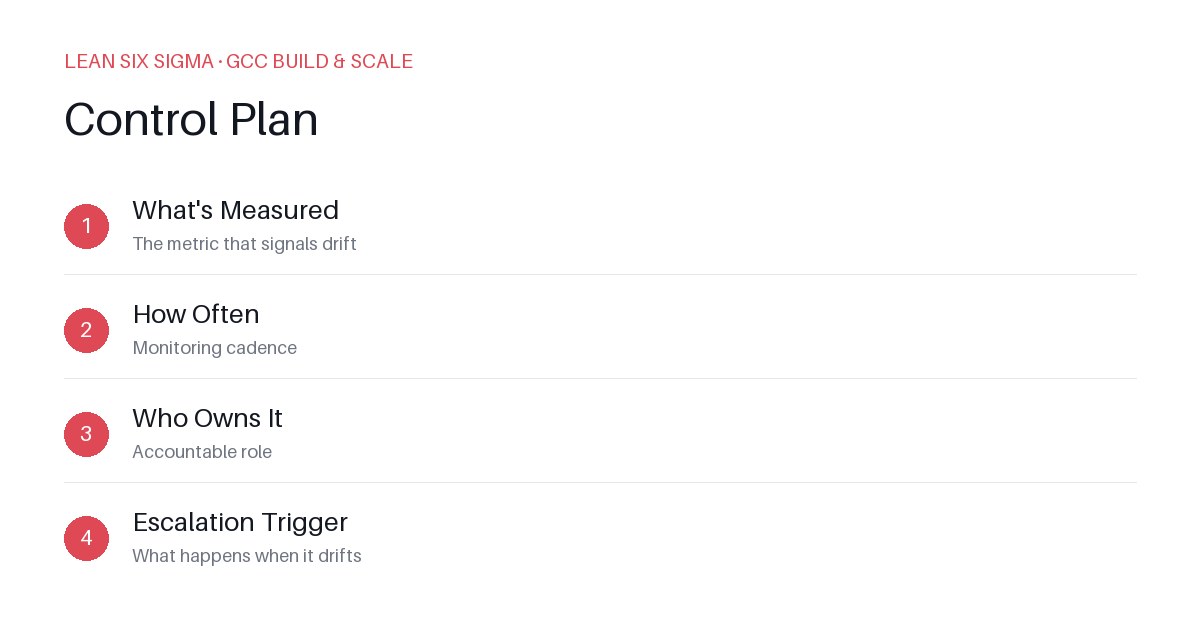
Downloadable templates
A practical walkthrough of applying Control Plan to real GCC build-and-scale work.
Control Plans for GCC Process Stability
Why Control Plan Matters for GCC Teams
Scaling a Global Capability Center means standardizing work across sites, handoffs, and teams that have never worked together before. Without a unified framework, processes become siloed, handoffs break down, and performance becomes unpredictable. Control Plan gives you a shared vocabulary and a repeatable sequence for doing that. It transforms ad-hoc troubleshooting into disciplined process governance, enabling GCCs to scale without sacrificing quality or speed.
The Control Plan Sequence
A Control Plan is not just a document — it’s an operational rhythm. It breaks down process stability into four actionable components:
-
What's Measured — The metric that signals drift
This is the leading or lagging indicator that tells you when a process is slipping. Examples include cycle time, error rate, first-pass yield, or SLA compliance. The key is choosing a metric that directly correlates with business impact and is observable in real time. -
How Often — Monitoring cadence
How frequently do you check the metric? Daily? Weekly? Per sprint? The cadence should match the speed of your operations and the cost of delay. Over-monitoring wastes resources; under-monitoring lets drift compound. -
Who Owns It — Accountable role
Clarity on ownership prevents the “everyone’s responsible, so no one’s responsible” trap. Assign a single accountable role per metric — typically a process owner, team lead, or GCC coordinator. This person doesn’t have to do the work but must ensure it’s done. -
Escalation Trigger — What happens when it drifts
Define clear thresholds and response protocols. For example: “If error rate exceeds 5% for two consecutive weeks, escalate to process governance council.” Escalation isn’t failure — it’s a structured way to trigger root-cause analysis and corrective action.
Applying It
Start small: pick one recurring pain point your GCC team hits every week, and walk it through these 4 steps before rolling the approach out more broadly. Download the template below to run your first pass.
Example: Implementing a Control Plan for Code Review SLA
- What’s Measured: Average time from PR submission to first review
- How Often: Monitored weekly via Jira dashboard
- Who Owns It: Engineering Process Lead
- Escalation Trigger: If average review time exceeds 48 hours for two weeks, notify Engineering Director and schedule a retro
This simple structure turns a vague complaint (“reviews are too slow”) into a manageable, trackable process improvement.
Scaling the Approach
Once you’ve stabilized one metric, replicate the Control Plan across other critical processes — deployment frequency, incident response time, or training completion rates. Over time, these individual plans form a process health dashboard that gives GCC leadership real-time visibility into operational stability.
Common Pitfalls to Avoid
- Choosing vanity metrics: Ensure your metrics drive action, not just reporting.
- Overcomplicating ownership: One clear owner per metric beats a committee.
- Ignoring feedback loops: A Control Plan is living — review and adjust cadence and triggers quarterly.
By embedding Control Plans into your GCC operating model, you don’t just fix problems — you build resilience.
Comments
Be the first to comment on this post.
Sign in to leave a comment.