Control Plans for GCC Process Stability
August 31, 2026
Like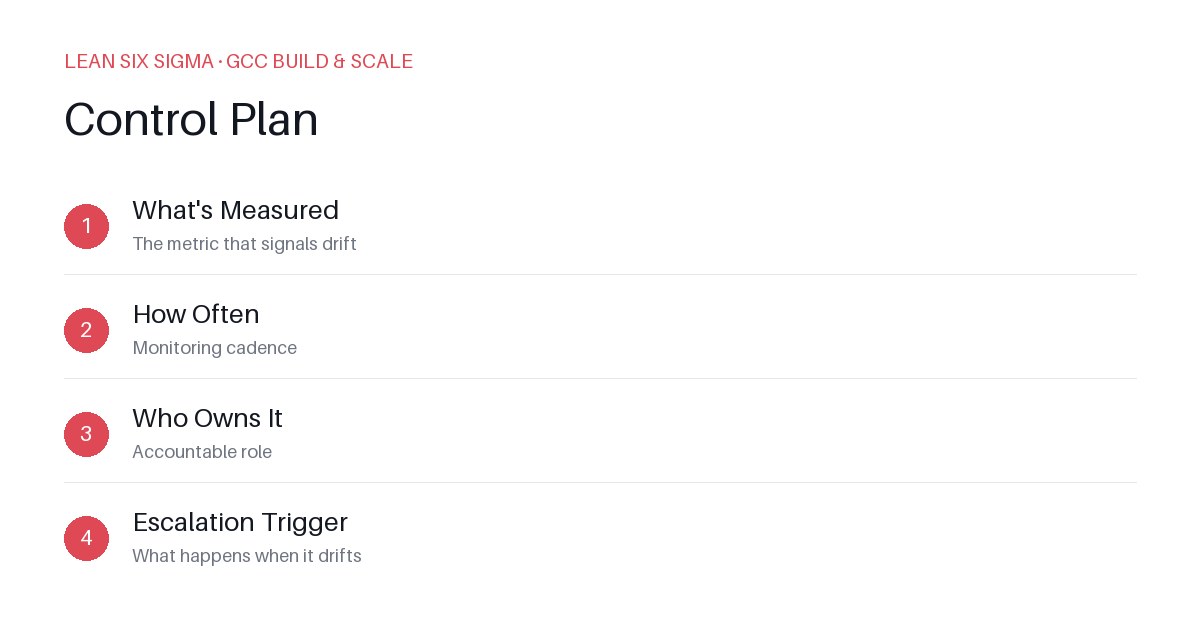
Downloadable templates
Implement control plans to stabilize GCC processes, reduce variation, and maintain performance across global teams using Lean Six Sigma principles.
Why Control Plans Matter in GCCs
Global Capability Centers (GCCs) thrive on predictability. A control plan isn’t just a document — it’s a living roadmap that locks in process performance, prevents drift, and scales excellence across locations. Without it, GCCs risk slipping into ad-hoc fixes and inconsistent outputs.
Define Critical Process Areas (CPAs)
Start by identifying the CPAs — the processes that directly impact quality, delivery, or customer satisfaction. Common GCC CPAs include:
- Ticket resolution workflows
- Code review and deployment pipelines
- Incident response procedures
- Vendor onboarding and integration steps
Map each CPA to its key performance indicators (KPIs). Example: For ticket resolution, track first-contact resolution rate, average handling time, and customer satisfaction scores.
Establish Baseline Performance
Before implementing control plans, you need a baseline. Use historical data to set realistic targets. If your current first-contact resolution rate is 65%, aim for 75% within 90 days. Document this baseline clearly — it becomes your reference point for measuring improvement and detecting anomalies.
Design the Control Plan Structure
A robust control plan should include:
- Process Description: Clear steps, roles, and responsibilities
- KPIs and Targets: Specific, measurable goals
- Control Activities: Checks, audits, and feedback loops
- Response Actions: What to do when deviations occur
- Review Cadence: How often to assess and adjust
Example: For code review, define who reviews, what criteria are checked, how long reviews take, and escalation paths for missed SLAs.
Implement Control Activities
Embed control activities into daily operations. This might include:
- Automated dashboards that flag KPI deviations
- Weekly cross-functional reviews to discuss performance
- Standardized checklists for critical steps
- Training refreshers when error rates spike
Automate what you can. Use tools like Jira, ServiceNow, or custom dashboards to monitor KPIs in real time. Automation reduces human error and frees up time for root cause analysis.
Monitor and Adapt
Control plans aren’t set-and-forget. Review them monthly. Ask:
- Are KPIs trending toward targets?
- Are control activities effective, or just checkbox exercises?
- Are there new risks or process changes affecting stability?
Adjust based on data. If a control activity isn’t catching issues, tweak it. If a target is unrealistic, recalibrate. The goal is continuous improvement, not perfection.
Scale Across GCCs
Once a control plan works in one location, standardize it. Document the plan, train teams, and integrate it into onboarding. Use a central repository to store and version control all GCC control plans. This ensures consistency and makes it easier to share best practices.
Remember: A control plan is only as good as its execution. Keep it practical, data-driven, and adaptable. Stability isn’t a destination — it’s a habit.
Comments
Be the first to comment on this post.
Sign in to leave a comment.