GCC Control Plans: Locking in Gains & Preventing Drift
October 18, 2026
Like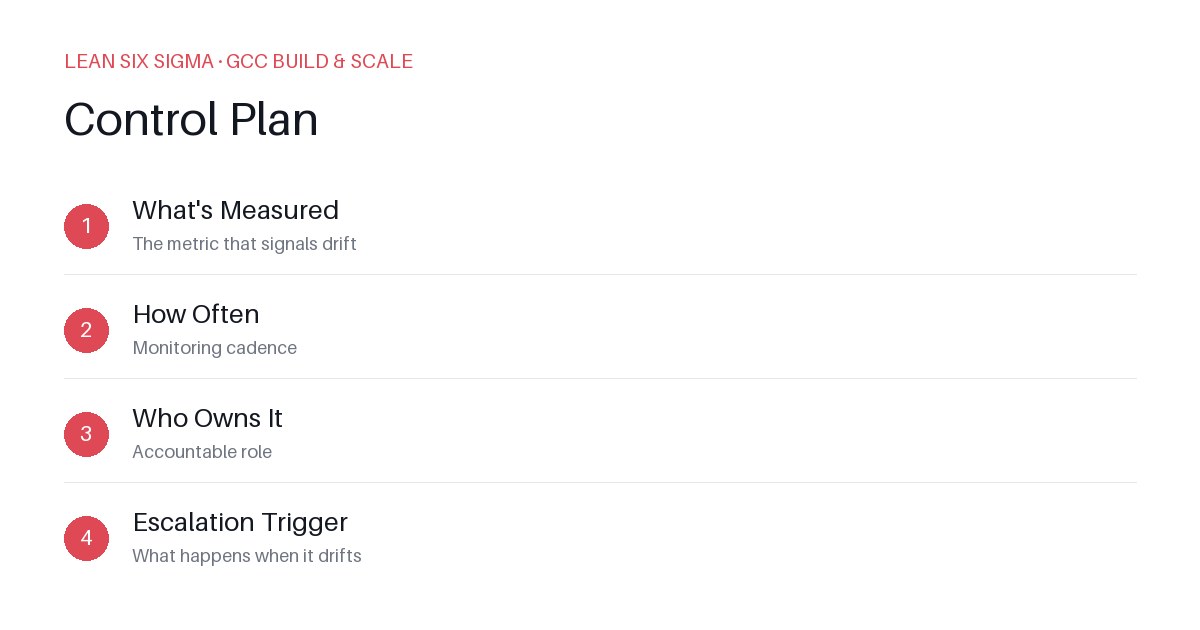
Downloadable templates
A practical guide to building control plans that lock in GCC gains and prevent process drift in global operations.
Why Control Plans Matter in a GCC
You’ve stabilized the process. Defect rates dropped. Cycle time improved. Now comes the hard part: keeping it that way.
In a Global Capability Center (GCC), processes don’t live in one location. They’re replicated across regions, teams, and time zones. Without a formal control plan, gains erode. People revert to old habits. New hires don’t inherit the best practices.
A control plan is your defense against process drift. It’s not a one-time document. It’s a living system that tells everyone what to do, when to check, and how to fix things before they break.
What Goes Into a GCC Control Plan
A control plan should be specific, actionable, and easy to follow. Avoid vague language. Instead of “monitor quality,” say “check first 50 units for defect type X and log results in the dashboard.”
Start with these elements:
- Process Owner: Who is accountable for the control? Name a person, not a department.
- Control Method: How will you measure stability? Visual management, automated alerts, daily reviews?
- Frequency: How often will the control run? Real-time, hourly, daily?
- Acceptance Criteria: What counts as “in control”? Define thresholds clearly.
- Action Steps: If something goes off-track, what’s the exact response? Escalation paths, root cause steps, fix procedures.
Keep it concise. If it takes more than a page to read, it’s too complex. Teams need to use it, not file it.
Implementing Controls Across the GCC
GCCs span multiple locations. Your control plan must work everywhere, not just in the headquarters.
- Standardize the Format: Use the same template for all sites. Different formats create confusion.
- Localize Where Needed: Some regions may have different regulations or tools. Adjust the control method, not the core logic.
- Train Consistently: Roll out the plan with live examples. Show teams how to use it in real scenarios.
- Audit Regularly: Check that controls are being followed. Spot-check logs. Interview team members. Fix gaps quickly.
Maintaining Stability Long-Term
Control plans decay if ignored. Treat them like a living process.
- Review Monthly: Update thresholds, owners, or methods as the process evolves.
- Celebrate Wins: When a control prevents a problem, recognize it. Reinforce the habit.
- Link to Improvements: Use control data to find new improvement opportunities. Stability is the base for further gains.
A GCC thrives when processes are predictable. Control plans make that predictability real. Build them well, use them daily, and your gains will stick.
Comments
Be the first to comment on this post.
Sign in to leave a comment.