DMAIC Cuts GCC Onboarding Delays: A Lean Six Sigma Playbook
October 7, 2026
Like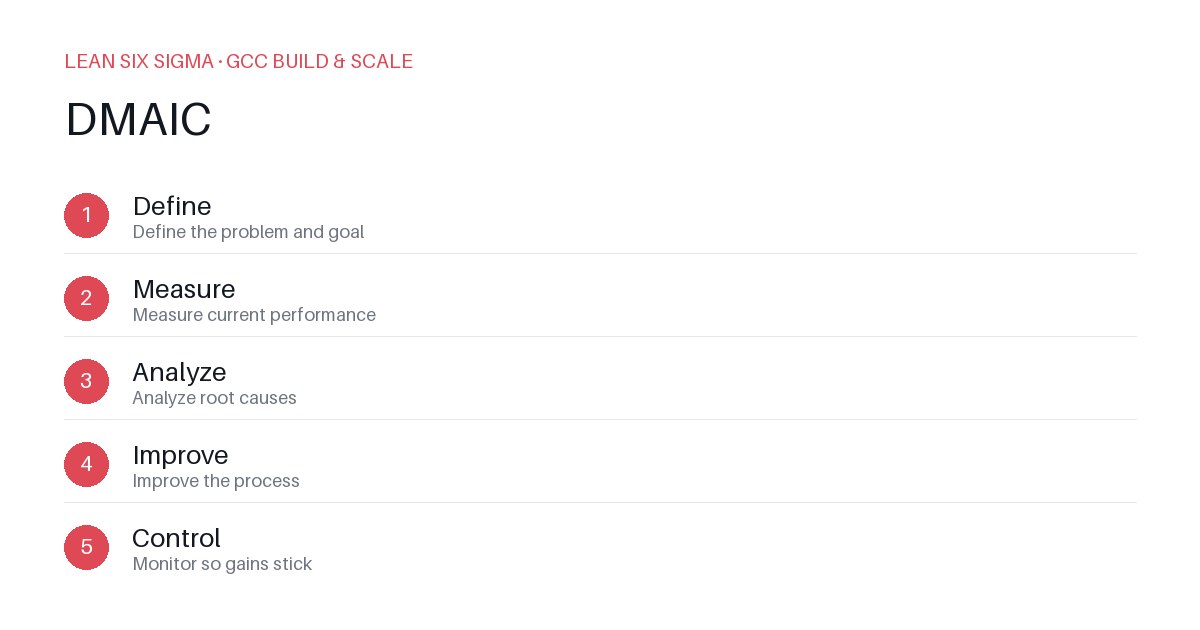
Downloadable templates
Use DMAIC to diagnose and eliminate onboarding bottlenecks, getting new talent productive in weeks, not months.
Defining the Real Problem
Onboarding delays at a GCC often look like a 'too many people' problem. It isn't. It's a process problem. You're losing weeks of ramp-up time because new hires wait on access, training, or unclear expectations.
Start with Define. Don't guess. Measure the current state. Track the time from 'Day 1' to 'First Independent Deliverable'. If your data shows a 45-day average, that's your baseline. Set a target, like 21 days. This isn't a nice-to-have; it's a hard constraint to protect your scaling velocity.
Measuring the Bottleneck
Move to Measure. You need to map the value stream of onboarding. Where does the new hire sit idle?
- Access Provisioning: How long to get email, Jira, and cloud credentials? If it takes three days, that's a leak.
- Training Delivery: Is training on-demand or scheduled? If scheduled, are you waiting on a trainer's calendar?
- Stakeholder Alignment: Does the new hire know their first 30-day goals by Day 3?
Use a current-state map. Identify every handoff. In a typical GCC, there are five to seven handoffs between IT, HR, the GCC Manager, and the Project Lead. Each handoff adds wait time.
Analyzing the Root Causes
Now Analyze. Use a root-cause analysis (like a 5-Whys or Fishbone) on your longest bottleneck. Let's say access provisioning takes three days.
- Why three days? IT ticket backlog.
- Why backlog? Manual ticket creation.
- Why manual? No automated workflow for new hires.
The root cause isn't slow IT. It's a lack of automation in the provisioning workflow. Fixing the symptom (hiring more IT staff) fails. Fixing the root cause (automating the workflow) scales.
Improving the Process
In the Improve phase, design the solution. Build a standardized onboarding playbook.
- Automate Access: Integrate HRIS with IT provisioning tools to trigger access requests on Day 0.
- Standardize Training: Create a self-paced LMS module that unlocks as the hire completes each stage.
- Set Clear Milestones: Define Day 1, Week 1, and Month 1 deliverables. No ambiguity.
Pilot this with one team. Run a small-scale test. Track the time-to-productivity. If the pilot drops onboarding time from 45 days to 28 days, you have proof.
Controlling the Gain
Finally, Control. Make the new process the standard. Monitor key metrics weekly.
- Time to First Deliverable
- Access Provisioning Time
- Stakeholder Satisfaction Score
Assign an owner. The GCC Manager or Process Lead should own onboarding metrics. Review them in the monthly capability review. If metrics slip, trigger a corrective action. Lean Six Sigma isn't a one-time project. It's a habit. Keep the process tight, keep the team fast, and keep the GCC scaling without friction.
Comments
Be the first to comment on this post.
Sign in to leave a comment.