DMAIC to Fix GCC Onboarding Delays
October 21, 2026
Like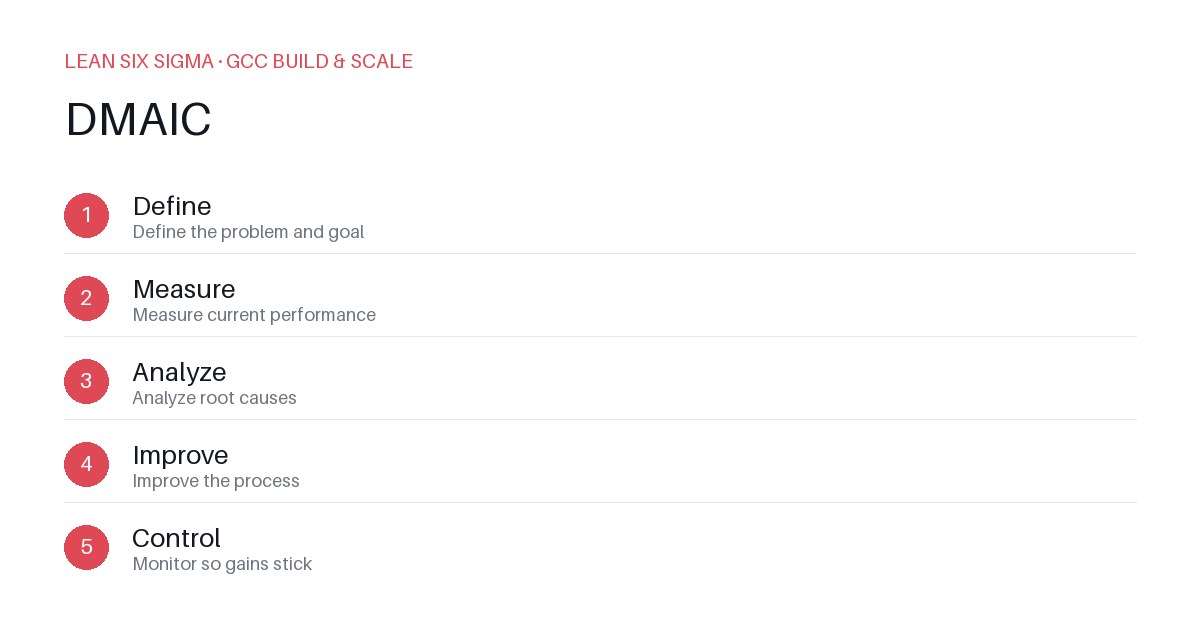
Downloadable templates
Map your onboarding workflow, cut waste with DMAIC, and get new hires productive in half the time.
DMAIC to Fix GCC Onboarding Delays
Defining the Real Problem
Most GCC (Global Customer Care) onboarding delays aren’t about people—they’re about process. New hires sit idle while waiting for access, training, or mentorship. You need a clear problem statement: reduce time-to-productivity for new GCC staff from 90 days to 45 days within six months. This isn’t just about speed; it’s about retention, cost savings, and customer experience. When onboarding drags, morale drops, errors rise, and churn increases. The goal is to create a seamless, predictable, and scalable onboarding journey that empowers new GCC team members to contribute meaningfully from day one.
Measuring Current State
Track every onboarding touchpoint. Use a timeline from day one to first deliverable. Common bottlenecks:
- IT access provisioning (avg. 5 days)
- Training module completion (avg. 10 days)
- First project assignment (avg. 7 days)
Collect data from 20 recent hires. Calculate cycle time and identify where delays compound. For example, if IT access takes 5 days, and training can’t start until access is granted, the total delay multiplies. Map each step visually: Day 1 (offer accepted), Day 2 (IT request submitted), Day 5 (access granted), Day 6–15 (training begins), Day 15–22 (training complete), Day 22–29 (first assignment), Day 30 (first deliverable). This granular view reveals hidden handoffs and approval queues that stall progress.
Analyzing Root Causes
Apply a fishbone diagram to onboarding delays. Common causes:
- Manual access requests requiring multiple approvals
- Training materials not aligned with current project needs
- No assigned buddy system, leading to confusion
Use 5 Whys on the longest delay. Example: Why does access take 5 days? Because IT queues requests. Why? Because approval workflow requires three signatures. Why? Because policy mandates it. Fix the policy, not the symptom. Another root cause: training modules are generic and outdated. New hires spend days searching for relevant content instead of learning job-specific tools. Without a buddy, they ask the same questions repeatedly, frustrating both new hires and mentors. These systemic gaps create a ripple effect that extends well beyond the first week.
Improving the Process
Redesign onboarding with lean principles:
- Automate IT access via role-based templates
- Create a 5-hour micro-training module per GCC function
- Assign a buddy for the first two weeks
Pilot the new process with 5 hires. Track cycle time daily. Expect 30% reduction in first week. For instance, pre-approved access templates can cut IT provisioning from 5 days to under 24 hours. Micro-training modules—delivered via interactive video and quizzes—ensure relevance and retention. Buddy assignments provide immediate support, reducing helpdesk tickets by up to 60%. Document each change, measure impact, and iterate based on feedback.
Controlling and Scaling
Implement control charts for onboarding metrics. Set alerts if cycle time exceeds 30 days. Review weekly with GCC leadership. Document changes in a living playbook. Scale to all GCCs by Q3. Monitor monthly. Adjust quarterly. This isn’t a one-time fix—it’s a repeatable system. Use dashboards to track KPIs like time-to-access, training completion rate, and first-deliverable date. Celebrate wins, address bottlenecks promptly, and embed continuous improvement into the culture. When onboarding becomes predictable, scalable, and human-centered, GCC teams thrive—and so does the business.
Comments
Be the first to comment on this post.
Sign in to leave a comment.