Kaizen Habits for Distributed GCC Teams
August 18, 2026
Like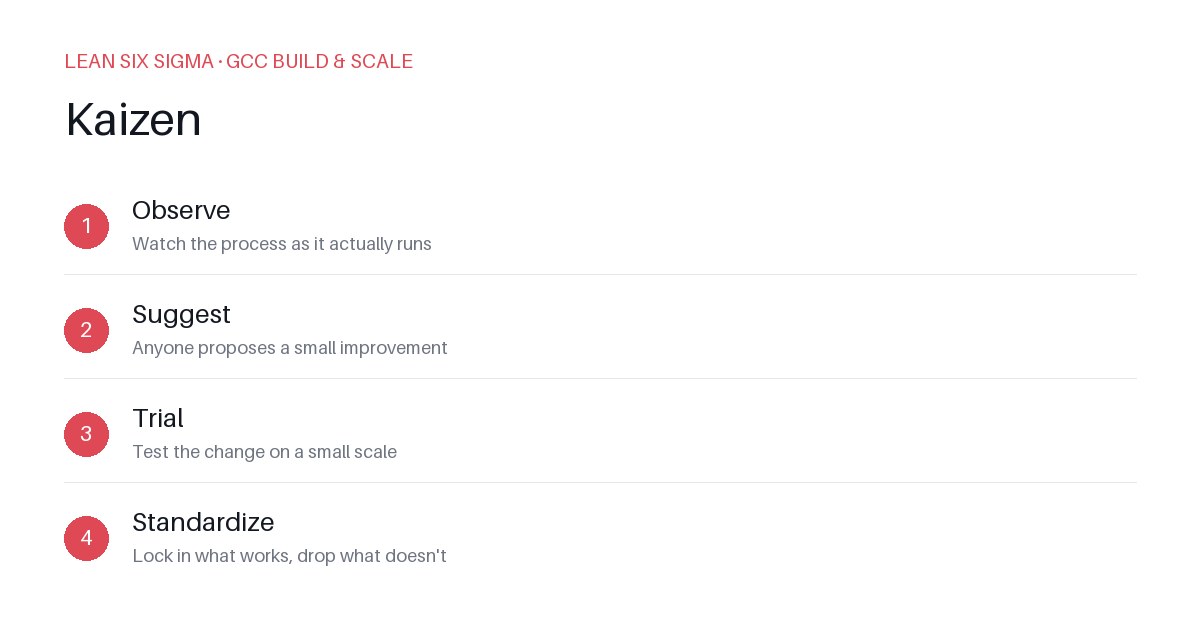
Downloadable templates
A practical walkthrough of applying Kaizen to real GCC build-and-scale work.
Why Kaizen Matters for GCC Teams
Scaling a Global Capability Center means standardizing work across sites, handoffs, and teams that have never worked together before. Kaizen gives you a shared vocabulary and a repeatable sequence for doing that.
In a distributed GCC, you’re dealing with time zones, cultural differences, and varying levels of process maturity. Traditional top-down process mandates often fail because they don’t account for local realities or generate buy-in. Kaizen flips the model: it empowers the people closest to the work to identify friction, propose solutions, and own the outcomes. This approach reduces resistance, accelerates adoption, and creates a culture of continuous improvement that scales naturally across your network.
The Kaizen Sequence
- Observe — Watch the process as it actually runs
- Suggest — Anyone proposes a small improvement
- Trial — Test the change on a small scale
- Standardize — Lock in what works, drop what doesn’t
This sequence isn’t just theoretical; it’s a practical framework that can be applied to any recurring workflow in your GCC. Let’s break down how each step translates into actionable practices for distributed teams.
Applying It
Start small: pick one recurring pain point your GCC team hits every week, and walk it through these 4 steps before rolling the approach out more broadly. Download the template below to run your first pass.
Step 1: Observe — Watch the Process as It Actually Runs
Many GCC teams assume they know how their processes work, but observation reveals the gap between documented procedures and real-world execution. Assign team members to shadow workflows across different sites. Look for bottlenecks, rework, or handoff delays.
Example: A GCC team handling software release approvals noticed that approvals were taking 5 days on average. Upon observation, they discovered that each site had its own checklist format, causing reviewers to spend time translating or reformatting documents before evaluation.
Step 2: Suggest — Anyone Proposes a Small Improvement
Once you’ve identified the problem, open the floor for suggestions. Encourage input from all levels — junior developers, senior engineers, and process owners alike. The key is to focus on incremental changes rather than overhauling entire systems.
Example: In the release approval scenario, team members suggested creating a standardized digital checklist template that could be used across all sites. This small change eliminated the need for manual formatting and reduced confusion.
Step 3: Trial — Test the Change on a Small Scale
Before rolling out any improvement globally, test it in a controlled environment. Choose one site or team to pilot the change. Measure its impact on efficiency, quality, and team satisfaction.
Example: The GCC team piloted the standardized checklist with one regional team. After two weeks, they observed a 30% reduction in approval time and fewer errors in documentation.
Step 4: Standardize — Lock In What Works, Drop What Doesn’t
If the trial is successful, document the new process and train all relevant teams. If it doesn’t work, analyze why and iterate. Standardization ensures that improvements are sustained and not lost to the next change in the process.
Example: After confirming the checklist’s effectiveness, the GCC team updated their standard operating procedures and conducted training sessions across all sites. This became the new norm for release approvals.
Making Kaizen a Habit
Kaizen isn’t a one-time project; it’s a mindset that requires consistent reinforcement. Here are some tips for embedding it into your GCC culture:
- Hold Regular Kaizen Sessions: Schedule monthly or quarterly sessions where teams share improvements and discuss new opportunities.
- Celebrate Small Wins: Recognize and reward teams that implement successful improvements, no matter how small.
- Use Visual Management: Display process maps and improvement metrics in shared spaces to keep Kaizen visible and accessible.
- Encourage Cross-Functional Participation: Invite members from different departments to participate in Kaizen activities to foster collaboration and diverse perspectives.
By consistently applying the Kaizen sequence and making it a habit, your GCC team can drive continuous improvement, enhance efficiency, and build a culture of innovation that scales across your global network.
Comments
Be the first to comment on this post.
Sign in to leave a comment.