Kaizen Habits for Distributed GCC Teams
September 1, 2026
Like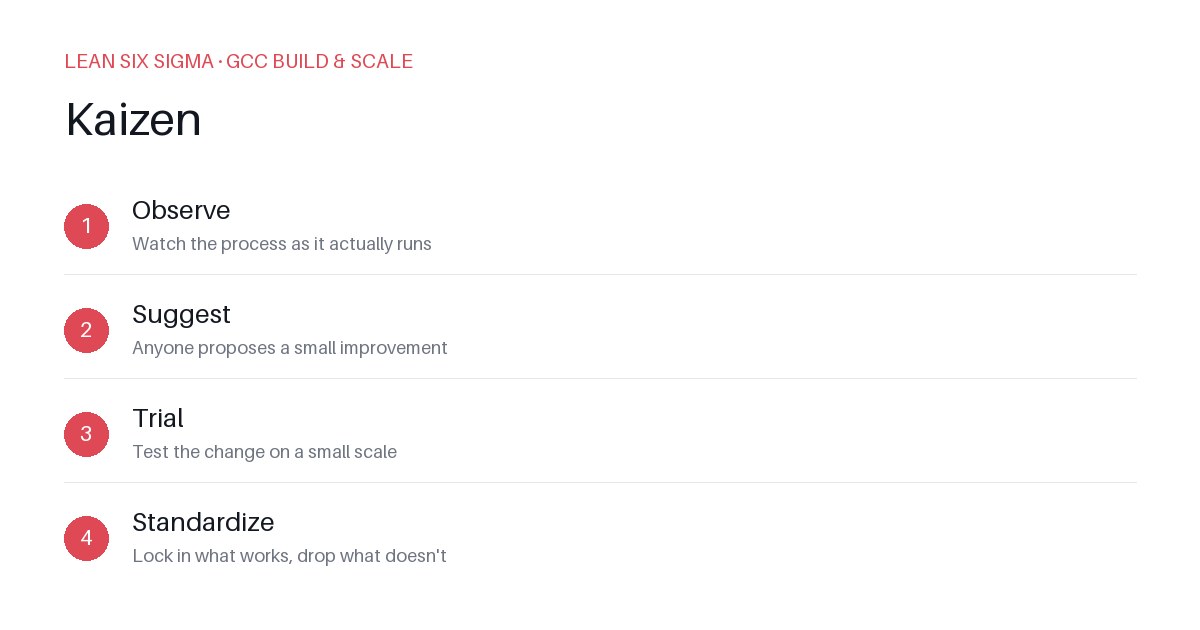
Downloadable templates
How to embed continuous improvement into daily workflows across time zones and remote teams.
The Problem With Distributed Kaizen
Most GCCs treat Kaizen as a quarterly event. You bring in facilitators, run workshops, and hope the changes stick. In a distributed model, this approach fails. Time zones, async communication, and lack of shared physical space break the momentum. Improvement becomes theoretical instead of operational.
You need habits, not events. Small, repeatable practices that keep the improvement engine running without relying on dedicated facilitators or perfect alignment.
Start With Daily 5-Minute Huddles
Replace the hour-long status update with a structured 5-minute huddle. Each team member shares:
- One win from yesterday
- One blocker
- One improvement idea
Keep it to a shared doc or chat channel. No meetings required. This creates a rhythm of awareness and catches issues before they cascade.
Build a Visual Improvement Board
You can't improve what you can't see. Set up a shared digital board (Confluence, Miro, or Jira) that tracks:
- Current process metrics
- Open improvement ideas
- Implemented changes
- Impact results
Update it weekly. If an idea doesn't move from "planned" to "done" within two weeks, archive it. Dead ideas clutter the board and kill morale.
Run Micro-Experiments, Not Grand Projects
Big transformations require massive buy-in. Micro-experiments don't. Pick one small process — like approval workflows or ticket routing — and test a change for two weeks. Measure the result. If it works, keep it. If not, revert.
Example: A GCC in India reduced approval time from 3 days to 1 day by removing one redundant sign-off. That change was tested in two weeks, measured, and rolled out globally.
Train Teams to Spot Waste
Kaizen isn't about adding steps; it's about removing friction. Teach your teams to identify the eight wastes:
- Defects
- Overprocessing
- Waiting
- Non-utilized talent
- Transportation
- Inventory
- Motion
- Extra features
Run a monthly "waste hunt" where teams submit one example of waste they observed. Reward the team that implements the most impactful fix.
Make Feedback Loops Tight
Long feedback loops kill improvement. Set a rule: any process change must be reviewed within 14 days of implementation. Use a simple checklist:
- Did it reduce time or cost?
- Did it improve quality?
- Are users adopting it?
If the answer is no to any question, roll back or adjust. No debate, no politics.
Close The Loop Publicly
Silent improvements don't scale. When a change is implemented, announce it in the GCC channel. Include:
- The problem
- The solution
- The result
- Who owned it
This builds accountability and shows others that improvement is valued. It also creates a library of proven changes that new teams can reuse.
Measure What Matters
Track three metrics:
- Number of improvement ideas submitted
- Percentage of ideas implemented
- Time from idea to implementation
If ideas are piling up but nothing is happening, your process is broken. If ideas are low, your training is weak. Adjust accordingly.
Start Small, Scale Fast
Don't try to implement all of this at once. Pick one habit — like the daily huddle or the micro-experiment — and run it for 30 days. Measure the result. Then add the next habit. Kaizen is about compounding small wins, not overwhelming teams with change.
Distributed GCCs can't rely on proximity for improvement. They have to engineer it into their daily workflows. Start with one habit. Make it stick. Then add another. The rest follows.
Comments
Be the first to comment on this post.
Sign in to leave a comment.