Kaizen Habits for Distributed GCC Teams
September 6, 2026
Like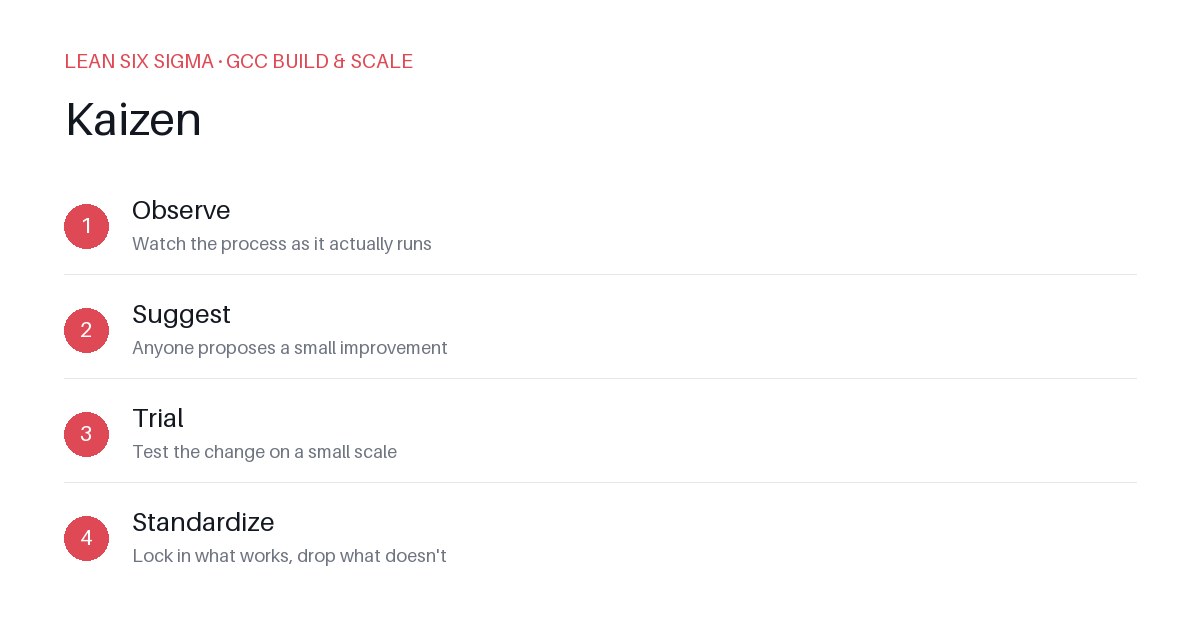
Downloadable templates
A practical walkthrough of applying Kaizen to real GCC build-and-scale work.
Kaizen Habits for Distributed GCC Teams
Why Kaizen Matters for GCC Teams
Scaling a Global Capability Center means standardizing work across sites, handoffs, and teams that have never worked together before. In a distributed environment, information asymmetry, cultural differences, and tool fragmentation can quickly erode efficiency and morale. Kaizen gives you a shared vocabulary and a repeatable sequence for doing that. It’s not just a lean manufacturing concept borrowed into software and operations; it’s a cultural operating system that turns every team member into a process owner. When applied consistently, Kaizen reduces friction at the handoff points where most GCC value leaks — whether that’s between discovery and delivery, between QA and production, or between regional offices that operate on different time zones.
The Kaizen Sequence
The power of Kaizen lies in its simplicity and its discipline. The sequence is designed to encourage continuous, incremental improvement without requiring massive reengineering or leadership approval for every small tweak.
- Observe — Watch the process as it actually runs. Don’t rely on documentation or assumptions. Sit with the team, log the steps, note where delays happen, and identify where rework occurs. In a GCC context, this might mean shadowing a developer in Tokyo while a QA engineer in Bangalore tests the same feature.
- Suggest — Anyone proposes a small improvement. The key is lowering the barrier to entry. A suggestion doesn’t need to be a full solution; it can be a question, a pattern you’ve noticed, or a tool that could reduce manual steps. Encourage psychological safety so junior members feel comfortable speaking up.
- Trial — Test the change on a small scale. Run a pilot with one squad, one release cycle, or one workflow. Measure the impact objectively — did cycle time drop? Did defect rates improve? Did team satisfaction increase? Keep the trial short enough to iterate quickly if needed.
- Standardize — Lock in what works, drop what doesn’t. Update runbooks, update automation scripts, and communicate the change broadly. Standardization is what turns a one-time win into a lasting capability. Without it, improvements evaporate.
Applying It
Start small: pick one recurring pain point your GCC team hits every week, and walk it through these 4 steps before rolling the approach out more broadly. For example, if your team consistently spends three hours a week reconciling environment configurations, that’s a prime candidate for a Kaizen sprint. Document the current state, gather suggestions from both dev and ops, trial a configuration-as-code tool on a single service, and if it saves time, standardize it across the team.
Download the template below to run your first pass. The template includes fields for each Kaizen step, metrics to track, and a feedback loop for post-trial review. Use it in your next team sync to align on a single improvement focus. Remember, Kaizen is not about perfection; it’s about progress. Consistent, small wins compound into significant operational maturity over time.
Comments
Be the first to comment on this post.
Sign in to leave a comment.