Kaizen Habits for Distributed GCC Teams
September 8, 2026
Like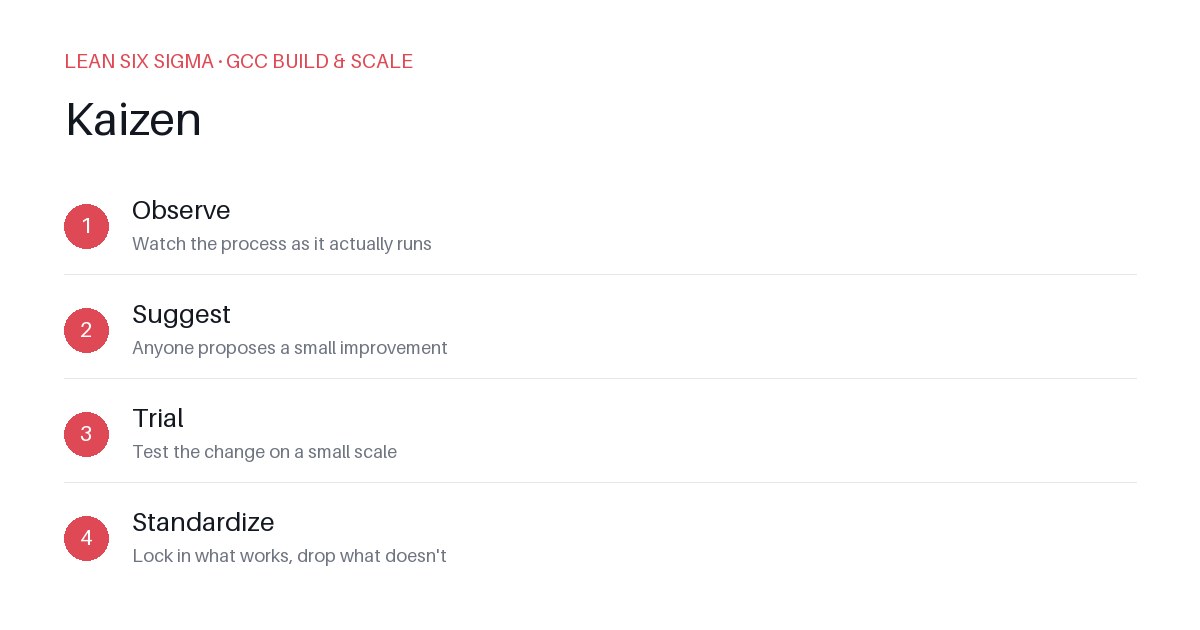
Downloadable templates
Small, daily improvements beat big annual overhauls. Here’s how to embed Kaizen into your distributed GCC workflow.
Why Distributed GCCs Struggle with Kaizen
Traditional Kaizen thrives on physical proximity: whiteboards, quick huddles, and shared context. When your Global Capability Center spans three time zones and five countries, that friction disappears. Teams default to async updates, which often become status reports, not improvement engines. The result? Stagnation masked as activity.
The Core Shift: From Events to Habits
Kaizen isn’t a quarterly initiative; it’s a daily discipline. In distributed settings, you can’t rely on osmosis. You must engineer habits into the workflow. Start with one non-negotiable: every team member must identify one waste and propose a fix within 48 hours of spotting it. Track it in your project tool. Review it in the next sprint planning.
Implementing a Visual Kanban for Distributed Teams
Digital boards are your new war rooms. Use a shared Kanban board with columns: Idea, Root Cause Analysis, Proposed Fix, Tested, Deployed. Assign a “Kaizen Champion” per team who rotates monthly. Their job: move items, remove blockers, and ensure no idea sits in Idea for more than a week. Visualize the bottleneck. Fix it. Repeat.
Time-Boxed Micro-Experiments
Distributed teams can’t afford weeks-long pilots. Run 72-hour micro-experiments. Example: A QA team notices 30% of test failures are flaky. They propose automating retry logic. They implement a patch, test it on a subset of jobs, measure failure rate drop, and report back in a 15-minute async video update. If it works, scale. If not, discard. Low risk, high learning.
Capturing and Sharing Wins
culture eats metrics for breakfast. If teams don’t see the payoff, they’ll revert to old habits. Create a “Kaizen Wins” channel. Every Friday, teams post one improvement with: What was broken, What you changed, Result. Tag the root cause (e.g., #waiting, #rework). Over time, patterns emerge. You’ll see that 60% of delays come from approval bottlenecks. Now you have data to drive process changes, not guesses.
Avoiding the Common Traps
Don’t force Kaizen into teams that are still stabilizing. Fix the basics first: clear roles, reliable tooling, predictable delivery. Don’t reward “number of ideas” — reward “impact per effort.” And never skip the root cause. A quick fix that masks a systemic issue is just deferred pain. Use the 5 Whys, even asynchronously. Post the chain in the ticket. Make the thinking visible.
Your First 30-Day Plan
- Pick one high-friction process (e.g., code review turnaround).
- Assign a Kaizen Champion.
- Set up a Kanban board with the 5 columns.
- Run one 72-hour experiment.
- Share the win in the #wins channel.
Kaizen in a distributed GCC isn’t about perfection. It’s about momentum. Small, visible, repeatable improvements compound. Start small. Measure relentlessly. Scale what works.
Comments
Be the first to comment on this post.
Sign in to leave a comment.