Kaizen Habits for Distributed GCC Teams
September 8, 2026
Like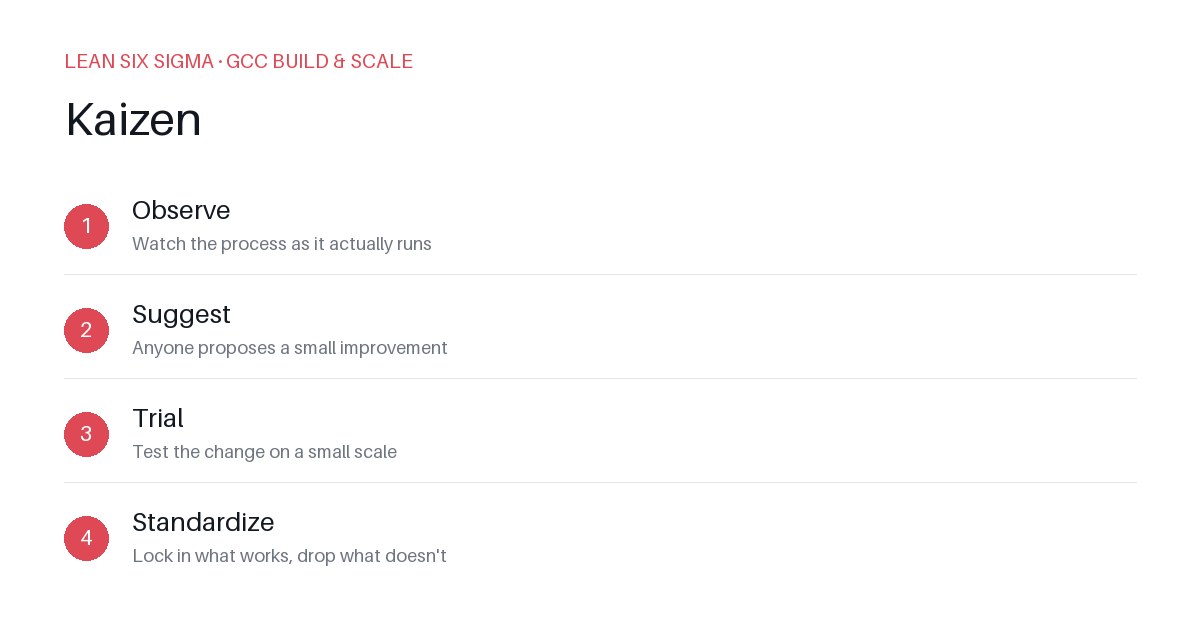
Downloadable templates
A practical walkthrough of applying Kaizen to real GCC build-and-scale work.
Kaizen Habits for Distributed GCC Teams
Why Kaizen Matters for GCC Teams
Scaling a Global Capability Center means standardizing work across sites, handoffs, and teams that have never worked together before. In distributed environments, time zones, cultural nuances, and asynchronous communication can easily erode consistency and efficiency. Kaizen gives you a shared vocabulary and a repeatable sequence for doing that. It’s not about radical overhauls or costly transformation programs; it’s about embedding continuous, incremental improvement into the daily rhythm of your GCC operations. When teams understand the same framework, they can align on what “good” looks like, reduce friction in cross-site handoffs, and build momentum through small, visible wins.
The Kaizen Sequence
- Observe — Watch the process as it actually runs. Don’t rely on assumptions or documented procedures alone. Sit in on meetings, review ticket flows, shadow handoffs, and note where delays, rework, or confusion occur. In a GCC context, this might mean observing how a requirement moves from a US-based product owner to an APAC development team, and where the message gets diluted or lost.
- Suggest — Anyone proposes a small improvement. Encourage a culture where every team member feels safe suggesting a tweak. These suggestions should be specific, actionable, and focused on one step at a time. For example, instead of “We need better documentation,” a suggestion might be “Add a checklist to the Jira transition from In Progress to Code Review.”
- Trial — Test the change on a small scale. Run the suggestion as a pilot with one team or for one sprint. Measure its impact using simple metrics: cycle time, error rate, or team satisfaction. Keep the trial short—two to four weeks is usually enough to gather meaningful feedback without creating overhead.
- Standardize — Lock in what works, drop what doesn’t. If the trial proves effective, formalize it: update runbooks, train new hires, and embed it into your workflow tools. If it doesn’t, document why and move on. The key is to treat standardization as a living process, not a one-time event.
Applying It
Start small: pick one recurring pain point your GCC team hits every week, and walk it through these 4 steps before rolling the approach out more broadly. Common starting points include slow code review turnaround, inconsistent deployment practices, or misaligned sprint planning across regions.
To make this actionable, follow these steps:
- Identify the bottleneck: Use data from your project management tools to find where work consistently stalls.
- Conduct a blameless observation session: Bring together representatives from each site involved in the process. Use a whiteboard or digital canvas to map the current state.
- Brainstorm and vote on suggestions: Limit yourself to one idea per person. Use dot voting to prioritize based on impact and effort.
- Run a time-boxed trial: Assign an owner, set success criteria, and schedule a review meeting at the end of the trial period.
- Document and disseminate: Create a one-page summary of what worked, why, and how to implement it. Share it across all GCC sites via your communication channels.
Download the template below to run your first pass. It includes fields for each step, space for metrics, and prompts for next actions.
Sustaining Kaizen in a GCC Environment
Kaizen only works if it becomes a habit, not a project. To embed it into your GCC culture:
- Recognize and reward: Celebrate small wins publicly. Even a shout-out in a weekly sync can reinforce the behavior.
- Rotate ownership: Let different teams lead Kaizen cycles. This builds cross-functional empathy and prevents burnout.
- Integrate with existing rituals: Tie Kaizen reviews into your sprint retrospectives, sprint planning, or monthly capability reviews.
- Measure leading indicators: Track not just outcomes (e.g., faster delivery) but behaviors (e.g., number of suggestions submitted, trial completion rate).
By making continuous improvement a shared responsibility, your GCC team will build resilience, reduce variability, and create a culture where every member feels empowered to make things better—every single day.
Comments
Be the first to comment on this post.
Sign in to leave a comment.