Kaizen Habits for Distributed GCC Teams
September 11, 2026
Like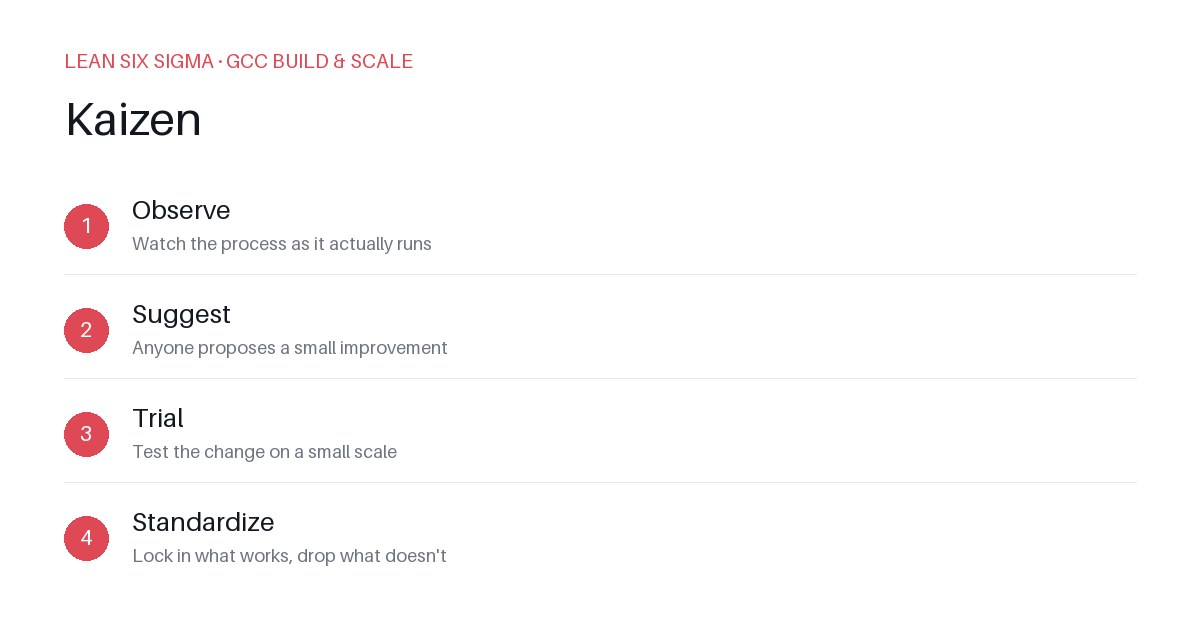
Downloadable templates
A practical walkthrough of applying Kaizen to real GCC build-and-scale work.
Kaizen Habits for Distributed GCC Teams
Why Kaizen Matters for GCC Teams
Scaling a Global Capability Center (GCC) means standardizing work across sites, handoffs, and teams that have never worked together before. In a distributed environment, misalignment often creeps in during routine workflows—like ticket triage, code review handoffs, or deployment approvals. Without a shared rhythm, these small friction points compound into delays, duplicated effort, and team fatigue.
Kaizen gives you a shared vocabulary and a repeatable sequence for doing that. It’s not about sweeping overhauls or mandatory process mandates. It’s about empowering every team member to notice inefficiencies, propose micro-improvements, and safely test them before they become permanent. When applied consistently, Kaizen turns process improvement from a top-down initiative into a cultural habit.
The Kaizen Sequence
- Observe — Watch the process as it actually runs, not as it’s documented. Look for wait times, rework, unclear ownership, or steps that add no value.
- Suggest — Anyone proposes a small, specific improvement. The best suggestions are actionable within a week or two and require minimal resources.
- Trial — Test the change on a small scale. Run it for one sprint, one project, or one team rotation. Measure impact without making it permanent.
- Standardize — Lock in what works, drop what doesn’t. Update documentation, train onboarding materials, and communicate what changed and why.
Applying It: A Practical Example
Start small: pick one recurring pain point your GCC team hits every week, and walk it through these 4 steps before rolling the approach out more broadly.
For instance, consider the handoff between QA and DevOps during release preparation. Teams might observe that QA spends hours retesting already-fixed issues because bug reports lack clear reproduction steps. A team member might suggest adding a mandatory checklist to bug tickets: “Include environment, steps to reproduce, expected vs. actual result, and screenshots.” The team then trials this by requiring the checklist only for bugs tagged “release-blocking” over the next two weeks. After measuring defect escape rates and rework hours, they find a 30% drop in redundant testing. They then standardize the checklist by adding it to the Jira template and updating the QA onboarding doc.
Building the Habit
Kaizen only works when it’s embedded into daily routines. Try these practices:
- Dedicate 15 minutes weekly in team syncs to review one observed pain point and brainstorm suggestions.
- Use a shared board (e.g., Trello, Confluence, or Jira) to log observations, proposals, trial results, and standardized changes.
- Celebrate small wins publicly. Recognition reinforces the behavior and encourages participation from quieter team members.
- Rotate facilitation so different voices lead each cycle, preventing the same people from driving every improvement.
Download the Template
Download the template below to run your first pass. It includes prompts for each Kaizen step, space for metrics, and fields for assigning owners and timelines. Use it to structure your first improvement cycle, then iterate on the template itself as part of the process.
By making Kaizen a habit rather than an event, your GCC team builds a self-correcting engine for continuous improvement—one small step at a time.
Comments
Be the first to comment on this post.
Sign in to leave a comment.