Kaizen Habits for Distributed GCC Teams
September 14, 2026
Like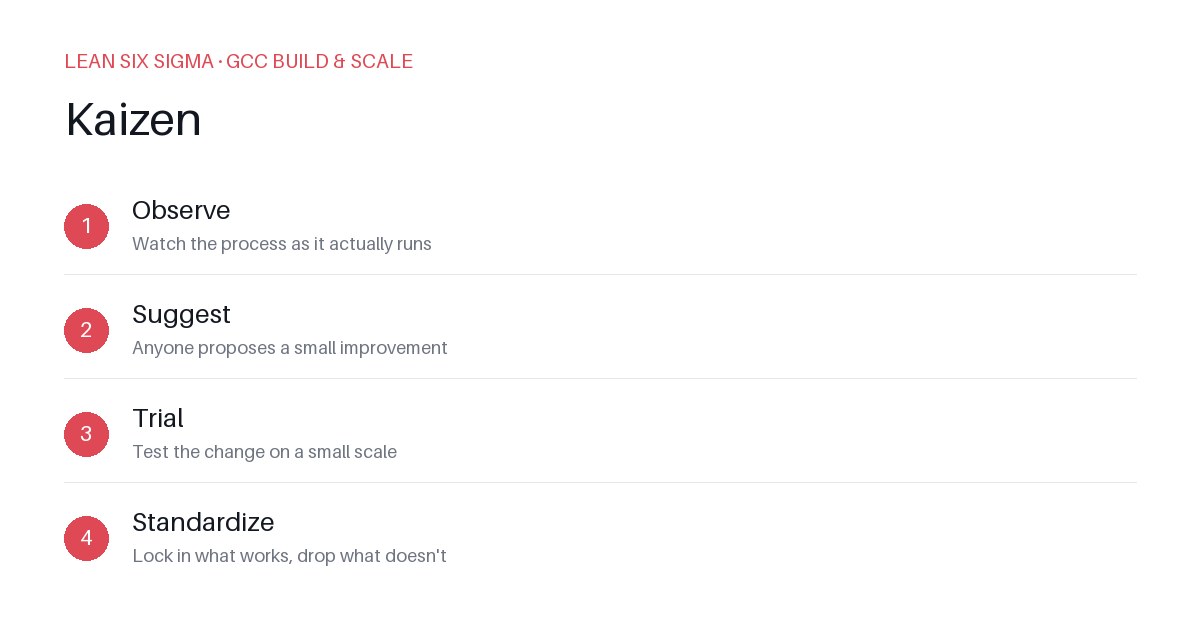
Downloadable templates
A practical walkthrough of applying Kaizen to real GCC build-and-scale work.
Kaizen Habits for Distributed GCC Teams
Why Kaizen Matters for GCC Teams
Scaling a Global Capability Center means standardizing work across sites, handoffs, and teams that have never worked together before. In distributed environments, misalignment often stems from unspoken assumptions, inconsistent workflows, and fragmented feedback loops. Kaizen gives you a shared vocabulary and a repeatable sequence for doing that — turning fragmented local improvements into cohesive global capability.
When teams operate across time zones, cultures, and toolchains, even small inefficiencies compound quickly. A delayed code review, a misunderstood acceptance criterion, or a duplicated documentation step can stall delivery across multiple sites. Kaizen provides a lightweight, disciplined framework to surface these friction points, test fixes safely, and institutionalize what works — without requiring top-down mandates or lengthy change-management cycles.
The Kaizen Sequence
-
Observe — Watch the process as it actually runs
Don’t rely on documented procedures alone. Shadow real workflows. Note where delays occur, where people work around the system, and where handoffs break. In GCC contexts, this often means observing sprint handoffs between site A and site B, or watching how QA tickets flow from dev to test environments. -
Suggest — Anyone proposes a small improvement
Encourage frontline contributors to flag one specific, actionable tweak. The suggestion should be narrow, measurable, and low-risk. Examples: “Add a checklist to the Jira transition from Dev to QA,” or “Create a shared template for API contract reviews.” -
Trial — Test the change on a small scale
Run the suggestion for one sprint or one project team. Track leading indicators: cycle time, defect escape rate, or handoff delay frequency. Keep the experiment contained so rollback is easy if the change doesn’t deliver value. -
Standardize — Lock in what works, drop what doesn’t
If the trial shows consistent improvement, formalize the practice: update runbooks, train onboarding materials, and embed the step into your team’s definition of done. If it doesn’t, document why and archive the lesson. This closes the loop and builds trust in the Kaizen process itself.
Applying It
Start small: pick one recurring pain point your GCC team hits every week, and walk it through these 4 steps before rolling the approach out more broadly. Common starting points include:
- Handoff bottlenecks: Where do tickets stall between development and QA? Try a “ready-for-test” checklist to reduce back-and-forth.
- Documentation drift: When do specs diverge from implementation? Introduce a lightweight “definition of complete” that includes updated docs.
- Onboarding delays: New hires spend too long waiting for environment access? Trial a pre-provisioned sandbox and track time-to-first-PR.
Download the template below to run your first pass. Structure your session around a single process, assign an observer, a suggester, a trial coordinator, and a standardization owner. Keep the first Kaizen cycle under two weeks to maintain momentum.
Measuring Impact
Track three metrics per cycle:
- Cycle time reduction — How much faster does the process move?
- Error rate — Do defects or rework incidents drop?
- Adoption rate — What percentage of teams are using the standardized step?
Share results transparently across sites. Celebrate small wins to reinforce participation. Over time, these micro-improvements compound into a more resilient, self-correcting GCC operating model.
Next Steps
After your first cycle, schedule a 30-minute retrospective with the core team. Ask: What surprised us? What should we repeat? What should we adjust? Then pick the next pain point. Kaizen isn’t a one-time initiative — it’s a habit. Build it into your cadence, and your distributed GCC will grow sharper, faster, and more aligned.
Comments
Be the first to comment on this post.
Sign in to leave a comment.