Kaizen Habits for Distributed GCC Teams
September 16, 2026
Like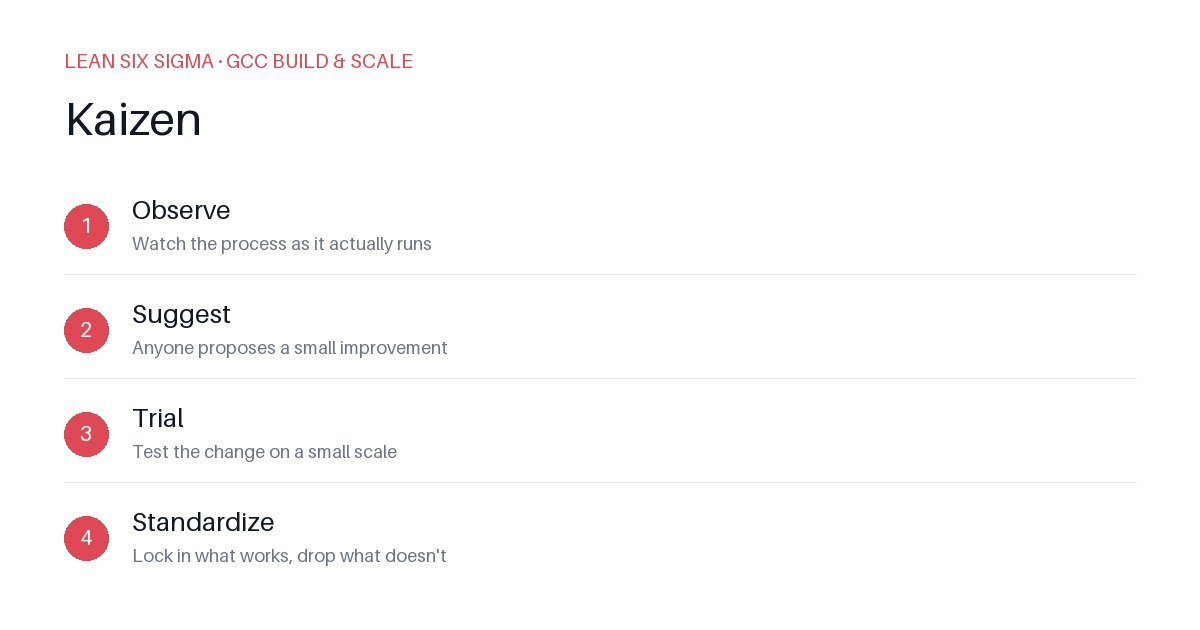
Downloadable templates
Five daily habits to drive continuous improvement across distributed Global Capability Center teams without adding process overhead.
Start with a 10-Minute Daily Huddle
Distributed teams often suffer from misalignment because communication happens asynchronously. A structured 10-minute daily stand-up forces clarity.
- What did we finish? Share one completed task.
- What are we tackling today? Commit to one priority.
- Where are we blocked? Identify roadblocks immediately.
Use a shared digital board to track progress. This habit prevents small issues from becoming bottlenecks.
Implement the "Five Whys" for Root Cause Analysis
When defects or delays occur, teams often treat symptoms instead of causes. The "Five Whys" technique digs deeper.
Example: A code review took too long.
- Why? Reviewers were busy.
- Why? They had too many pending tasks.
- Why? Work wasn't prioritized.
- Why? No clear ownership.
- Why? Roles were undefined.
The root cause is unclear ownership, not reviewer speed. Address the real issue.
Use Visual Management for Transparency
Distributed teams lose visibility into work status. Visual management bridges this gap.
- Kanban boards: Show work-in-progress limits.
- Burndown charts: Track sprint progress.
- Error dashboards: Highlight recurring issues.
Post these in shared channels. Transparency drives accountability.
Run Weekly Kaizen Events
Weekly focused sessions drive improvement.
- Select one process: Pick one bottleneck.
- Gather data: Analyze metrics.
- Brainstorm solutions: Team generates ideas.
- Test and iterate: Implement small changes.
Example: Reduce meeting time by 20%. Track results.
Celebrate Small Wins
Kaizen is about incremental progress. Celebrate improvements to reinforce behavior.
- Share success stories: Highlight wins in team channels.
- Recognize contributors: Acknowledge those who drive change.
- Reflect on progress: Review improvements monthly.
Positive reinforcement sustains momentum. Small wins compound.
Avoid Common Pitfalls
- Don't overcomplicate: Start with one habit.
- Don't ignore feedback: Listen to team input.
- Don't skip measurement: Track metrics.
Kaizen requires discipline. Consistency beats intensity. Start small, iterate often, and scale what works.
Comments
Be the first to comment on this post.
Sign in to leave a comment.