Kaizen Habits for Distributed GCC Teams
August 18, 2026
Like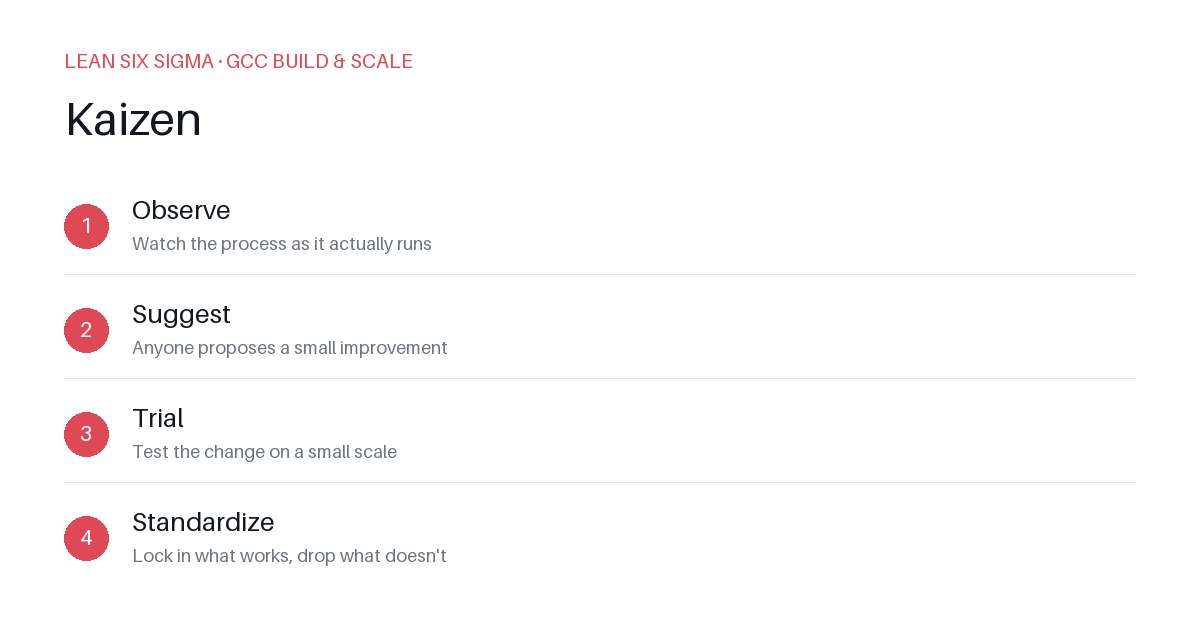
Downloadable templates
A practical walkthrough of applying Kaizen to real GCC build-and-scale work.
Kaizen Habits for Distributed GCC Teams
Why Kaizen Matters for GCC Teams
Scaling a Global Capability Center means standardizing work across sites, handoffs, and teams that have never worked together before. In a distributed environment, miscommunication, duplicated effort, and inconsistent processes can quickly erode efficiency and morale. Kaizen gives you a shared vocabulary and a repeatable sequence for doing that. It’s not about overhauling everything overnight; it’s about creating a culture of continuous, incremental improvement that everyone can own.
When teams are spread across time zones and cultures, formal documentation often falls short. Kaizen bridges that gap by encouraging frontline contributors to speak up, test ideas safely, and embed small wins into daily workflows. Over time, these micro-improvements compound into significant gains in speed, quality, and cross-site alignment.
The Kaizen Sequence
- Observe — Watch the process as it actually runs. Don’t rely on assumptions or past documentation. Sit with the team, shadow handoffs, and note where delays, errors, or friction occur. Ask: “What’s the real bottleneck?”
- Suggest — Anyone proposes a small improvement. Encourage ideas from all levels, not just managers. The best fixes often come from those doing the work. Keep suggestions focused, specific, and actionable.
- Trial — Test the change on a small scale. Run a pilot for a week or two. Measure impact against a baseline. This step removes fear of failure and builds confidence in the process.
- Standardize — Lock in what works, drop what doesn’t. Document the new approach, train the team, and assign ownership. Regularly revisit it to ensure it still fits evolving needs.
Applying It
Start small: pick one recurring pain point your GCC team hits every week, and walk it through these 4 steps before rolling the approach out more broadly. Download the template below to run your first pass.
Example: Streamlining Cross-Site Handoffs
Imagine your GCC team handles weekly feature reviews that involve engineers in India, QA in the US, and product owners in Europe. Currently, the handoff takes two days, with emails piling up and key details getting lost.
- Observe: You notice that the original request often lacks clear acceptance criteria, causing back-and-forth.
- Suggest: A QA lead proposes a simple checklist template to be filled out before the handoff.
- Trial: The team uses the template for three consecutive reviews. Feedback shows fewer clarifications needed and faster sign-offs.
- Standardize: The checklist becomes part of the standard workflow, shared in your team’s playbook and reinforced in onboarding.
Tips for Success
- Pick visible, low-risk processes to start. Avoid complex, high-stakes workflows for your first Kaizen cycle.
- Celebrate small wins. Recognition fuels participation and reinforces the habit.
- Review regularly. Hold a 15-minute weekly huddle to discuss what’s working and what’s not.
- Document everything. Even simple improvements deserve a record so they don’t get lost.
Kaizen isn’t a one-time project—it’s a mindset. By embedding these habits into your GCC team’s rhythm, you build resilience, clarity, and continuous growth across every site and shift.
Comments
Be the first to comment on this post.
Sign in to leave a comment.