Kaizen Habits for Distributed GCC Teams
September 28, 2026
Like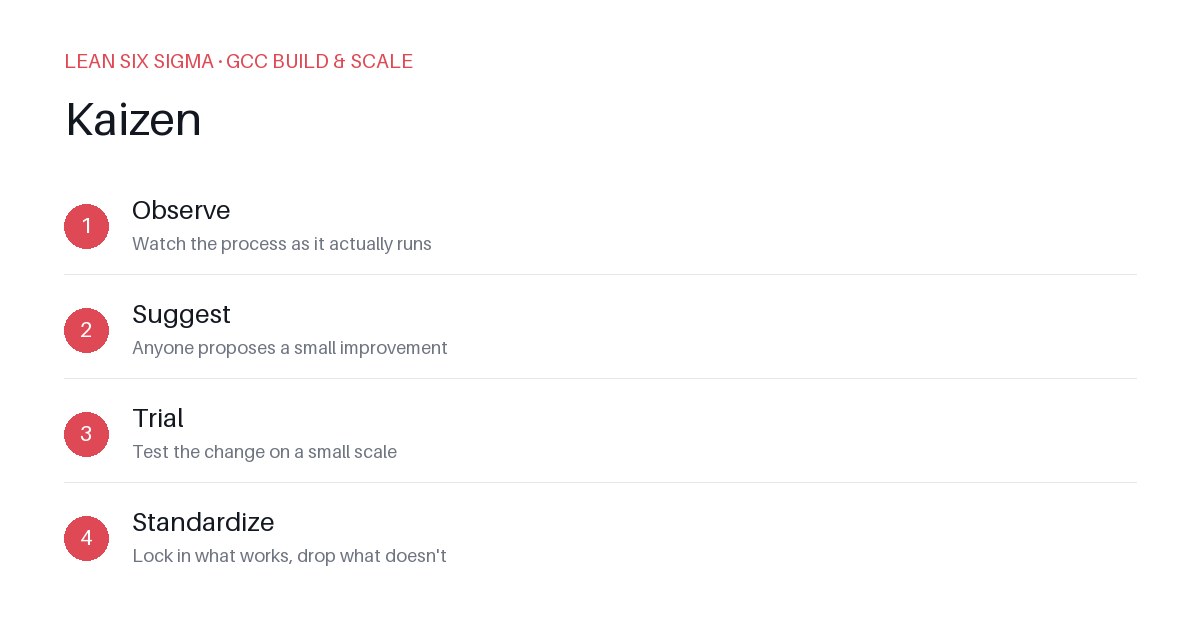
Downloadable templates
A practical walkthrough of applying Kaizen to real GCC build-and-scale work.
Why Kaizen Matters for GCC Teams
Scaling a Global Capability Center (GCC) means standardizing work across sites, handoffs, and teams that have never worked together before. Without a shared operating rhythm, local teams drift into their own processes, creating friction during cross-site collaboration. Kaizen gives you a shared vocabulary and a repeatable sequence for doing that. It’s not just a Japanese management concept — it’s a practical framework for continuous, incremental improvement that thrives in distributed environments where you can’t rely on constant face-to-face alignment.
The Kaizen Sequence
- Observe — Watch the process as it actually runs. Don’t rely on assumptions or documented procedures alone. Sit with the team, shadow a handoff, review recent tickets or deliverables, and identify where time is lost, where errors occur, or where handoffs stall.
- Suggest — Anyone proposes a small improvement. Encourage input from all levels — from junior developers to senior architects. The best ideas often come from those who do the work daily. Focus on changes that are low-risk, high-impact, and easy to test.
- Trial — Test the change on a small scale. Run a pilot with one team, one project, or one week. Measure the effect. Did it reduce cycle time? Improve quality? Reduce friction? If it didn’t work, that’s fine — learning is the goal.
- Standardize — Lock in what works, drop what doesn’t. Update documentation, train the team, and integrate the improvement into your regular workflow. Then repeat the cycle with the next pain point.
Applying It
Start small: pick one recurring pain point your GCC team hits every week, and walk it through these 4 steps before rolling the approach out more broadly. Common starting points include:
- Handoff delays between site A and site B due to unclear acceptance criteria
- Code review bottlenecks caused by inconsistent review depth or timing
- Meeting overload where status updates could be async
For example, if your team notices that code reviews take 3 days on average, you might:
- Observe — Track review timestamps, comment volume, and rework cycles.
- Suggest — Propose a 24-hour review SLA with a checklist for critical vs. cosmetic feedback.
- Trial — Run this with one squad for two sprints.
- Standardize — If cycle time drops and quality holds, document the checklist and train all reviewers.
Download the template below to run your first pass. Use it to map your current process, identify the one bottleneck to tackle, and plan your 4-step Kaizen sprint. Consistency matters more than perfection — run a Kaizen cycle every two weeks, and you’ll build a culture of continuous improvement that scales with your GCC.
Comments
Be the first to comment on this post.
Sign in to leave a comment.