Kaizen Habits for Distributed GCC Teams
October 1, 2026
Like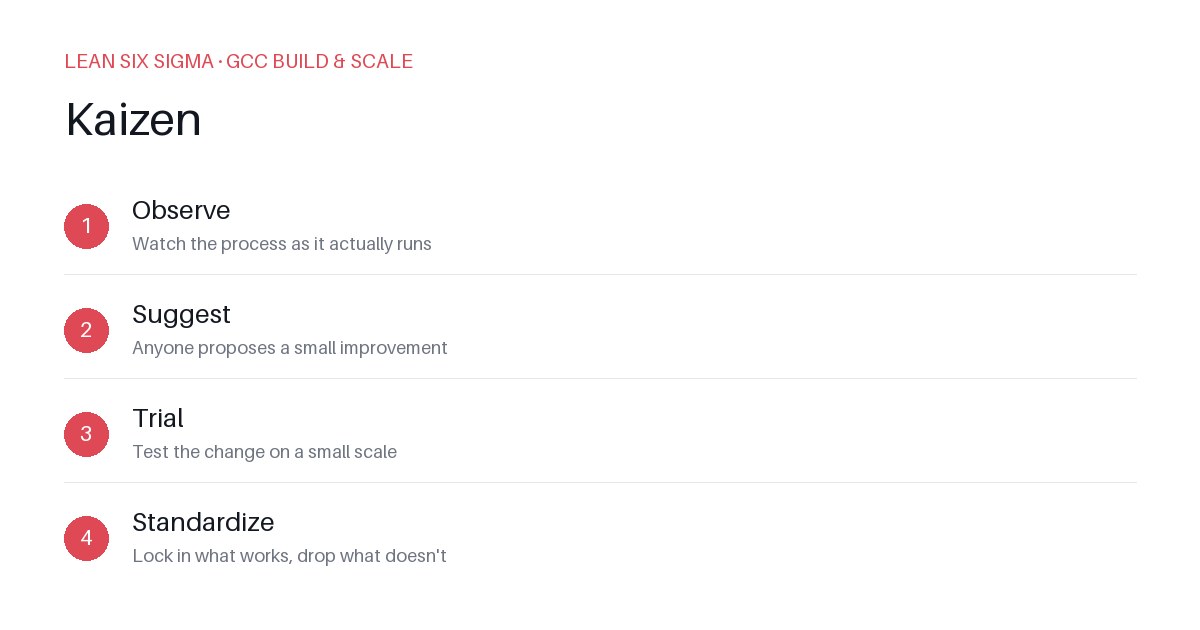
Downloadable templates
A practical walkthrough of applying Kaizen to real GCC build-and-scale work.
Why Kaizen Matters for GCC Teams
Scaling a Global Capability Center means standardizing work across sites, handoffs, and teams that have never worked together before. Kaizen gives you a shared vocabulary and a repeatable sequence for doing that.
The Kaizen Sequence
- Observe — Watch the process as it actually runs
- Suggest — Anyone proposes a small improvement
- Trial — Test the change on a small scale
- Standardize — Lock in what works, drop what doesn't
Applying It
Start small: pick one recurring pain point your GCC team hits every week, and walk it through these 4 steps before rolling the approach out more broadly. Download the template below to run your first pass.
How to Run Your First Kaizen Sprint
To get the most out of your initial Kaizen cycle, follow these practical steps:
- Choose a focused problem: Don’t tackle your entire workflow. Pick one specific handoff, report, or approval step that causes consistent delays or errors.
- Gather the right people: Include at least one person from each site involved in that process. Their diverse perspectives are essential for spotting hidden bottlenecks.
- Timebox the observation phase: Spend 1–2 days shadowing the current process. Take notes on where work stalls, where rework happens, and where communication breaks down.
- Hold a structured suggestion session: Use a simple whiteboard or digital board. Encourage quick, actionable ideas. Avoid debating; capture everything.
- Run a controlled trial: Implement your top 1–2 suggestions for a limited period (e.g., one sprint or one project). Measure the impact on cycle time, error rate, or team satisfaction.
- Document and share results: Create a one-page summary of what worked, what didn’t, and why. Share it with the broader GCC network so others can adapt or avoid the same mistakes.
Common Pitfalls to Avoid
- Overcomplicating the first pass: Stick to one problem. Success builds momentum; failure breeds skepticism.
- Skipping the trial phase: Never standardize a change without testing it first. Real-world conditions always differ from theoretical models.
- Ignoring cultural context: What works in one region may not translate directly to another. Adapt suggestions to local workflows and communication norms.
- Treating Kaizen as a one-time event: Kaizen is a habit, not a project. Schedule regular cycles to keep continuous improvement embedded in your GCC culture.
Building Kaizen Habits into Daily Operations
To sustain Kaizen beyond the initial sprint:
- Embed it in rituals: Add a 10-minute “Kaizen huddle” to your weekly standup or sprint review.
- Recognize contributors: Publicly acknowledge teams that implement improvements. Recognition reinforces behavior.
- Track metrics over time: Monitor cycle time, defect rate, and team feedback. Data proves value and guides future focus areas.
- Share templates and playbooks: Create reusable guides for future Kaizen cycles. This reduces friction and accelerates adoption across new teams.
By treating Kaizen as a disciplined, repeatable practice, your GCC team can transform scattered improvements into lasting operational excellence.
Comments
Be the first to comment on this post.
Sign in to leave a comment.