Kaizen Habits for Distributed GCC Teams
October 14, 2026
Like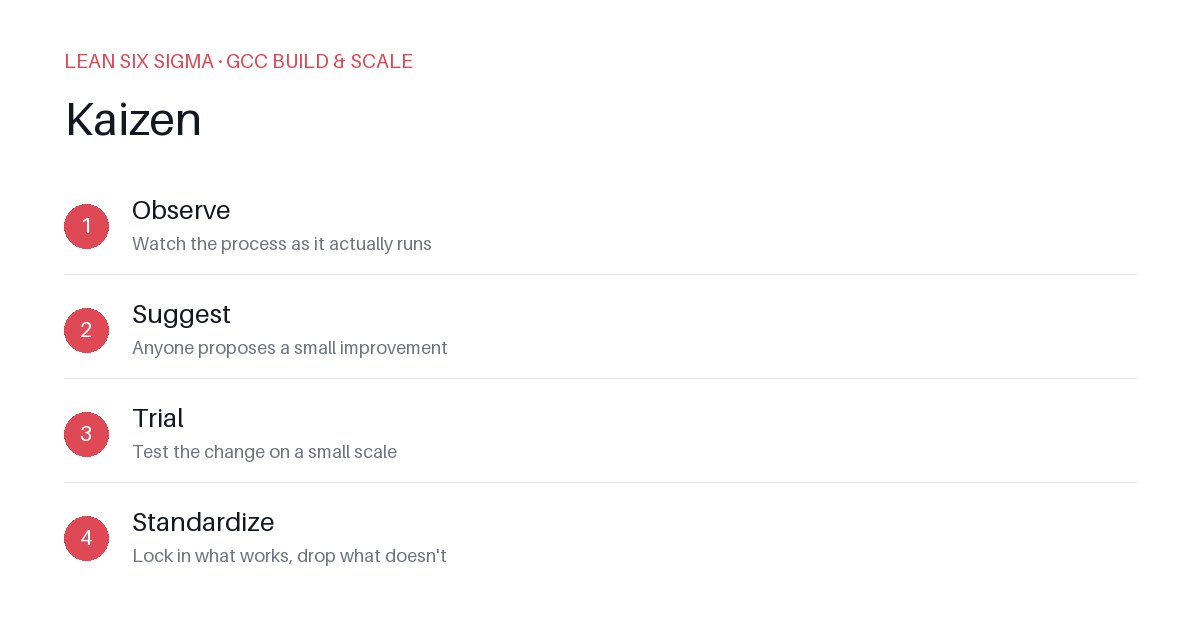
Downloadable templates
A practical walkthrough of applying Kaizen to real GCC build-and-scale work.
Why Kaizen Matters for GCC Teams
Scaling a Global Capability Center means standardizing work across sites, handoffs, and teams that have never worked together before. Kaizen gives you a shared vocabulary and a repeatable sequence for doing that.
In distributed environments, friction often hides in the gaps between teams — misaligned definitions, redundant approvals, or inconsistent tooling. Without a disciplined improvement loop, these small inefficiencies compound into significant delays and morale drain. Kaizen provides a lightweight, collaborative framework to surface and resolve these issues systematically, ensuring that every team member, regardless of location, contributes to continuous refinement.
The Kaizen Sequence
- Observe — Watch the process as it actually runs
- Suggest — Anyone proposes a small improvement
- Trial — Test the change on a small scale
- Standardize — Lock in what works, drop what doesn't
This four-step cycle is not a one-time project but an ongoing rhythm. Each iteration builds on the last, creating compounding gains in efficiency and quality.
Applying It
Start small: pick one recurring pain point your GCC team hits every week, and walk it through these 4 steps before rolling the approach out more broadly. Download the template below to run your first pass.
Step 1: Observe — Map the Real Process
Begin by shadowing the actual workflow. Use tools like process mapping, time tracking, or even simple checklists to capture how work flows from start to finish. Pay attention to handoffs between teams, approval bottlenecks, and rework loops. For example, if your GCC team handles software deployment across three regions, document how each region initiates, reviews, and executes the deployment. Note where delays occur and where information is lost or duplicated.
Step 2: Suggest — Encourage Cross-Functional Input
Invite team members to propose improvements based on their observations. The key is psychological safety — ensure that all suggestions are welcomed without judgment. Use structured brainstorming sessions or digital suggestion boards to collect ideas. For instance, a junior developer might suggest automating a manual approval step, while a QA engineer might propose a shared checklist to reduce rework.
Step 3: Trial — Test Changes in Controlled Environments
Select one or two high-impact, low-risk suggestions to test. Implement them in a pilot group or on a specific project. Measure the impact using clear metrics — cycle time, error rate, or team satisfaction. For example, if you’re testing a new approval workflow, track how long it takes to complete a deployment cycle before and after the change.
Step 4: Standardize — Institutionalize What Works
Once a trial proves successful, document the new process and train the team. Update SOPs, integrate the change into onboarding materials, and assign ownership for maintenance. If a trial fails, analyze why and adjust. For instance, if a new communication protocol causes confusion, revert to the previous method and refine the approach.
Building a Kaizen Culture
To sustain Kaizen practices, embed them into your team’s rhythm. Hold weekly “Kaizen Huddles” to discuss improvements, celebrate wins, and address roadblocks. Recognize and reward contributions to continuous improvement. Over time, this fosters a culture where every team member feels empowered to drive change, leading to a more agile and resilient Global Capability Center.
Comments
Be the first to comment on this post.
Sign in to leave a comment.