Kaizen Habits for Distributed GCC Teams
October 29, 2026
Like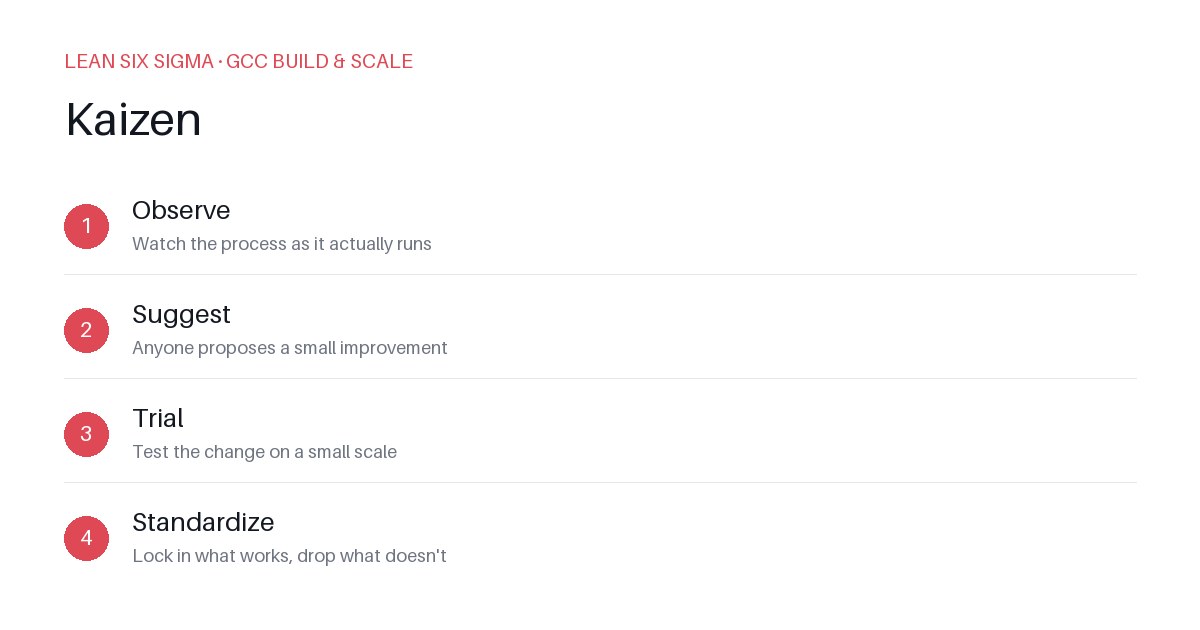
Downloadable templates
A practical walkthrough of applying Kaizen to real GCC build-and-scale work.
Why Kaizen Matters for GCC Teams
Scaling a Global Capability Center (GCC) means standardizing work across sites, handoffs, and teams that have never worked together before. In a distributed environment, you’re not just managing people—you’re managing processes, tools, and cultural friction. Without a shared framework, small inefficiencies compound into systemic delays. Kaizen gives you a shared vocabulary and a repeatable sequence for doing that. It turns ad-hoc fixes into intentional improvements, ensuring that every site contributes to a continuously evolving operating model rather than reinventing the wheel.
The Kaizen Sequence
- Observe — Watch the process as it actually runs. Don’t rely on documentation or assumptions. Sit with the team, map the handoffs, note where work stalls, and identify bottlenecks. In GCCs, this often means observing cross-timezone dependencies, tool-switching friction, or unclear ownership during incident response.
- Suggest — Anyone proposes a small improvement. Encourage frontline contributors to surface ideas. The best Kaizen suggestions are often simple: a clearer status template, a standardized escalation path, or a 5-minute daily sync for overlapping shifts. The key is that the suggestion is actionable, specific, and tied to a real pain point.
- Trial — Test the change on a small scale. Run a pilot with one team or one project. Measure the impact: did it reduce rework? Speed up approvals? Improve clarity? Document what worked and what didn’t. This step builds confidence and provides data-driven feedback before broader rollout.
- Standardize — Lock in what works, drop what doesn’t. Update SOPs, train the team, and embed the improvement into the workflow. If the change doesn’t show measurable benefit, discard it without guilt. Standardization ensures that good practices don’t disappear when people leave or when new hires join.
Applying It
Start small: pick one recurring pain point your GCC team hits every week, and walk it through these 4 steps before rolling the approach out more broadly. For example, if your team struggles with inconsistent incident documentation across regions, use Kaizen to observe the current process, suggest a unified template, trial it on the next major incident, and then standardize it as the official format.
Download the template below to run your first pass. Use it to map your current workflow, capture suggestions from your team, track trial results, and document standardized changes. Over time, these small wins build momentum, foster a culture of continuous improvement, and create a more resilient, agile GCC. Remember: Kaizen isn’t about perfection—it’s about progress. Every improvement, no matter how small, makes your distributed team sharper, faster, and more aligned.
Comments
Be the first to comment on this post.
Sign in to leave a comment.