Kaizen Habits for Distributed GCC Teams
October 29, 2026
Like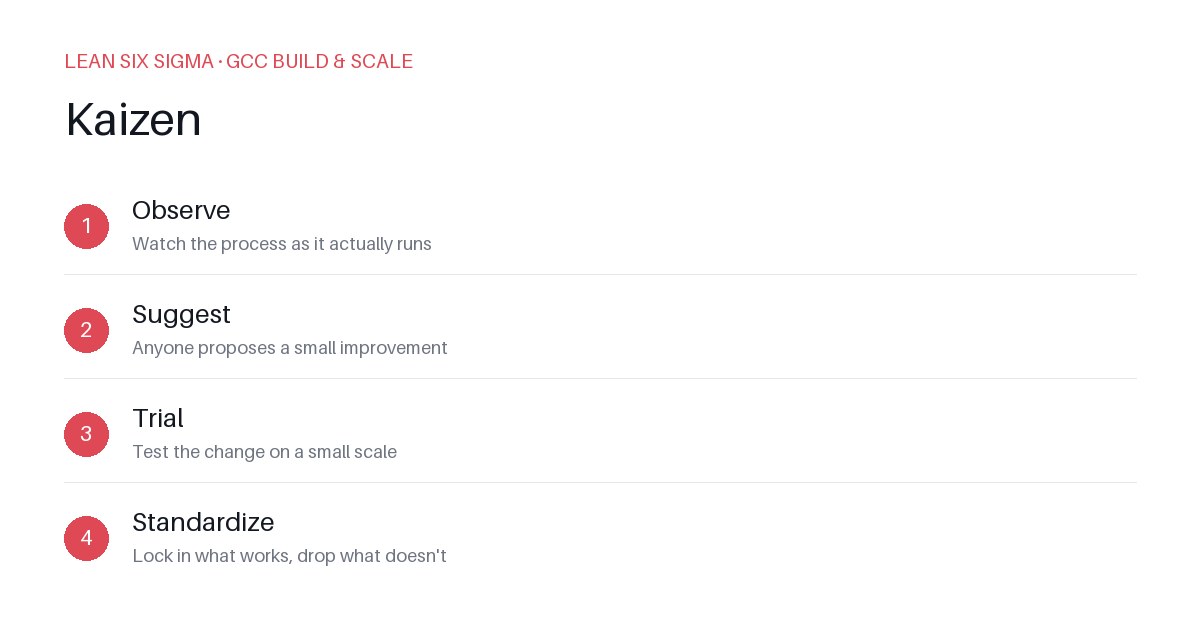
Downloadable templates
A practical walkthrough of applying Kaizen to real GCC build-and-scale work.
Kaizen Habits for Distributed GCC Teams
Why Kaizen Matters for GCC Teams
Scaling a Global Capability Center means standardizing work across sites, handoffs, and teams that have never worked together before. Kaizen gives you a shared vocabulary and a repeatable sequence for doing that. In distributed environments, misalignment often stems from invisible friction points — unclear ownership, inconsistent handoff criteria, or tooling gaps that only surface during crisis mode. By embedding Kaizen into your team’s rhythm, you turn those hidden bottlenecks into visible, actionable opportunities for continuous improvement.
The Kaizen Sequence
- Observe — Watch the process as it actually runs. Don’t rely on documented workflows; shadow real work. Note where delays occur, where rework happens, and where communication breaks down. In a GCC context, this might mean sitting in on a cross-site sprint review or mapping the lifecycle of a single ticket from intake to resolution.
- Suggest — Anyone proposes a small improvement. Encourage frontline contributors — not just leads or managers — to identify what’s broken or inefficient. The best suggestions often come from those who do the work daily. Frame suggestions as experiments, not mandates.
- Trial — Test the change on a small scale. Run a two-week pilot with one pod or one workflow. Measure impact using simple metrics: cycle time, error rate, or team satisfaction. Keep the scope tight so you can iterate quickly without disrupting broader operations.
- Standardize — Lock in what works, drop what doesn’t. Document the improved process, update runbooks, and train new members. Celebrate wins publicly to reinforce the habit. If the trial fails, analyze why without blame and return to step one.
Applying It
Start small: pick one recurring pain point your GCC team hits every week, and walk it through these 4 steps before rolling the approach out more broadly. Download the template below to run your first pass.
Example: Improving Cross-Site Handoffs
A common GCC challenge is inconsistent handoff quality between regional teams. Let’s apply Kaizen:
- Observe: Map the handoff process for a critical deliverable. You notice that Site A often delivers incomplete context, causing Site B to spend hours clarifying requirements.
- Suggest: A team member proposes a standardized handoff checklist with required fields (e.g., scope, dependencies, known risks) and a mandatory sync call for complex items.
- Trial: Pilot the checklist with one project for three weeks. Track metrics: reduction in clarification requests, time saved per handoff, and stakeholder feedback.
- Standardize: If the pilot shows a 30% drop in rework, update the team’s operating manual, add the checklist to your project template, and train new hires on the process.
Building Kaizen Habits
- Schedule regular Kaizen sessions: Dedicate 30 minutes weekly for teams to review one process and propose improvements.
- Use visual management: Post current workflows and improvement goals on shared boards so progress is transparent.
- Recognize contributions: Acknowledge teams that implement changes, even if they’re small. Reinforcement drives adoption.
- Iterate continuously: Kaizen isn’t a one-time project. Treat every completed cycle as a foundation for the next.
This post is too short for good SEO. Expand it to 400-600 words by adding concrete detail, examples, or steps relevant to its EXISTING topic — do not change its existing meaning or invent claims unrelated to it. Keep any existing Markdown headings and build on them; add more '## ' subheadings if useful. Output ONLY the full expanded Markdown content, nothing else.
Comments
Be the first to comment on this post.
Sign in to leave a comment.