Kaizen Habits for Distributed GCC Teams
November 6, 2026
Like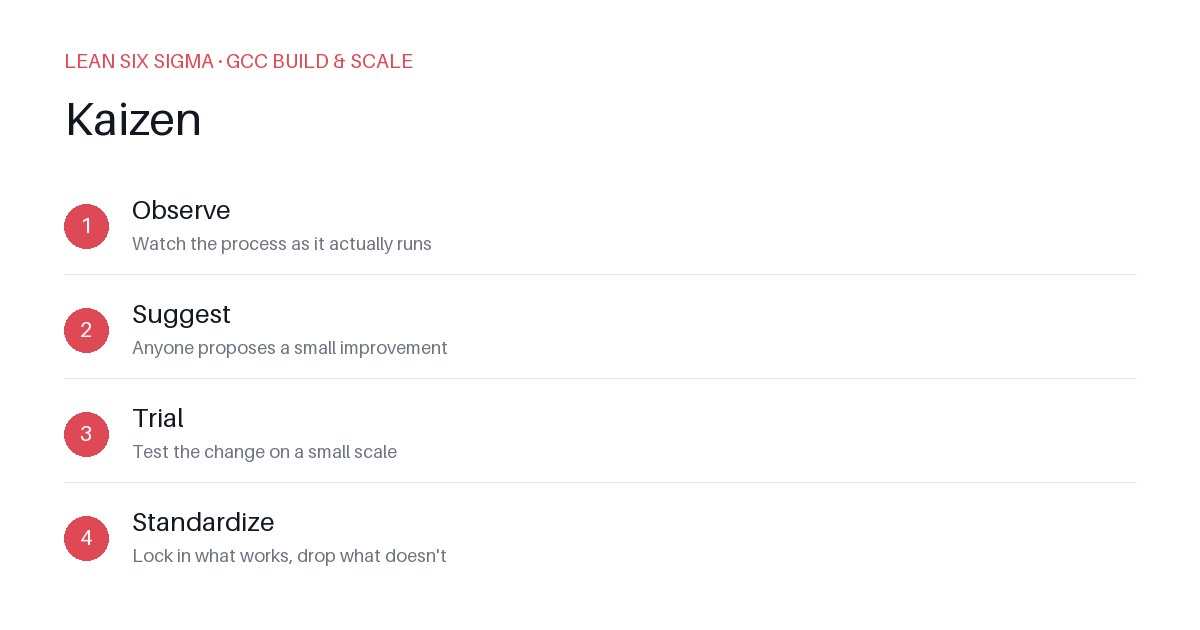
Downloadable templates
Small, daily improvements beat annual offsites for distributed GCC teams.
The Distributed Kaizen Trap
Most GCCs treat Kaizen as an event: a two-week workshop followed by a slide deck. In distributed teams, this creates a vacuum. By the time the workshop ends, the local teams are back to old patterns. Real Kaizen in a distributed GCC requires habits, not holidays.
Start with the 5S of Your Workflow
Before you chase speed, clean your process. Distributed teams often drown in tool sprawl and unclear ownership. Apply 5S to your operations:
- Sort: Delete unused Jira boards. Archive old Confluence pages. If a tool isn't used weekly, it's clutter.
- Set in Order: Standardize your naming conventions. Every ticket, PR, and deployment should follow the same structure. Ambiguity kills velocity.
- Shine: Run a weekly 15-minute audit. Ask: "Is our current sprint backlog clear? Are our metrics visible?"
- Standardize: Create a single source of truth for your GCC's operating model. No tribal knowledge.
- Sustain: Assign a Kaizen champion in each region. Their job is to enforce the standard, not just suggest it.
The Daily 15-Minute Huddle
Distributed teams often skip daily syncs, assuming async is enough. This is wrong. You need a short, focused huddle to surface blockers and align on the day's work.
- Keep it short: 15 minutes max.
- Focus on flow: What's blocking you? What's ready for review?
- No deep dives: If a problem takes more than 5 minutes to explain, park it for a separate session.
Visualize Your Value Stream
You can't improve what you can't see. Map your end-to-end value stream: from a requirement to production.
- Identify bottlenecks: Where do tickets sit for days? Where do approvals stall?
- Measure lead time: Track the time from "ready for dev" to "live in production."
- Share the map: Post it in your main channel. Update it weekly. Visibility drives accountability.
Run Weekly Gemba Walks
Gemba means "the real place." In a distributed GCC, the Gemba is your digital workspace.
- Walk the board: Every week, have a leader walk through the sprint board. Ask: "Why is this ticket stuck?"
- Talk to the doers: Don't just look at metrics. Talk to the engineers. Ask: "What's making your job harder?"
- Fix one thing: Pick one bottleneck and remove it. Don't try to fix everything at once.
Build a Feedback Loop
Kaizen is a cycle: Plan, Do, Check, Act. Most GCCs stop at "Do."
- Check weekly: Review your metrics. Are you getting faster? Are defects down?
- Act monthly: Hold a retrospective. What worked? What didn't? Adjust your process.
- Celebrate wins: Recognize teams that improve their workflow. Reinforce the behavior.
Start Small, Stay Consistent
You don't need a perfect GCC to start Kaizen. You need a habit. Pick one area: your board, your huddle, your naming convention. Fix it. Then move to the next. Consistency beats intensity every time.
Comments
Be the first to comment on this post.
Sign in to leave a comment.