Kaizen Habits for Distributed GCC Teams
August 24, 2026
Like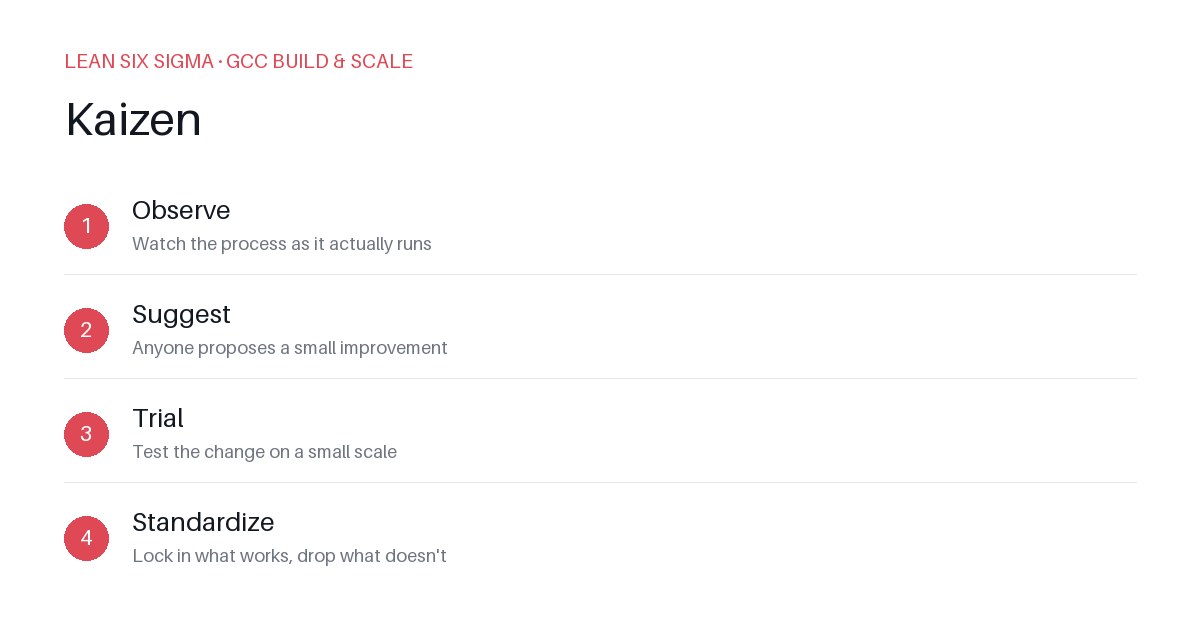
Downloadable templates
A practical walkthrough of applying Kaizen to real GCC build-and-scale work.
Kaizen Habits for Distributed GCC Teams
Why Kaizen Matters for GCC Teams
Scaling a Global Capability Center means standardizing work across sites, handoffs, and teams that have never worked together before. Kaizen gives you a shared vocabulary and a repeatable sequence for doing that. In a distributed environment, ambiguity breeds friction. When engineers in Bangalore, product managers in San Francisco, and QA leads in Berlin all interpret “done” or “ready” differently, velocity stalls and morale drops. Kaizen bridges that gap by replacing opinion with observation, and intuition with iteration. It turns isolated fixes into institutional knowledge, ensuring that every site contributes to a continuously improving operating model.
The Kaizen Sequence
-
Observe — Watch the process as it actually runs
Don’t rely on documentation or assumptions. Sit with the team during a sprint review, a release handoff, or a defect triage session. Map where time is lost, where handoffs stall, and where rework begins. Use simple tools like sticky notes or digital whiteboards to capture the current state without judgment. -
Suggest — Anyone proposes a small improvement
Encourage cross-functional input. A developer might notice that QA blocks happen because test cases aren’t ready; a PM might suggest a lightweight pre-read checklist. The key is psychological safety: ideas are welcome, but they must be specific, actionable, and tied to observed pain points. -
Trial — Test the change on a small scale
Run the suggestion as a pilot for one sprint or one team. Measure impact: Did cycle time drop? Did defects escape to production? Did team satisfaction improve? Keep the scope tight so you can learn quickly without disrupting delivery. -
Standardize — Lock in what works, drop what doesn’t
If the trial succeeded, document the new practice, update runbooks, and train the next cohort. If it failed, archive the lesson and iterate. Standardization isn’t about rigidity; it’s about compounding small wins into reliable operations.
Applying It
Start small: pick one recurring pain point your GCC team hits every week, and walk it through these 4 steps before rolling the approach out more broadly. Download the template below to run your first pass.
For example, consider the common bottleneck of “definition of ready” slippage. In many GCCs, stories enter development without clear acceptance criteria, leading to mid-sprint rework. Apply the Kaizen sequence: observe how often stories stall, suggest a lightweight checklist co-created by PMs and devs, trial it on one team for two sprints, and standardize the checklist in your Jira workflow if metrics improve.
Repeat this cycle monthly. Rotate the pain point: maybe it’s release coordination, knowledge transfer, or on-call rotation. Over time, your GCC builds a library of proven micro-improvements that compound into systemic resilience.
Remember: Kaizen isn’t a one-time initiative. It’s a habit. And in distributed teams, habits are the only thing that scales.
Comments
Be the first to comment on this post.
Sign in to leave a comment.