Kaizen Habits for Distributed GCC Teams
August 24, 2026
Like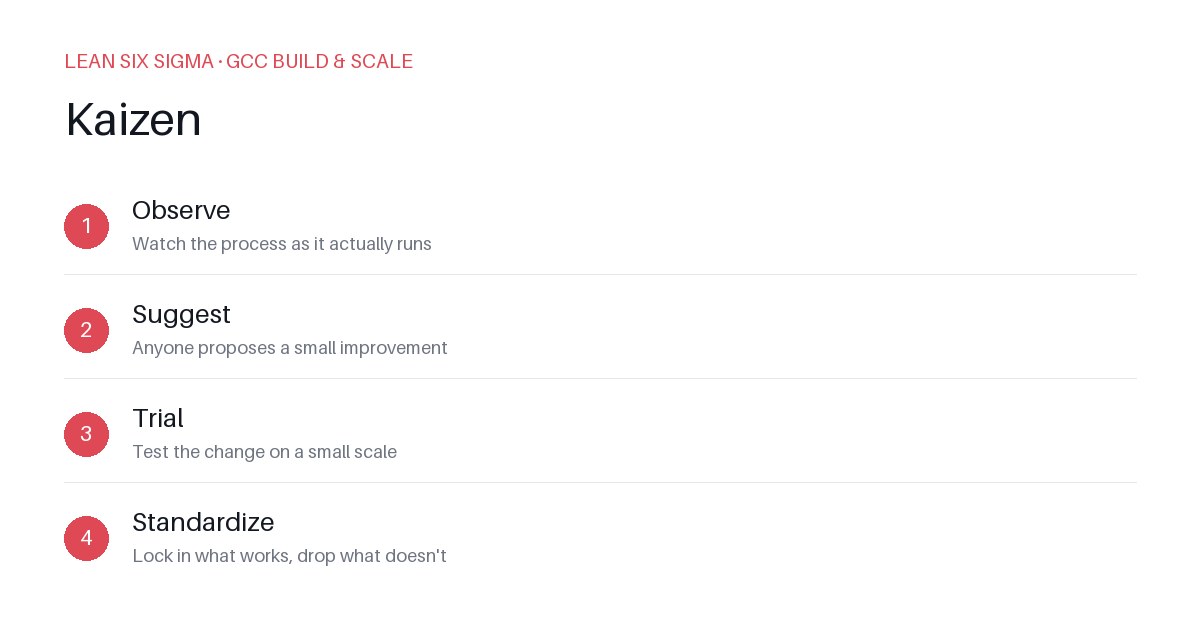
Downloadable templates
A practical walkthrough of applying Kaizen to real GCC build-and-scale work.
Kaizen Habits for Distributed GCC Teams
Why Kaizen Matters for GCC Teams
Scaling a Global Capability Center means standardizing work across sites, handoffs, and teams that have never worked together before. Kaizen gives you a shared vocabulary and a repeatable sequence for doing that.
When you’re managing multiple locations — say, engineering in Bangalore, QA in Hyderabad, and product management in Pune — you quickly realize that “how we do things” varies wildly from one site to another. Without a disciplined approach to improvement, you end up with fragmented processes, duplicated effort, and frustration.
Kaizen isn’t about radical overhauls or expensive consulting. It’s about small, incremental improvements driven by the people who actually do the work. For GCC teams, this means empowering local contributors to identify friction, test fixes, and embed better practices into daily operations — without waiting for top-down mandates.
The Kaizen Sequence
- Observe — Watch the process as it actually runs
- Suggest — Anyone proposes a small improvement
- Trial — Test the change on a small scale
- Standardize — Lock in what works, drop what doesn’t
This four-step loop is simple, but its power lies in consistency. Each iteration builds on the last, creating compounding gains in efficiency, quality, and team morale.
Applying It
Start small: pick one recurring pain point your GCC team hits every week, and walk it through these 4 steps before rolling the approach out more broadly. Download the template below to run your first pass.
Step 1: Observe — See the Real Process
Most teams think they know how their process works — until they watch it unfold in real time. Schedule a 30-minute observation session where a facilitator shadows a team member as they perform a routine task: code review, bug triage, deployment, or client handoff.
Take notes on:
- Where delays happen
- What tools are used (or bypassed)
- Where communication breaks down
- What workarounds exist
Example: A GCC team noticed that during sprint retrospectives, action items were recorded in three different places — Slack, Jira, and a shared doc. This caused confusion about ownership and follow-up.
Step 2: Suggest — Invite Input from the Frontline
Once you’ve identified a problem, open the floor for suggestions. The key is psychological safety: make it clear that all ideas are welcome, no matter how small. Use a structured format — for instance, “I noticed X, I suggest Y, because Z.”
Encourage cross-site participation. A developer in Mumbai might spot a bottleneck that a product manager in Singapore never considered.
Example: After observing the retrospective chaos, a junior QA engineer suggested using a single Jira board with a “Retrospective Actions” column, linked to the sprint.
Step 3: Trial — Test Before You Commit
Don’t implement changes organization-wide. Run a pilot with one team, one sprint, or one project. Define success metrics upfront: cycle time, error rate, team satisfaction, or adoption rate.
Keep the trial short — 2 to 4 weeks is ideal. This reduces risk and builds confidence.
Example: The GCC team ran the new Jira-based action tracking for two sprints. They measured completion rate of retrospective items and team feedback via a quick survey.
Step 4: Standardize — Embed the Win
If the trial works, document it. Create a one-pager: what changed, why it works, how to implement it, and who owns it. Share it across all sites.
If it doesn’t work, analyze why and iterate. Kaizen is not linear — it’s cyclical.
Example: The team formalized the new process, added it to their onboarding checklist, and assigned a “Process Champion” per site to ensure consistency.
Building Kaizen Habits
Kaizen thrives on routine. Make it part of your team cadence:
- Weekly: Run a 15-minute “Kaizen Huddle” to surface one improvement idea.
- Biweekly: Review trials and decide what to standardize or discard.
- Monthly: Celebrate wins publicly. Share metrics and stories across sites.
Remember: Kaizen isn’t a program. It’s a mindset. And for distributed GCC teams, it’s one of the most effective ways to align people, processes, and purpose — without bureaucracy.
Comments
Be the first to comment on this post.
Sign in to leave a comment.