Kaizen Habits for Distributed GCC Teams
August 27, 2026
Like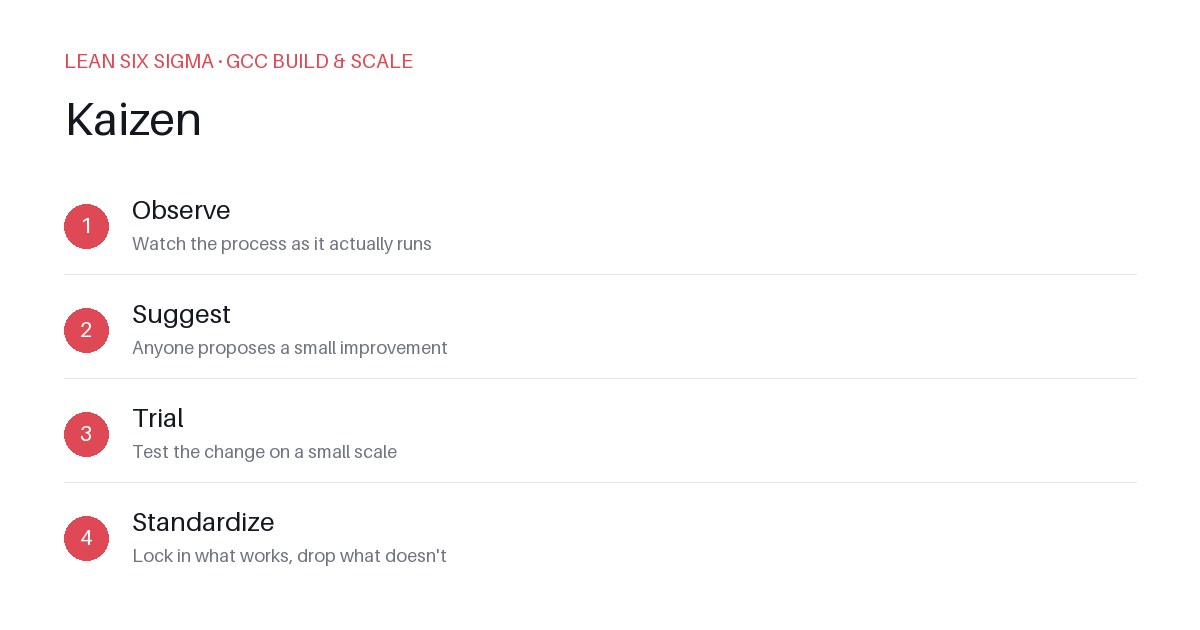
Downloadable templates
A practical walkthrough of applying Kaizen to real GCC build-and-scale work.
Why Kaizen Matters for GCC Teams
Scaling a Global Capability Center means standardizing work across sites, handoffs, and teams that have never worked together before. Kaizen gives you a shared vocabulary and a repeatable sequence for doing that. In distributed environments, where communication overhead is high and context switching is constant, even small inefficiencies compound quickly. Without a disciplined approach to continuous improvement, GCCs risk becoming fragmented operations — each site optimizing for local needs while the whole system stagnates. Kaizen bridges that gap by embedding a culture of incremental, collaborative problem-solving into daily workflows.
The Kaizen Sequence
- Observe — Watch the process as it actually runs. Don’t rely on assumptions or documented procedures; shadow the work in progress. Note where delays occur, where information gets lost, where rework begins.
- Suggest — Anyone proposes a small improvement. Encourage frontline contributors to identify friction points. The best ideas often come from those executing the work, not just those designing it.
- Trial — Test the change on a small scale. Run a pilot with one team or one project cycle. Measure impact without disrupting broader operations.
- Standardize — Lock in what works, drop what doesn’t. Document the improved process, train the team, and integrate it into routine practice. Then repeat.
Applying It
Start small: pick one recurring pain point your GCC team hits every week, and walk it through these 4 steps before rolling the approach out more broadly. Download the template below to run your first pass.
Concrete Example: Streamlining Cross-Site Handoffs
Consider a GCC team that delivers software updates across three regions. Each week, the handoff from Dev to QA involves three manual steps: status emails, Slack pings, and a shared spreadsheet update. Misalignment often causes QA to start testing before code is ready, resulting in rework and delayed releases.
Using Kaizen:
- Observe: A team member shadows the handoff and notices that 60% of delays come from waiting for confirmation emails that never arrive.
- Suggest: A developer proposes replacing emails with a single automated status dashboard linked to the CI/CD pipeline.
- Trial: The team runs the dashboard for one sprint. QA now sees real-time build status, reducing wait time by 40%.
- Standardize: The dashboard becomes the official handoff protocol. Training is added to onboarding, and the old email process is deprecated.
Scaling the Practice
Once a successful trial is standardized, document the lesson and share it across sites. Host a 30-minute “Kaizen Review” monthly where teams present one improvement, what worked, and what didn’t. Celebrate small wins publicly to reinforce the behavior. Over time, these micro-improvements compound into significant efficiency gains — faster cycle times, fewer defects, and higher team morale.
Kaizen isn’t about overhauling systems overnight. It’s about building momentum through consistent, team-driven refinement. In a distributed GCC, that momentum is what turns siloed efforts into synchronized capability.
Comments
Be the first to comment on this post.
Sign in to leave a comment.