PDCA Loops for GCC Vendor Governance
September 13, 2026
Like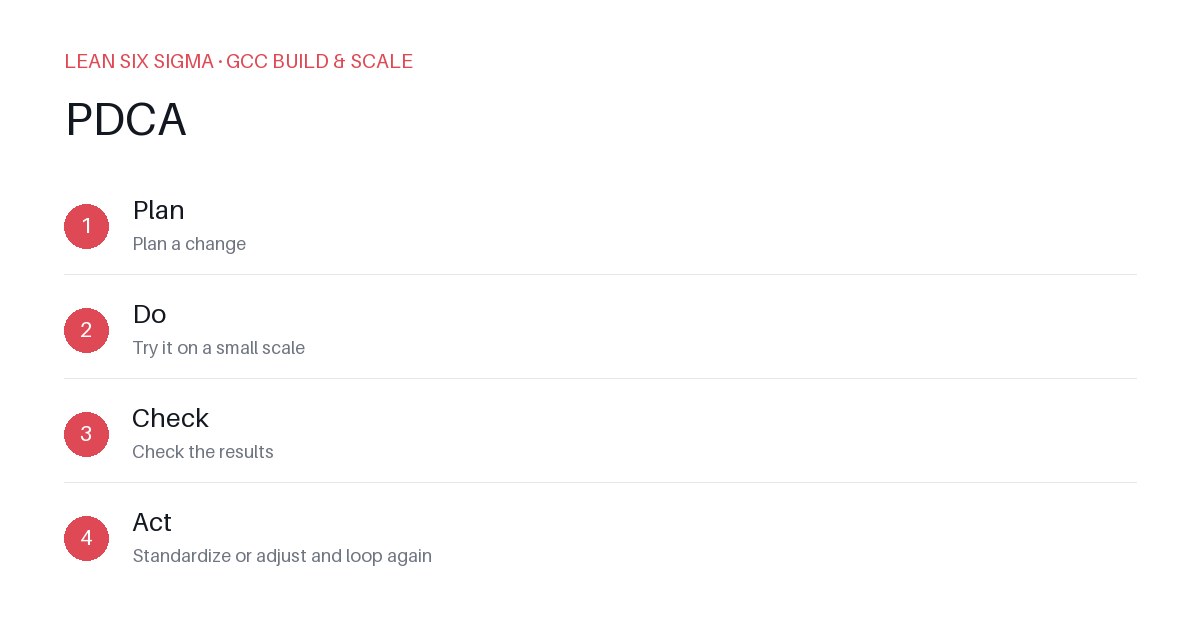
Downloadable templates
A practical walkthrough of applying PDCA to real GCC build-and-scale work.
PDCA Loops for GCC Vendor Governance
Why PDCA Matters for GCC Teams
Scaling a Global Capability Center (GCC) means standardizing work across sites, handoffs, and teams that have never worked together before. Vendor governance is one of the most complex operational challenges in this scaling phase — it touches procurement, legal, finance, IT, and delivery teams, often with overlapping responsibilities and fragmented data. PDCA gives you a shared vocabulary and a repeatable sequence for doing that. Instead of relying on ad-hoc fixes or heroics from individual team members, PDCA creates a structured rhythm for identifying vendor performance gaps, testing improvements, measuring impact, and institutionalizing better practices. This leads to faster time-to-value, reduced risk, and more predictable outcomes across the GCC’s global footprint.
The PDCA Sequence
- Plan — Plan a change: Define the specific vendor governance issue (e.g., slow SLA reporting, inconsistent contract renewal processes), set clear objectives, identify stakeholders, and determine what success looks like.
- Do — Try it on a small scale: Pilot the proposed solution with one vendor category, one region, or one project team. Keep the scope tight to isolate variables and gather actionable feedback.
- Check — Check the results: Measure against the objectives set in the Plan phase. Use data from vendor portals, ticketing systems, or performance dashboards to assess whether the change improved efficiency, reduced errors, or enhanced compliance.
- Act — Standardize or adjust and loop again: If successful, formalize the process through updated SOPs, training, or system configurations. If not, analyze root causes and return to Plan with refined hypotheses. This cyclical nature ensures continuous improvement rather than one-time fixes.
Applying It
Start small: pick one recurring pain point your GCC team hits every week, and walk it through these 4 steps before rolling the approach out more broadly. Download the template below to run your first pass.
Example: Streamlining Vendor SLA Reporting
A GCC team noticed that monthly SLA reports from cloud service providers were consistently late, causing delays in vendor performance reviews. Using PDCA:
- Plan: The team defined the goal as reducing report submission latency from 10 days to 3 days. They identified the root cause as manual data extraction from vendor portals and agreed to test an automated export process.
- Do: They piloted the new automated workflow with two non-critical vendors in the EMEA region over a four-week period.
- Check: Reports were submitted on time 90% of the time, and the time spent compiling data dropped by 70%. However, one vendor’s portal had incompatible export formats, requiring a workaround.
- Act: The team updated the vendor onboarding checklist to include portal compatibility requirements and documented the workaround for future cases. They then expanded the automated process to all vendors in APAC.
Why This Works for GCC Vendor Governance
Vendor governance in a GCC is inherently cross-functional and data-dependent. PDCA’s iterative nature allows teams to test changes without disrupting global operations, build consensus through transparent measurement, and embed improvements into standard operating procedures. Over time, this creates a culture of continuous refinement where vendor performance is not just monitored but actively optimized. By anchoring governance improvements in PDCA loops, GCC leaders can transform vendor management from a reactive compliance exercise into a strategic enabler of global capability delivery.
Comments
Be the first to comment on this post.
Sign in to leave a comment.