PDCA Loops for GCC Vendor Governance
September 18, 2026
Like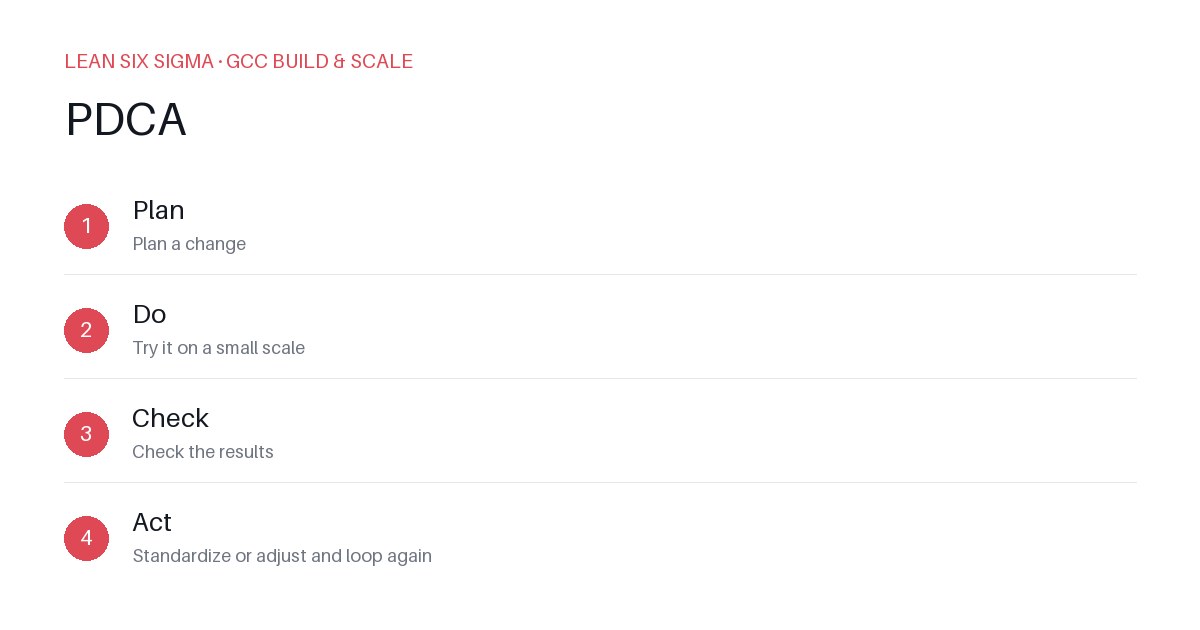
Downloadable templates
A practical walkthrough of applying PDCA to real GCC build-and-scale work.
Why PDCA Matters for GCC Teams
Scaling a Global Capability Center means standardizing work across sites, handoffs, and teams that have never worked together before. PDCA gives you a shared vocabulary and a repeatable sequence for doing that. In GCC environments, where processes are often inherited, fragmented, or locally optimized, PDCA serves as a disciplined framework for continuous improvement. It replaces ad-hoc fixes with structured experimentation, enabling teams to test changes safely, measure outcomes objectively, and institutionalize what works. This is especially critical when managing vendor relationships, where misalignment can lead to delays, cost overruns, or service degradation.
The PDCA Sequence
- Plan — Plan a change
- Do — Try it on a small scale
- Check — Check the results
- Act — Standardize or adjust and loop again
Each phase requires clarity, documentation, and stakeholder alignment. The Plan phase involves defining the problem, establishing baseline metrics, and designing a minimal viable change. The Do phase is about execution with minimal disruption—ideally in a controlled environment or with a single vendor partner. The Check phase demands data-driven evaluation against the original objectives. Finally, the Act phase determines whether to scale, refine, or discard the change, feeding insights back into the next cycle.
Applying It
Start small: pick one recurring pain point your GCC team hits every week, and walk it through these 4 steps before rolling the approach out more broadly. Download the template below to run your first pass.
Consider a common GCC challenge: inconsistent SLA reporting from multiple vendors. Instead of demanding immediate overhaul, a team might use PDCA to test a standardized reporting format with one vendor first.
Step 1: Plan the Change
Define the specific issue: “Vendor A and Vendor B submit SLA reports in different formats, causing 15 hours/week of manual consolidation.” Set a measurable goal: “Reduce consolidation time to under 3 hours/week within 60 days.” Identify the change: “Implement a unified CSV template with mandatory fields for all vendors.” Assign owners, timelines, and success criteria.
Step 2: Do the Change
Pilot the new template with one low-risk vendor. Provide clear instructions, a sample file, and a deadline for submission. Monitor the process without changing other workflows. Track time spent on consolidation, error rates, and vendor feedback.
Step 3: Check the Results
Compare actual outcomes against the baseline. Did consolidation time drop? Were there formatting errors? Did the vendor experience friction? If the goal wasn’t met, analyze why—was the template unclear? Was vendor support insufficient? Use this data to refine the approach.
Step 4: Act and Iterate
If successful, update the vendor contract or onboarding process to require the new format for all partners. Document the change as a standard operating procedure. Schedule a review in 30 days to ensure adherence. If the pilot failed, adjust the template or communication strategy and run another cycle.
Building PDCA Into Vendor Governance
Embedding PDCA into GCC vendor governance transforms reactive management into proactive optimization. It encourages a culture of experimentation over blame, data over opinion, and incremental progress over big-bang transformations. By applying PDCA consistently, GCC teams can:
- Reduce process debt through continuous refinement
- Align vendor expectations with internal standards
- Build trust through transparent, measurable improvements
- Scale best practices across global sites
The key is discipline: don’t skip steps, don’t ignore data, and don’t stop at one cycle. PDCA isn’t a one-time project—it’s an operating rhythm. When applied to vendor governance, it turns fragmented relationships into coordinated, high-performing partnerships.
Download the PDCA template below to structure your first improvement cycle. Start with a single vendor, a single metric, and a single change. The rest will follow.
Comments
Be the first to comment on this post.
Sign in to leave a comment.