PDCA Loops for GCC Vendor Governance
September 20, 2026
Like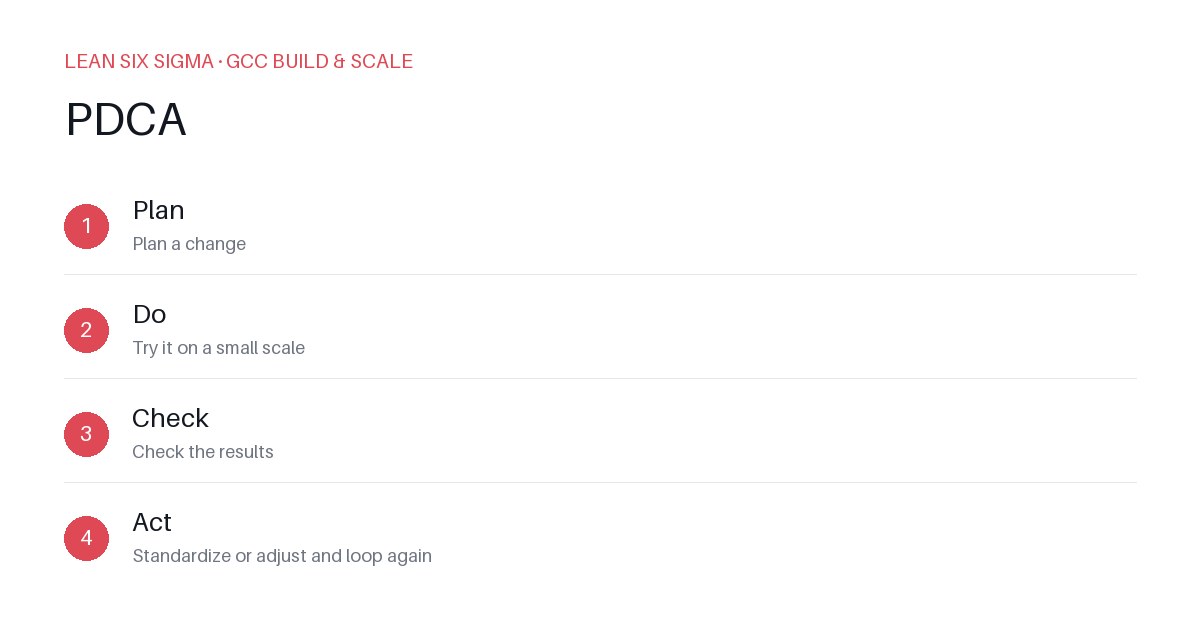
Downloadable templates
A practical walkthrough of applying PDCA to real GCC build-and-scale work.
PDCA Loops for GCC Vendor Governance
Why PDCA Matters for GCC Teams
Scaling a Global Capability Center means standardizing work across sites, handoffs, and teams that have never worked together before. PDCA gives you a shared vocabulary and a repeatable sequence for doing that. In the context of vendor governance, where multiple external partners deliver critical components of your capability stack, this cycle becomes essential. Without it, you risk fragmented SLAs, inconsistent quality, and reactive firefighting instead of proactive optimization. PDCA transforms vendor management from a static contractual exercise into a dynamic, continuous improvement engine that aligns vendor performance with evolving business needs.
The PDCA Sequence
-
Plan — Plan a change
Define the specific vendor-related issue you want to address. This might include clarifying scope boundaries, establishing KPIs, or introducing a new escalation path. Gather baseline data, identify stakeholders, and outline success criteria before any action is taken. -
Do — Try it on a small scale
Pilot your planned change with a single vendor, one project, or a limited geographic region. Keep the scope tight and time-bound. This phase is about learning, not perfection. Document what you observe, including unexpected friction points or hidden dependencies. -
Check — Check the results
Compare outcomes against your baseline and success criteria. Did the change improve cycle time, reduce defects, or enhance communication? Use both quantitative metrics (e.g., SLA compliance rates) and qualitative feedback (e.g., team sentiment surveys). Identify what worked, what didn’t, and why. -
Act — Standardize or adjust and loop again
If the change proved effective, formalize it into your vendor governance framework—update templates, train teams, and embed it into onboarding processes. If it fell short, refine your approach and return to Plan. Remember: PDCA is not linear; it’s cyclical. Each loop builds institutional knowledge and drives incremental gains.
Applying It
Start small: pick one recurring pain point your GCC team hits every week, and walk it through these 4 steps before rolling the approach out more broadly. For example, if cross-site handoffs with a vendor consistently cause delays, use PDCA to redesign the handoff protocol. Begin by mapping the current workflow, identifying bottlenecks, and proposing a standardized checklist. Pilot it with one vendor team, measure the impact on turnaround time, and iterate.
Download the template below to run your first pass. It includes fields for defining the problem, setting measurable objectives, tracking pilot outcomes, and capturing lessons learned. Consistent use of this framework ensures that improvements are documented, evaluated, and institutionalized rather than lost in ad-hoc problem-solving.
Building a Culture of Continuous Improvement
PDCA isn’t just a process—it’s a mindset. When embedded into vendor governance, it encourages accountability, transparency, and collaboration across internal and external teams. Leaders who champion this cycle see faster time-to-value, fewer compliance risks, and stronger vendor partnerships. Over time, the compounding effect of small, validated improvements leads to significant operational maturity.
To sustain momentum, schedule regular PDCA reviews in vendor governance meetings. Celebrate wins, share failures openly, and treat every loop as a learning opportunity. The goal isn’t perfection on the first try—it’s relentless refinement.
This post is too short for good SEO. Expand it to 400-600 words by adding concrete detail, examples, or steps relevant to its EXISTING topic — do not change its existing meaning or invent claims unrelated to it. Keep any existing Markdown headings and build on them; add more '## ' subheadings if useful. Output ONLY the full expanded Markdown content, nothing else.
Comments
Be the first to comment on this post.
Sign in to leave a comment.