PDCA Loops for GCC Vendor Governance
September 23, 2026
Like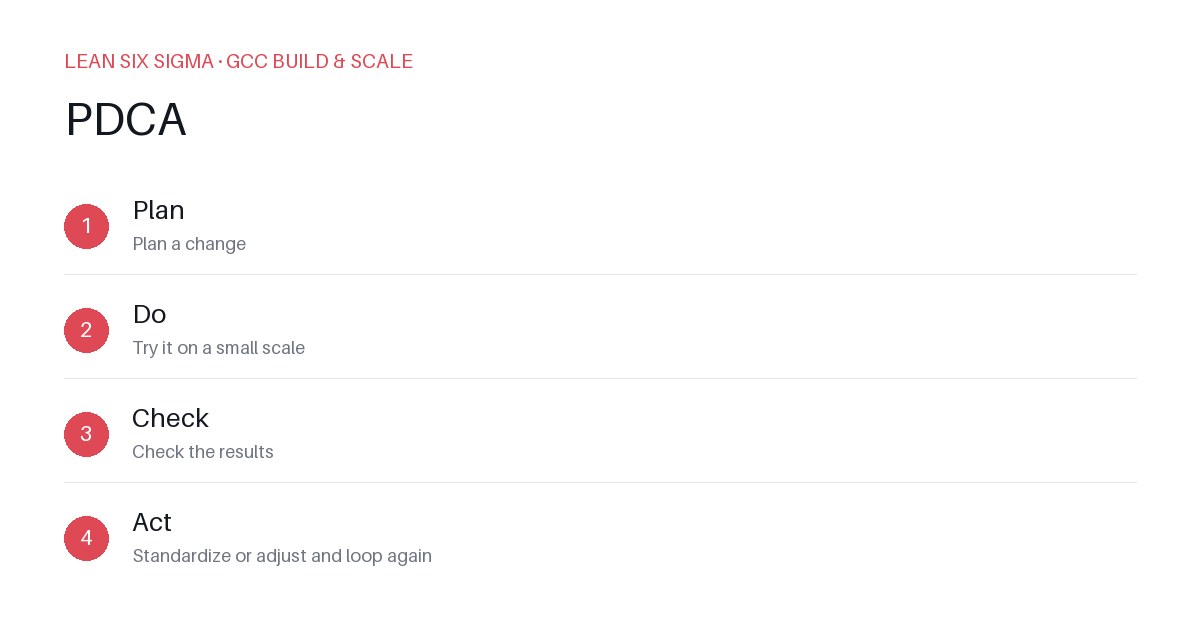
Downloadable templates
Run PDCA cycles on your GCC vendor contracts to catch scope creep and cost overruns before they derail your transformation.
Define What “Governance” Actually Means Here
Governance isn’t a boardroom slide deck. It’s the system that keeps your GCC vendor from becoming a black hole of unapproved work, hidden costs, and misaligned deliverables. When you bring on a GCC partner, you’re outsourcing execution, not accountability. If your governance is vague, the vendor will fill the gaps with their own assumptions — and those assumptions cost you time, money, and credibility.
PDCA (Plan-Do-Check-Act) isn’t a one-time framework. It’s a rhythm. You run it monthly, quarterly, or per phase, depending on your contract structure. The goal is simple: catch drift early, fix it fast, and keep the GCC aligned with your business outcomes.
Plan: Lock Scope, Metrics, and Escalation Paths
Start by writing down what success looks like — and what failure looks like — before the vendor touches a line of code or a process map.
- Define deliverables in output terms, not input terms. Don’t say “support the GCC.” Say “deliver 3 process redesigns per quarter with ≤5% rework rate.”
- Set leading indicators, not just lagging ones. Track cycle time reduction, defect escape rate, and stakeholder satisfaction — not just hours billed.
- Document escalation rules. If a deliverable is late by 3 days, who decides? What’s the penalty? What’s the remediation plan? No ambiguity.
Your Plan phase should be a living document, not a signed PDF. Update it when scope changes — and log every change.
Do: Execute with Visibility, Not Just Effort
Execution is where most GCCs fail. Not because the vendor lacks skill, but because they operate in the dark. You need real-time visibility into what’s happening, not just monthly status reports.
- Run weekly syncs focused on blockers, not progress. Progress is assumed. Blockers are what you need to solve.
- Use shared dashboards. If your vendor isn’t updating metrics in a system you own, you don’t have data — you have their word.
- Limit ad-hoc requests. Every new ask must go through the Plan. If it’s urgent, fast-track it, but still log it. Unlogged work becomes unaccountable work.
The Do phase is about discipline. No discipline, no PDCA.
Check: Measure Against Reality, Not Expectations
Check isn’t about praising or blaming. It’s about comparing what happened to what you planned — and deciding what to change.
- Compare actuals to targets. If you aimed for 20% process cycle time reduction and got 8%, why? Was it scope? Resources? Tools? Stakeholder availability?
- Audit a sample of deliverables. Don’t wait for final acceptance. Check mid-deliverable. Early catches save late fires.
- Run a blameless post-mortem on missed targets. What broke the plan? Was it a process issue? A skill gap? A miscommunication?
Check is where you separate facts from opinions. Stick to facts.
Act: Fix, Scale, or Walk Away
Act is the most important phase. If you don’t act, PDCA is just a reporting exercise.
- If the issue is fixable, fix it. Update the Plan. Reassign resources. Change tools. Communicate the change.
- If the issue is systemic, scale the fix. If three deliverables failed due to poor requirements gathering, add a requirements validation step to the Plan.
- If the vendor can’t adapt, terminate the contract. Don’t let a broken partnership drain your GCC’s momentum.
Act is where you close the loop. No action, no improvement.
Run It Again
PDCA isn’t a phase. It’s a cycle. Run it every month. Every quarter. Every major milestone. The GCC vendor isn’t going to self-correct. You have to drive the correction. If you stop running PDCA, governance becomes a memory, not a system. And memory fails under pressure.
Comments
Be the first to comment on this post.
Sign in to leave a comment.