PDCA Loops for GCC Vendor Governance
September 30, 2026
Like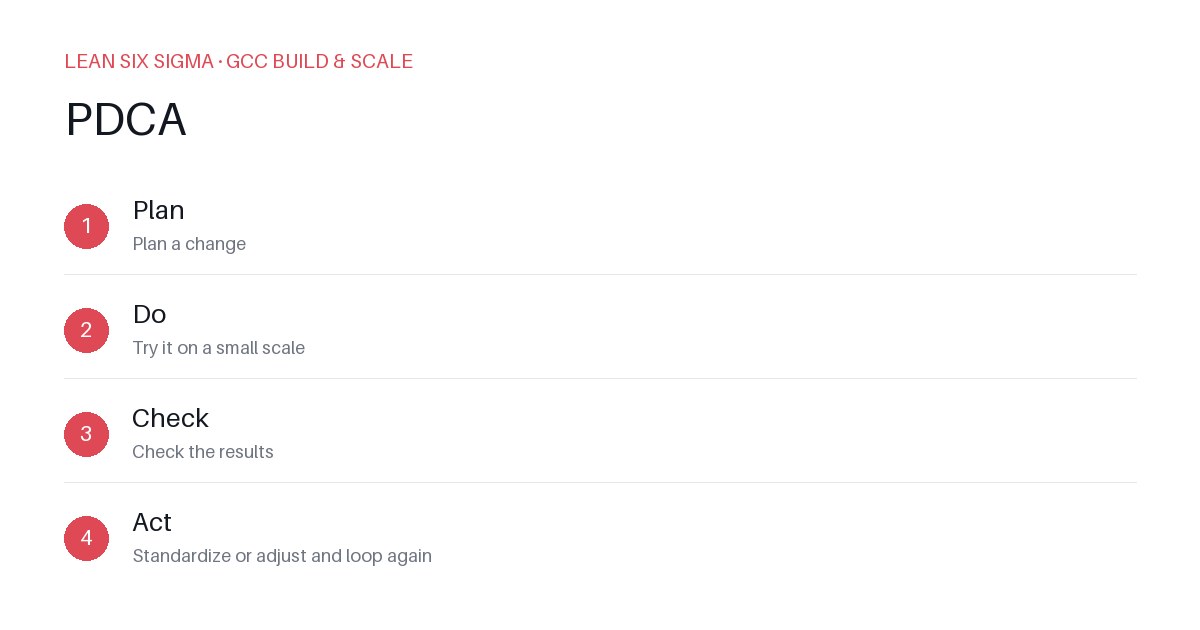
Downloadable templates
A practical walkthrough of applying PDCA to real GCC build-and-scale work.
PDCA Loops for GCC Vendor Governance
Why PDCA Matters for GCC Teams
Scaling a Global Capability Center (GCC) means standardizing work across sites, handoffs, and teams that have never worked together before. In this environment, vendor governance is not just an administrative task—it’s a strategic lever that directly impacts delivery speed, cost predictability, and quality consistency. PDCA gives you a shared vocabulary and a repeatable sequence for doing that. Without it, governance efforts often become fragmented, reactive, or overly bureaucratic. With it, you create a rhythm of continuous improvement that aligns vendor performance with GCC outcomes.
The PDCA Sequence
- Plan — Plan a change
Define the specific vendor governance gap (e.g., inconsistent SLA tracking, delayed onboarding, unclear escalation paths). Identify success metrics, stakeholders, and a pilot scope. - Do — Try it on a small scale
Implement the change with one vendor or one site. Keep the intervention lightweight and time-bound. - Check — Check the results
Measure against baseline metrics. Gather feedback from internal teams and vendor partners. Look for unintended side effects. - Act — Standardize or adjust and loop again
If the change works, document it, embed it into governance playbooks, and scale. If not, refine and repeat.
Applying It to Vendor Governance
Start small: pick one recurring pain point your GCC team hits every week, and walk it through these 4 steps before rolling the approach out more broadly. Download the template below to run your first pass.
Example: Improving Vendor SLA Compliance
Plan:
Identify that 30% of vendor deliverables miss SLA deadlines due to unclear ownership and delayed issue logging. Define success: reduce missed SLAs by 50% within 60 days. Select one mid-tier vendor as pilot.
Do:
Implement a lightweight SLA tracking dashboard with automated alerts. Assign a GCC-side point of contact for weekly syncs. Run this for two delivery cycles.
Check:
Review data: missed SLAs dropped to 18%. Feedback shows the dashboard reduces ambiguity but requires vendor training. Identify that escalation delays remain a bottleneck.
Act:
Update the governance playbook to include SLA dashboard onboarding as part of vendor onboarding. Add escalation SLAs to the contract. Scale to three additional vendors next quarter.
Example: Standardizing Vendor Risk Assessments
Plan:
Current risk assessments are inconsistent across sites, leading to compliance gaps. Goal: achieve 100% completion of standardized risk questionnaires within 14 days of vendor selection. Pilot with one region.
Do:
Deploy a centralized risk assessment workflow in your governance platform. Train regional leads and assign a GCC risk champion to support completion.
Check:
Completion rate reaches 85%. Delays stem from missing legal review steps. Adjust by integrating legal sign-off into the workflow.
Act:
Finalize the workflow, add legal as a required approver, and publish the updated process globally. Schedule a quarterly review to refine further.
Building a Culture of Continuous Governance
PDCA isn’t a one-time project—it’s an operating model. When applied to vendor governance, it shifts your GCC from reactive oversight to proactive partnership management. Each loop builds institutional knowledge, reduces friction, and aligns vendor behavior with GCC objectives. Over time, this creates a self-reinforcing cycle: clearer processes lead to better vendor performance, which fuels further refinement.
Use PDCA to turn governance from a compliance checkbox into a strategic advantage. Start with one loop. Measure. Learn. Scale. Repeat.
Comments
Be the first to comment on this post.
Sign in to leave a comment.