PDCA Loops for GCC Vendor Governance
October 17, 2026
Like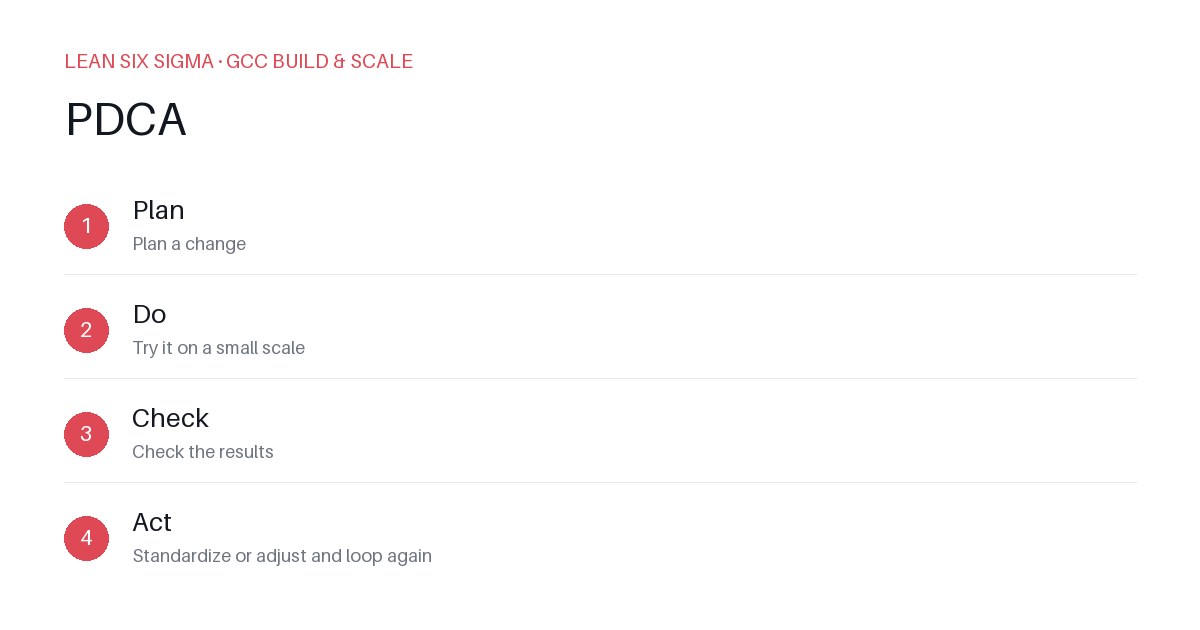
Downloadable templates
Run PDCA cycles to fix vendor drift in your Global Capability Center and keep delivery predictable.
The Problem: Vendor Drift in GCCs
You bring in a vendor to build out a GCC. Six months in, their process diverges from your Lean Six Sigma standards. Defect rates climb. Lead times stretch. You’re paying for capability, not stability.
This isn’t a people problem. It’s a governance problem. You need a repeatable loop to detect, fix, and lock in vendor performance.
Plan: Define the Vendor Governance PDCA
Start with a clear scope. Don’t boil the ocean. Pick one high-leverage area: defect rates, cycle time, or compliance adherence.
Set measurable targets. Example: reduce defect escape rate from 8% to 3% in 90 days.
Identify the vendor’s current state. Pull data from your quality dashboard. Interview their team. Map their workflow.
Choose countermeasures. Standardize their defect classification. Add a pre-release review gate. Assign a dedicated QA lead.
Do: Run the Pilot
Execute the countermeasures with the vendor. Keep it tight.
Run a 30-day pilot. Track daily defect counts. Log any process exceptions.
Hold weekly 30-minute reviews with the vendor. Review metrics. Adjust tactics.
Document everything. Capture what worked, what didn’t, and why.
Check: Analyze the Results
Compare results to your baseline.
Did defect rates drop? If yes, quantify the improvement. If no, identify the root cause.
Look for systemic issues. Is the vendor’s training lagging? Is their toolchain misconfigured?
Use a simple root cause analysis. Ask five whys. Trace back to the process gap.
Act: Standardize and Scale
If the pilot worked, codify the changes.
Update the vendor’s operating manual. Add the new review gate to their SOP.
Train their team. Schedule a knowledge transfer session.
If the pilot failed, adjust and restart the loop.
Never skip the Act step. Without it, you’re just running experiments, not building capability.
Real Scenario: Fixing Vendor Defect Rates
A GCC in India relied on a vendor for test automation. Defect escape rate hit 12%.
Plan: Target 5% escape rate in 60 days.
Do: Add a mandatory peer review before each build. Vendor team runs a 10-minute daily standup on defects.
Check: Escape rate dropped to 7% in week two. Peer review caught 60% of issues.
Act: Make peer review mandatory. Add it to the vendor’s SLA. Track it monthly.
Six months later, escape rate sits at 3.2%. Vendor performance stabilized.
Common Mistakes to Avoid
- Skipping the Check phase. You can’t improve what you don’t measure.
- Making changes without vendor buy-in. Co-create the countermeasures.
- Scaling too fast. Pilot one team. Prove the model. Then expand.
Next Steps
Pick one vendor. Pick one metric. Run a 30-day PDCA loop.
Track the results. Share the lessons. Build a governance playbook.
GCCs thrive on discipline. Vendor governance is part of that discipline. Start small. Loop fast. Scale what works.
Comments
Be the first to comment on this post.
Sign in to leave a comment.