PDCA Loops for GCC Vendor Governance
October 19, 2026
Like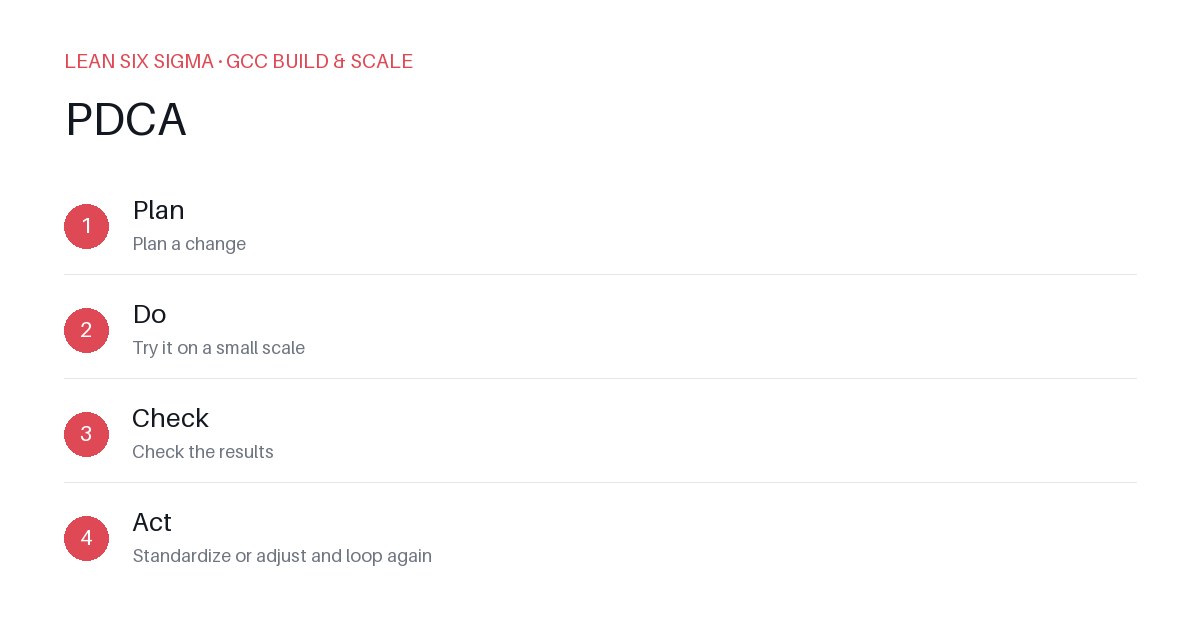
Downloadable templates
A practical walkthrough of applying PDCA to real GCC build-and-scale work.
PDCA Loops for GCC Vendor Governance
Why PDCA Matters for GCC Teams
Scaling a Global Capability Center means standardizing work across sites, handoffs, and teams that have never worked together before. PDCA gives you a shared vocabulary and a repeatable sequence for doing that. In the context of GCC vendor governance, this matters because vendors are no longer just cost centers — they are strategic partners embedded in your delivery model. Misaligned expectations, inconsistent quality gates, or unclear escalation paths can quickly derail programs. PDCA provides a structured, evidence-based way to test improvements, measure their impact, and institutionalize what works — without disrupting active delivery.
The PDCA Sequence
- Plan — Plan a change
- Do — Try it on a small scale
- Check — Check the results
- Act — Standardize or adjust and loop again
Applying It
Start small: pick one recurring pain point your GCC team hits every week, and walk it through these 4 steps before rolling the approach out more broadly. Download the template below to run your first pass.
Concrete Example: Improving Vendor Change Request Turnaround
Consider a common GCC challenge: vendor change requests (CRs) are taking too long to approve, causing bottlenecks in release cycles.
Plan: Define the current baseline — e.g., average CR approval time is 5 business days. Identify root causes through quick interviews with vendors and internal stakeholders: unclear approval criteria, single-point-of-contact dependencies, and lack of SLA visibility. Set a measurable goal: reduce average approval time to 2 business days within 30 days. Design a pilot: implement a standardized CR template with pre-defined approval workflows and assign a dedicated vendor liaison for the pilot group.
Do: Run the pilot with two low-risk vendors over two weeks. Enforce the new template, track each CR’s journey, and log any exceptions or delays. Ensure all participants understand the new process and have a feedback channel.
Check: Analyze results. Did average approval time drop? If yes, by how much? Were there any unintended consequences — e.g., vendors reporting lower satisfaction due to rigid templates? Compare against the baseline and goal. Use metrics like cycle time, rejection rate, and stakeholder feedback scores.
Act: If the pilot succeeded, formalize the new CR process across all vendors. Update governance documentation, train new vendor onboarding teams, and embed the metric into quarterly vendor performance reviews. If results were mixed, adjust the template or workflow and re-run the cycle.
Why This Works for GCC Governance
PDCA turns governance from a static policy exercise into a dynamic improvement engine. Instead of issuing mandates and hoping for compliance, you create feedback loops that adapt to real-world conditions. Over time, this builds trust with vendors — they see that governance is about enabling delivery, not policing it. It also empowers GCC teams to make data-driven decisions, prioritize high-impact changes, and scale solutions that actually work across diverse global sites.
Next Steps
- Identify one recurring vendor governance pain point (e.g., onboarding delays, quality variance, reporting inconsistencies).
- Map the current process and define a measurable baseline.
- Design a minimal viable change for a 2-week pilot.
- Track results rigorously and decide: standardize, adjust, or abandon.
- Repeat. Each loop builds institutional knowledge and stronger vendor partnerships.
Download the PDCA template below to run your first governance improvement cycle.
Comments
Be the first to comment on this post.
Sign in to leave a comment.