PDCA Loops for GCC Vendor Governance
October 22, 2026
Like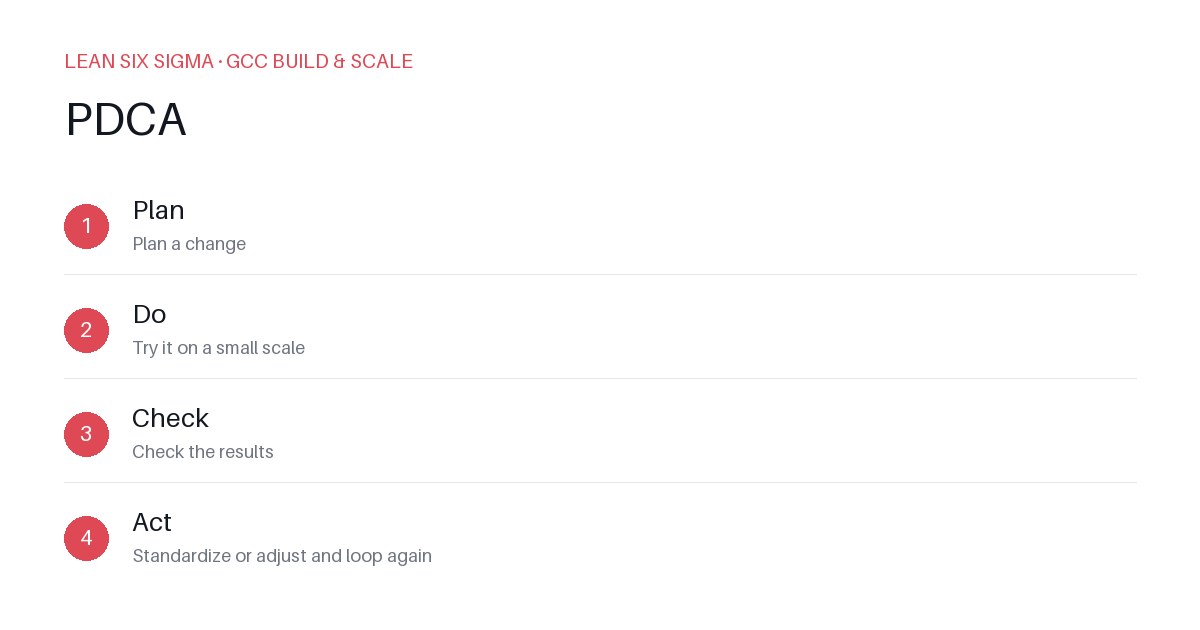
Downloadable templates
A practical walkthrough of applying PDCA to real GCC build-and-scale work.
PDCA Loops for GCC Vendor Governance
Why PDCA Matters for GCC Teams
Scaling a Global Capability Center means standardizing work across sites, handoffs, and teams that have never worked together before. PDCA gives you a shared vocabulary and a repeatable sequence for doing that. In the context of vendor governance, this approach is especially critical. Vendors are external partners who influence cost, quality, and risk. Without a disciplined cycle of improvement, governance efforts often become static compliance exercises rather than dynamic value drivers. PDCA transforms vendor management from a checklist activity into a continuous learning engine.
The PDCA Sequence
- Plan — Plan a change
- Do — Try it on a small scale
- Check — Check the results
- Act — Standardize or adjust and loop again
This four-step cycle is not linear; it is iterative. Each loop builds on the last, allowing teams to refine processes, reduce friction, and increase alignment with business outcomes.
Applying It
Start small: pick one recurring pain point your GCC team hits every week, and walk it through these 4 steps before rolling the approach out more broadly. Download the template below to run your first pass.
Example: Improving Vendor Performance Review Cadence
Many GCC teams struggle with inconsistent vendor performance reviews. Some vendors are assessed quarterly, others annually, and some not at all. This inconsistency leads to missed risks and uneven accountability.
Plan: Define a standardized review cadence aligned with contract tiers. Create a simple scoring rubric covering cost, quality, and responsiveness. Identify one vendor as a pilot.
Do: Run the new review process with the pilot vendor. Collect feedback from both the vendor and internal stakeholders.
Check: Compare the new review outcomes against historical data. Did the process surface issues faster? Was the vendor more engaged? Were internal teams satisfied with the clarity of expectations?
Act: If the pilot succeeds, document the process, train other GCC team members, and schedule the next round of reviews. If it falls short, adjust the rubric or cadence and repeat the cycle.
Why This Works for Vendor Governance
PDCA loops create transparency and accountability. By starting with a focused change, testing it, measuring impact, and scaling what works, GCC teams can build trust with vendors while improving service delivery. Over time, these loops embed continuous improvement into the vendor relationship, turning governance from a cost center into a strategic advantage.
Comments
Be the first to comment on this post.
Sign in to leave a comment.