PDCA Loops for GCC Vendor Governance
November 2, 2026
Like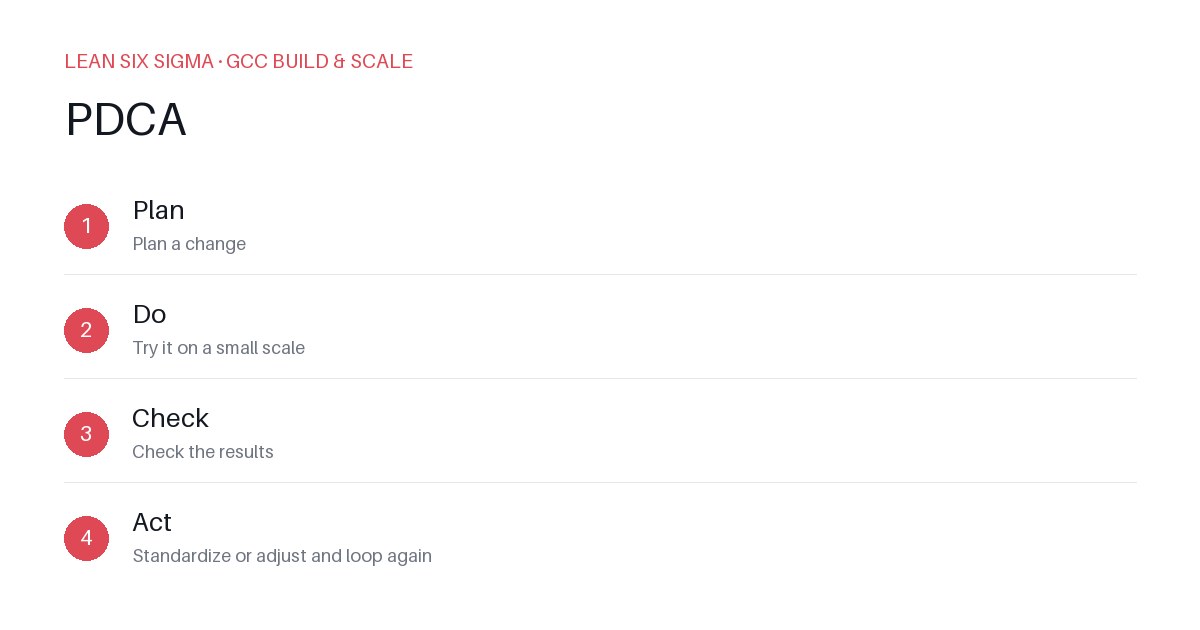
Downloadable templates
Use PDCA cycles to control vendor performance, reduce risk, and keep your GCC operations predictable.
Why Vendor Governance Needs PDCA
You don’t manage GCC vendors with annual reviews. You manage them with continuous feedback loops. PDCA (Plan-Do-Check-Act) gives you a repeatable structure to catch issues early, adjust contracts, and keep deliverables on track.
Plan: Define What “Good” Looks Like
Start with clear metrics tied to business outcomes, not activity counts. Example targets:
- On-time delivery of sprint increments: ≥ 90%
- Defect escape rate to production: ≤ 2%
- Vendor-initiated improvement suggestions: ≥ 3 per quarter
Assign an owner for each metric. Document acceptance criteria for each deliverable. If you can’t measure it, you can’t govern it.
Do: Run the Work and Capture Data
Execute the sprint or project phase. Log actuals against your plan. Use the same tool your team already uses for tracking so data collection doesn’t become a separate burden.
Key practice: log exceptions, not just successes. A missed deadline or rework request is a data point, not a failure.
Check: Compare Actuals to Targets
At the end of each cycle (usually one sprint or two weeks), run a quick comparison:
- Did we hit the target?
- If not, what caused the gap?
- Is the variance acceptable or does it trigger action?
Hold a 30-minute review with the vendor and internal product owner. Focus on facts, not blame. Document the outcome.
Act: Adjust and Lock In Changes
If metrics are off, decide:
- Process fix: adjust workflow or handoff steps.
- Resourcing fix: add support or shift scope.
- Contract fix: update SLAs or penalties.
If metrics are on track, reinforce the behavior. Share wins publicly. Consider adding the vendor to a preferred list for future work.
Example: Fixing a Repeated Defect
A GCC vendor repeatedly delivers code with logic errors. You track this over three sprints.
- Plan: target defect escape rate at 2%.
- Do: vendor delivers increments; defects are logged.
- Check: rate is 6%. Root cause: missing test coverage for edge cases.
- Act: add a mandatory test checklist, assign a QA lead, and update the acceptance criteria. Next cycle, rate drops to 2.5%.
Common Mistakes to Avoid
- Treating PDCA as a monthly report instead of a weekly habit.
- Measuring only output (hours, lines of code) instead of outcomes (quality, speed, risk).
- Letting vendors self-report without independent verification.
- Skipping the Act step when targets are met.
Next Steps
Pick one vendor. Define two metrics. Run a 30-day PDCA cycle. Document what changed. Repeat. Governance becomes predictable when you treat it as a process, not a policy.
Comments
Be the first to comment on this post.
Sign in to leave a comment.