PDCA Loops for GCC Vendor Governance
November 5, 2026
Like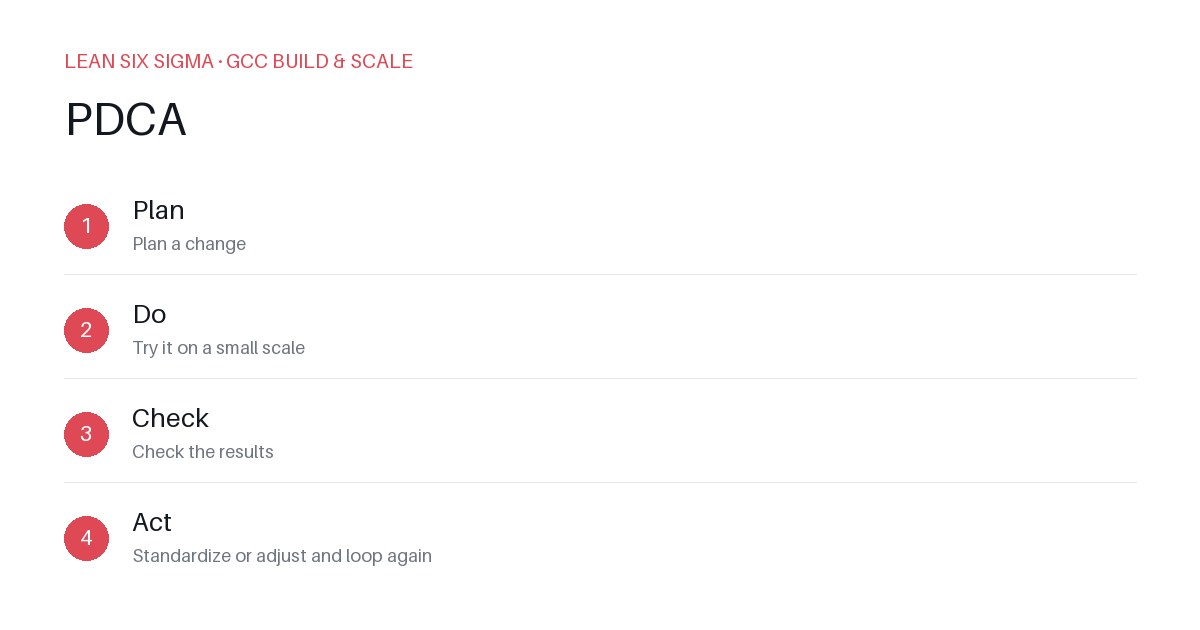
Downloadable templates
A practical walkthrough of applying PDCA to real GCC build-and-scale work.
Why PDCA Matters for GCC Teams
Scaling a Global Capability Center (GCC) means standardizing work across sites, handoffs, and teams that have never worked together before. Without a disciplined feedback mechanism, processes become fragmented, leading to duplicated effort, inconsistent quality, and delayed time-to-value. PDCA gives you a shared vocabulary and a repeatable sequence for doing that. It transforms ad-hoc fixes into institutionalized improvements, ensuring that every change is intentional, measured, and scalable. In a GCC environment where cross-border collaboration and vendor integration are the norm, PDCA becomes the operating system for continuous governance — not just a project management tool.
The PDCA Sequence
- Plan — Plan a change: Define the specific problem, establish success metrics, and outline the experimental approach. In GCC contexts, this often means mapping vendor workflows, identifying bottlenecks in handoff protocols, or documenting unclear SLAs.
- Do — Try it on a small scale: Implement the change in a controlled environment — perhaps with one vendor partner, a single project team, or a limited geographic site. This minimizes risk while generating real-world data.
- Check — Check the results: Compare outcomes against baseline metrics. Did cycle time decrease? Were error rates reduced? Did stakeholder satisfaction improve? Use both quantitative KPIs and qualitative feedback from team members and vendor contacts.
- Act — Standardize or adjust and loop again: If successful, formalize the change into SOPs, training materials, or vendor onboarding checklists. If not, refine the approach and restart the cycle. This iterative nature ensures that governance evolves with market demands and internal maturity.
Applying It
Start small: pick one recurring pain point your GCC team hits every week, and walk it through these 4 steps before rolling the approach out more broadly. Common starting points include vendor onboarding delays, inconsistent quality assurance checks, or misaligned reporting formats across regions. Download the template below to run your first pass — it includes fields for baseline metrics, experimental parameters, and post-implementation review prompts.
Building Vendor Governance with PDCA
When applied to vendor governance, PDCA helps GCC leaders move from reactive issue resolution to proactive process optimization. For example, if a vendor consistently misses milestone deadlines, the Plan phase might involve co-creating a revised communication cadence and milestone tracking dashboard. The Do phase tests this with a single active project. Check evaluates whether on-time delivery improves and whether the dashboard reduces status-update meetings. If results are positive, Act embeds the dashboard into all vendor contracts and training modules.
Scaling the Loop Across the GCC
Once a single PDCA cycle proves effective, replicate the framework across other vendors and processes. Establish a governance council that reviews PDCA outcomes monthly, sharing wins and lessons learned. This creates a culture of continuous improvement where vendors and internal teams alike are accountable to data-driven decisions. Over time, PDCA loops become embedded in your GCC’s operating rhythm — turning governance from a compliance exercise into a competitive advantage.
Comments
Be the first to comment on this post.
Sign in to leave a comment.