PDCA Loops for GCC Vendor Governance
August 24, 2026
Like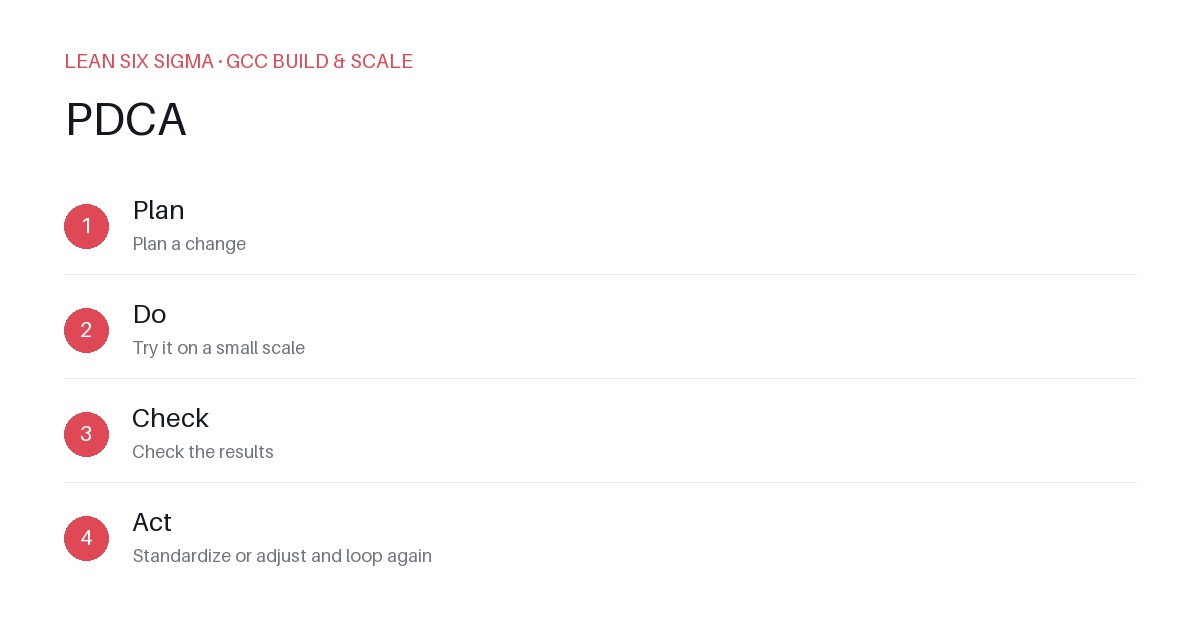
Downloadable templates
A practical walkthrough of applying PDCA to real GCC build-and-scale work.
PDCA Loops for GCC Vendor Governance
Why PDCA Matters for GCC Teams
Scaling a Global Capability Center means standardizing work across sites, handoffs, and teams that have never worked together before. PDCA gives you a shared vocabulary and a repeatable sequence for doing that. When you’re managing vendors across multiple regions, inconsistency is the enemy of efficiency. PDCA turns guesswork into a disciplined process, allowing teams to align on what “good” looks like, identify gaps quickly, and iterate without starting from scratch each time.
The PDCA Sequence
-
Plan — Plan a change
Define the objective, gather baseline data, identify stakeholders, and outline measurable success criteria. In vendor governance, this might mean mapping current SLA adherence rates or cataloging recurring approval bottlenecks. -
Do — Try it on a small scale
Implement the planned change in a controlled environment. For example, pilot a new vendor onboarding checklist with one regional team or test a revised performance scoring model with a subset of vendors. -
Check — Check the results
Compare outcomes against the success criteria set in the Plan phase. Use metrics like cycle time reduction, error rates, or stakeholder satisfaction scores. Document what worked, what didn’t, and why. -
Act — Standardize or adjust and loop again
If the change proves effective, formalize it into policy or process documentation. If not, refine the approach and run another PDCA cycle. This continuous improvement mindset ensures vendor governance evolves with business needs.
Applying It to Vendor Governance
Start small: pick one recurring pain point your GCC team hits every week, and walk it through these 4 steps before rolling the approach out more broadly. For instance, if vendor contract renewals consistently miss deadlines, apply PDCA to streamline the review workflow.
Step 1: Plan the Vendor Renewal Process
Gather data on current renewal timelines, identify bottlenecks (e.g., legal review delays, missing performance metrics), and define a target cycle time. Engage legal, procurement, and finance stakeholders to align on requirements.
Step 2: Do a Pilot Renewal
Select one vendor and apply the new workflow. Use a standardized checklist, automate status tracking, and set clear ownership for each review stage. Monitor progress daily and log any deviations.
Step 3: Check the Outcomes
Measure the actual cycle time against the target. Survey participants for feedback on clarity and efficiency. If the process reduced turnaround time by 30% but introduced confusion around compliance checks, note that for adjustment.
Step 4: Act and Iterate
Update the vendor renewal SOP based on pilot findings. Roll out the refined process to the next cohort of vendors. Schedule a quarterly review to assess long-term impact and identify new improvement opportunities.
Building a Culture of Continuous Improvement
PDCA isn’t a one-time fix—it’s a framework for embedding agility into your GCC operations. By institutionalizing these loops, teams develop a habit of proactive problem-solving rather than reactive firefighting. Over time, this leads to more predictable vendor performance, stronger cross-functional collaboration, and a governance model that scales with your global footprint.
Download the template below to run your first pass.
Comments
Be the first to comment on this post.
Sign in to leave a comment.