PDCA Loops for GCC Vendor Governance
September 1, 2026
Like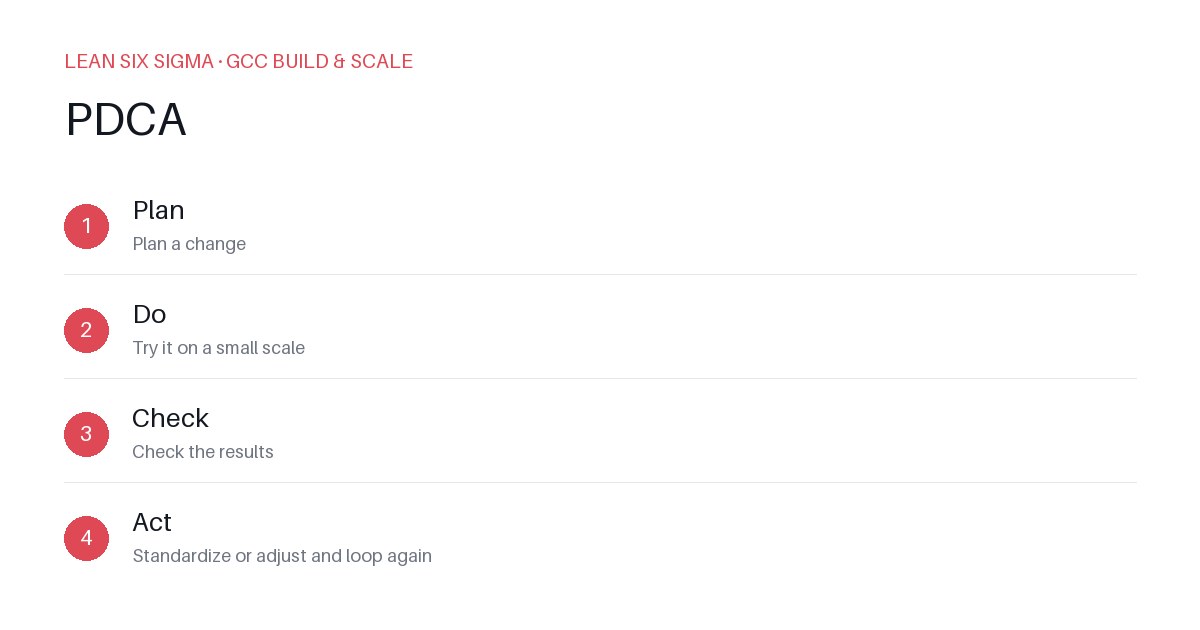
Downloadable templates
Apply PDCA to your GCC vendor governance to reduce risk, cut costs, and keep delivery aligned with business goals.
Why Vendor Governance Needs a PDCA Lens
Global Capability Centers (GCCs) rely on third-party vendors to scale quickly. But without disciplined governance, vendors drift from SLAs, introduce hidden costs, and create compliance gaps. PDCA (Plan-Do-Check-Act) gives you a repeatable loop to keep vendor performance in check without micromanaging.
Plan: Define Clear Vendor Expectations
Start with measurable goals. Don’t just say “good service.” Define what that means.
- Map critical processes to vendor responsibilities.
- Set SLAs with hard thresholds (e.g., 99.9% uptime, 48-hour incident response).
- Document escalation paths and review cadence.
- Align vendor KPIs with your GCC’s strategic outcomes.
Example: A GCC in India uses a vendor for cloud infrastructure. Instead of a vague “maintain performance” clause, they specify latency targets, cost caps, and monthly reporting requirements.
Do: Implement with Controlled Changes
Launch vendor changes or new contracts with clear execution steps.
- Pilot new vendors on a small project first.
- Use standardized onboarding checklists.
- Track initial performance against baseline metrics.
- Avoid scope creep by freezing requirements during the trial phase.
Tip: Keep a change log. Every modification to vendor terms or scope should be documented and reviewed.
Check: Measure What Matters
Data beats opinions. Review vendor performance against the Plan.
- Use dashboards for real-time SLA tracking.
- Conduct quarterly business reviews (QBRs) with vendors.
- Flag deviations early—don’t wait for annual reviews.
- Gather feedback from internal users who rely on vendor services.
Scenario: A GCC notices a vendor’s bug resolution time has increased by 30%. Instead of ignoring it, they trigger a corrective action plan.
Act: Adjust and Standardize
Fix gaps and lock in improvements.
- Revise vendor contracts based on Check findings.
- Implement training or process changes for underperforming vendors.
- Share best practices across GCC locations.
- Terminate or renegotiate vendors that consistently miss targets.
Repeat the cycle. Governance isn’t a one-time event—it’s a continuous loop.
Common Pitfalls to Avoid
- Vague KPIs: If you can’t measure it, you can’t improve it.
- Skipping the Act phase: Checking without acting leads to stagnation.
- One-size-fits-all approach: Not all vendors need the same governance intensity.
- Ignoring vendor feedback: Partners often spot inefficiencies you miss.
Quick Start Steps
- Pick one critical vendor process.
- Define SLAs and KPIs using the Plan step.
- Run a 30-day pilot (Do).
- Review metrics and gather feedback (Check).
- Adjust terms or processes (Act).
- Scale the loop to other vendors.
PDCA turns vendor governance from a reactive burden into a proactive advantage. Keep the loop tight, and your GCC stays agile, compliant, and cost-effective.
Comments
Be the first to comment on this post.
Sign in to leave a comment.