RACI Matrices for GCC Cross-Site Ownership
September 9, 2026
Like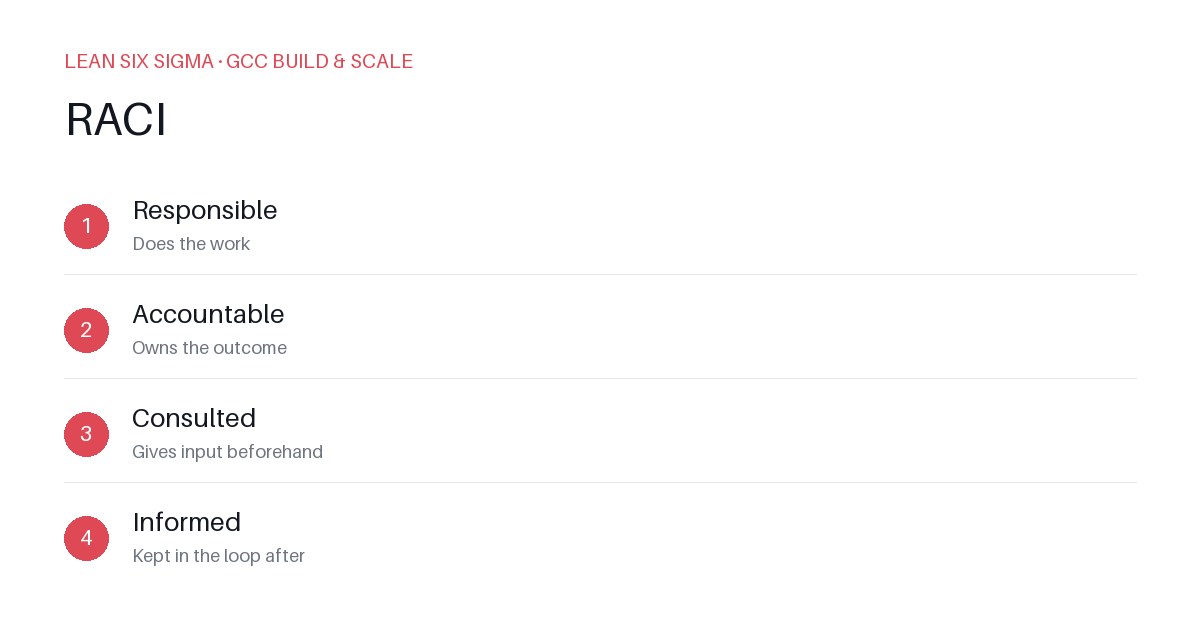
Downloadable templates
A practical walkthrough of applying RACI to real GCC build-and-scale work.
Why RACI Matters for GCC Teams
Scaling a Global Capability Center means standardizing work across sites, handoffs, and teams that have never worked together before. RACI gives you a shared vocabulary and a repeatable sequence for doing that. Without it, you risk duplicated effort, unclear ownership, and decisions that stall because no one knew who had the final say. In a GCC context — where time zones, cultural norms, and local process variations collide — RACI becomes the operating system that keeps delivery predictable and accountable.
The RACI Sequence
- Responsible — Does the work
- Accountable — Owns the outcome
- Consulted — Gives input beforehand
- Informed — Kept in the loop after
Each role serves a distinct purpose. The Responsible party executes the task and reports progress. The Accountable party is the single point of decision and outcome ownership — there should be only one. Consulted parties provide expertise or constraints before work begins. Informed parties receive updates after decisions are made or work is completed. Confusing these roles — especially assigning multiple Accountables or skipping Consulted — is the most common cause of RACI breakdowns.
Applying It
Start small: pick one recurring pain point your GCC team hits every week, and walk it through these 4 steps before rolling the approach out more broadly. Download the template below to run your first pass.
For example, consider a weekly release coordination process. Instead of leaving handoffs to informal chat or email threads, map out who is Responsible for building the release notes, who is Accountable for sign-off, who should be Consulted from QA and Legal, and who needs to be Informed post-launch. Document this once, socialize it with the team, and embed it in your project charter or runbook. Over time, this becomes muscle memory.
Building a GCC RACI Template
A practical template should include columns for Task/Process, Responsible, Accountable, Consulted, and Informed, along with notes for escalation paths and decision rights. Keep it lightweight — avoid over-engineering with color codes or complex matrices for simple workflows. Use it during sprint planning, project kickoffs, and post-mortems to clarify ownership before work begins.
Common Pitfalls to Avoid
- Assigning more than one Accountable per task, which dilutes accountability
- Skipping Consulted, which leads to rework when critical stakeholders are surprised
- Treating Informed as optional, which creates silos and missed dependencies
- Not revisiting RACI when team structures or processes change
Next Steps
After your first pass, collect feedback from the team. Are the roles clear? Are decisions faster? Are handoffs smoother? Iterate based on real usage, not theory. Once the pattern proves effective, scale it across other recurring processes — incident response, vendor onboarding, compliance reviews — until RACI becomes the default lens for ownership in your GCC.
Comments
Be the first to comment on this post.
Sign in to leave a comment.