RACI Matrices for GCC Cross-Site Ownership
September 19, 2026
Like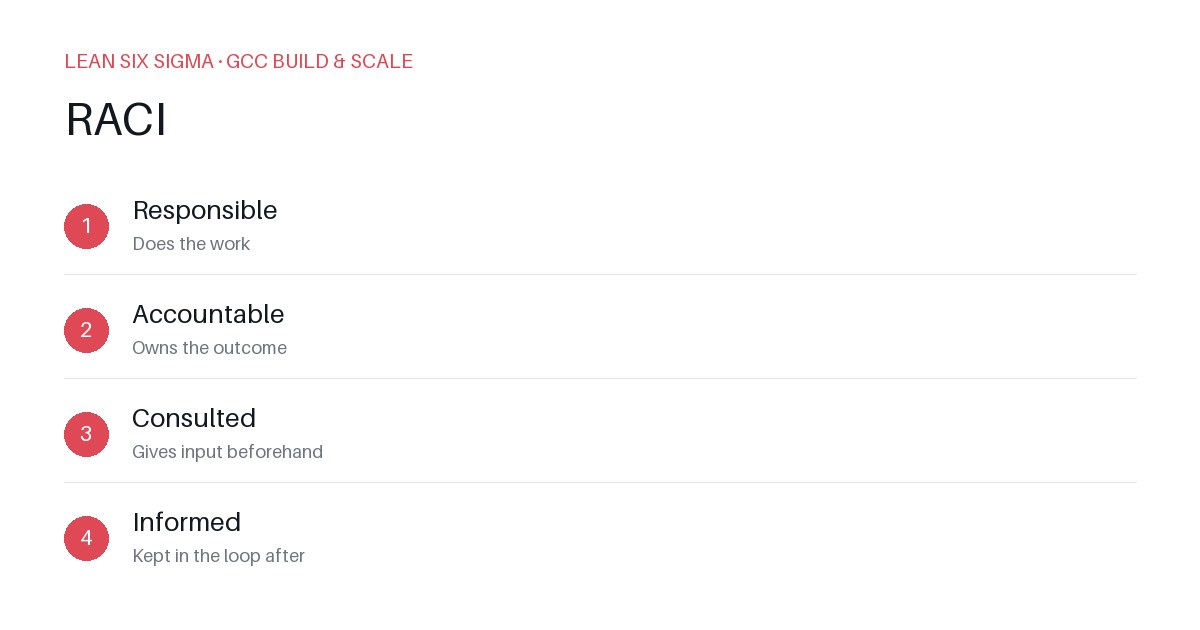
Downloadable templates
Use a strict RACI matrix to eliminate overlap and ambiguity in Global Capability Center cross-site project ownership.
Why Your RACI Is Failing Across Sites
Most GCC teams default to a shared responsibility model. When a process improvement hits the APAC site, the MEAP lead assumes they own the rollout. The APAC lead assumes the MEAP lead handles the compliance audit. Both assume the other will coordinate. Result: duplicated work, missed deadlines, and a frustrated customer base.
RACI is not a suggestion. It is a contract. You must define who is Responsible, Accountable, Consulted, and Informed for every workstream in a cross-site GCC project.
The Four Roles, Defined
- Responsible: The person who does the work. There can be multiple Responsible parties. If no one is Responsible, the work never happens.
- Accountable: The person who signs off. There must be exactly one Accountable party. If there are two, neither is accountable.
- Consulted: The person whose input is required before a decision is made. They do not have decision-making power.
- Informed: The person who receives updates. They do not influence the outcome.
Step 1: Map the Workstream
Start with a single, high-impact workstream. Do not try to RACI an entire GCC program. Pick one: for example, "Vendor Selection for the AI Analytics Platform." List every task in that workstream. Write them down.
| Task | Responsible | Accountable | Consulted | Informed |
|---|---|---|---|---|
| Define requirements | APAC Lead | MEAP Lead | APAC SME | APAC Director |
| Issue RFP | MEAP Procurement | MEAP Lead | APAC Legal | APAC Director |
| Evaluate bids | APAC SME | MEAP Lead | MEAP SME | APAC Director |
| Sign contract | MEAP Legal | MEAP Lead | APAC Director | APAC Director |
Step 2: Enforce the Single Accountable Rule
This is where most GCCs break. You will find multiple Accountable names. Force a choice. The Accountable party is the one who bears the consequences of failure. In the example above, MEAP Lead is Accountable for the vendor selection because MEAP owns the analytics capability. APAC Director is Informed, not Accountable.
Step 3: Run a RACI Workshop
Host a 90-minute workshop with the cross-site leads. Use a whiteboard or digital tool. Go through each task. Ask:
- Who does the work? (Responsible)
- Who signs off? (Accountable)
- Who must be asked before we proceed? (Consulted)
- Who needs to know the outcome? (Informed)
Resolve conflicts on the spot. If two people claim to be Accountable, ask who has the final budget authority. That person is Accountable.
Step 4: Publish and Enforce
Post the RACI matrix in a shared drive. Link it to the project charter. Require all teams to reference it in status updates. If a task is completed by the wrong Responsible party, flag it immediately. Do not let ambiguity fester.
Common Pitfalls
- Too many Responsible parties: This dilutes ownership. Consolidate tasks or split the workstream.
- No Consulted parties: This leads to decisions made in a vacuum. Identify key SMEs early.
- Informed instead of Accountable: This is the most common error. If someone must approve a budget, they are Accountable, not Informed.
Next Steps
Pick one workstream. Build the RACI. Enforce it. Repeat for the next workstream. Within three months, your cross-site GCC will have clear ownership, reduced friction, and faster delivery.
Comments
Be the first to comment on this post.
Sign in to leave a comment.