RACI Matrices for GCC Cross-Site Ownership
September 22, 2026
Like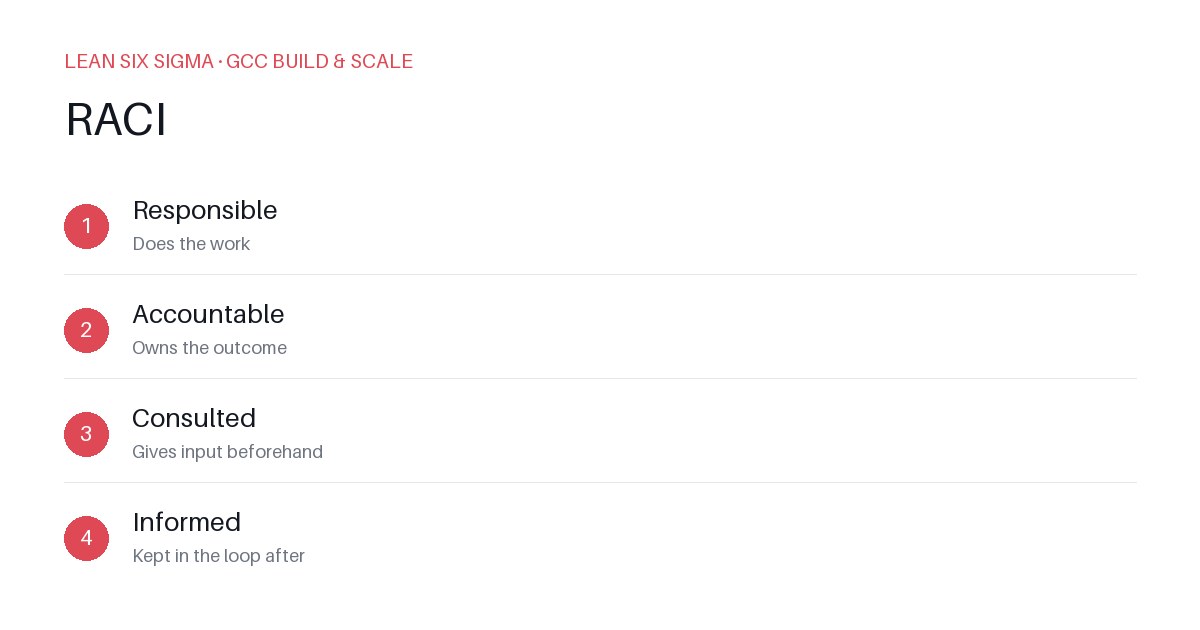
Downloadable templates
A practical walkthrough of applying RACI to real GCC build-and-scale work.
RACI Matrices for GCC Cross-Site Ownership
Why RACI Matters for GCC Teams
Scaling a Global Capability Center means standardizing work across sites, handoffs, and teams that have never worked together before. RACI gives you a shared vocabulary and a repeatable sequence for doing that.
Without clear ownership, GCC initiatives often stall in the “who’s doing what?” phase. Teams default to informal handoffs, which leads to duplicated effort, missed deadlines, and frustration. A RACI matrix cuts through that noise by assigning specific roles to each step of a process.
The RACI Sequence
- Responsible — Does the work
- Accountable — Owns the outcome
- Consulted — Gives input beforehand
- Informed — Kept in the loop after
Applying It
Start small: pick one recurring pain point your GCC team hits every week, and walk it through these 4 steps before rolling the approach out more broadly. Download the template below to run your first pass.
How to Build Your First RACI Matrix
Begin by listing the key activities in your chosen process. For example, if you’re onboarding new analysts into the GCC, your activities might include:
- Scheduling orientation sessions
- Preparing training materials
- Coordinating IT access setup
- Conducting a follow-up check-in
Next, identify the people involved. These could include:
- The GCC operations lead
- Local site managers
- IT support staff
- Training coordinators
- New hires
Now, assign roles using the RACI framework:
- Responsible: Who actually performs the task?
- Accountable: Who signs off or owns the result?
- Consulted: Who provides expert input before decisions are made?
- Informed: Who needs updates after the task is complete?
A common mistake is assigning multiple people as “Responsible” or “Accountable.” Keep it to one person per role to avoid ambiguity.
Example: Onboarding New Analysts
| Activity | Responsible | Accountable | Consulted | Informed |
|---|---|---|---|---|
| Schedule orientation | Training Coord. | Site Manager | GCC Ops Lead | New Hire |
| Prepare training materials | Training Coord. | Training Lead | SMEs | Site Manager |
| Set up IT access | IT Support | IT Manager | Site Manager | New Hire |
| Follow-up check-in | Site Manager | GCC Ops Lead | Training Coord. | New Hire |
Common Pitfalls to Avoid
- Overcomplicating roles: Don’t create more than one Responsible or Accountable per activity.
- Skipping the “Informed” column: People who need updates but aren’t directly involved often feel left out.
- Not reviewing regularly: RACI matrices should be revisited as processes evolve.
Next Steps
Use this framework to map out your most critical GCC workflows. Share the matrix with stakeholders, gather feedback, and refine. Over time, you’ll build a culture of clarity and accountability that scales with your GCC.
Comments
Be the first to comment on this post.
Sign in to leave a comment.