RACI Matrices for GCC Cross-Site Ownership
September 25, 2026
Like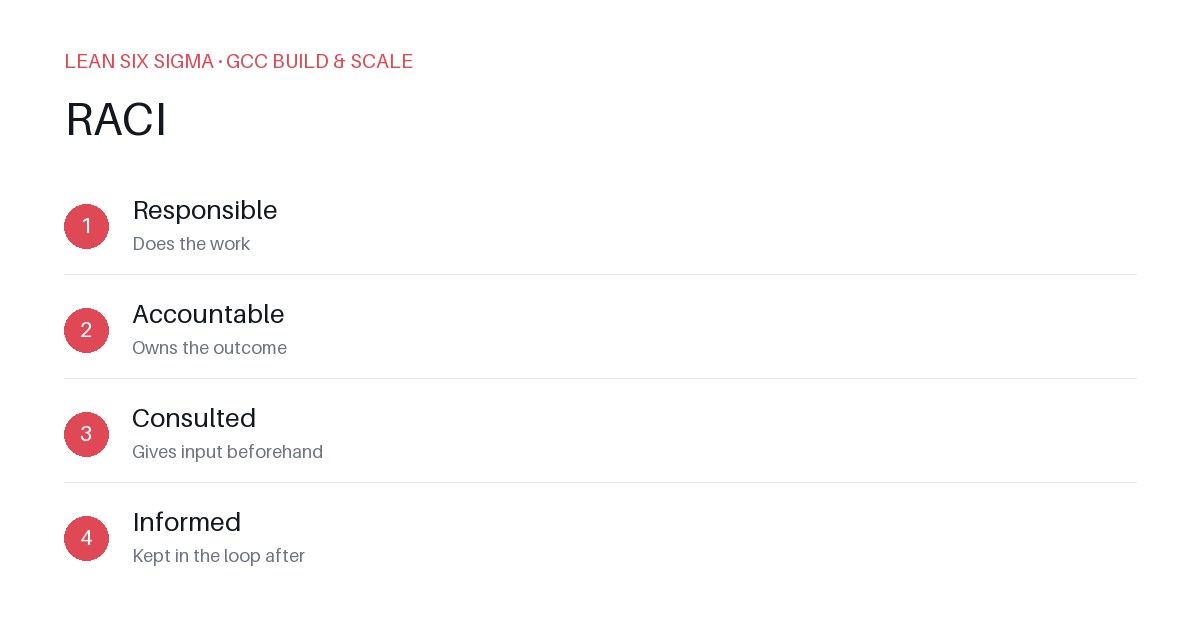
Downloadable templates
A practical walkthrough of applying RACI to real GCC build-and-scale work.
RACI Matrices for GCC Cross-Site Ownership
Why RACI Matters for GCC Teams
Scaling a Global Capability Center means standardizing work across sites, handoffs, and teams that have never worked together before. In a distributed model, ambiguity around “who does what” creates bottlenecks, duplicated effort, and delayed decisions. RACI gives you a shared vocabulary and a repeatable sequence for doing that. It turns implicit handoffs into explicit workflows, making it easier to onboard new contributors, audit processes, and resolve conflicts before they escalate.
The RACI Sequence
- Responsible — Does the work
- Accountable — Owns the outcome
- Consulted — Gives input beforehand
- Informed — Kept in the loop after
Each role serves a distinct purpose. The Responsible party executes the task; the Accountable party ensures the deliverable meets standards and signs off; Consulted parties provide expertise or constraints before work begins; and Informed parties receive updates without needing to act. This structure prevents role overlap and clarifies decision rights.
Applying It
Start small: pick one recurring pain point your GCC team hits every week, and walk it through these 4 steps before rolling the approach out more broadly. Download the template below to run your first pass.
Concrete Example: Incident Post-Mortem Ownership
Consider a cross-site incident response process. Without RACI, multiple teams may draft sections simultaneously, or the final report may sit unapproved for days. Applying RACI clarifies each step:
- Responsible: The on-call engineer from the affected region drafts the initial timeline and root cause analysis.
- Accountable: The GCC process owner reviews the draft, ensures alignment with global standards, and publishes the final post-mortem.
- Consulted: Security and Compliance teams review the report for policy adherence before publication.
- Informed: All site leads and regional managers receive the final document for awareness and local follow-up actions.
This simple matrix eliminates guesswork, reduces revision cycles, and ensures accountability is never diluted across regions.
Implementing RACI Across Your GCC
- Map recurring workflows — Identify 3–5 high-impact processes (e.g., sprint planning, release approvals, vendor onboarding).
- Assign roles per step — For each activity, designate one Responsible, one Accountable, and list all Consulted/Informed parties.
- Validate with stakeholders — Review the matrix with site leads to confirm accuracy and surface hidden dependencies.
- Embed in documentation — Publish the RACI alongside SOPs, Jira workflows, or Confluence pages so it becomes the source of truth.
- Review quarterly — As teams evolve, update the matrix to reflect new responsibilities or removed bottlenecks.
Common Pitfalls to Avoid
- Multiple Accountable parties — This creates confusion. Only one person should own the outcome.
- Over-consultation — Too many Consulted roles slow down decisions. Limit to those whose input is critical.
- Static matrices — RACI should evolve with your GCC’s maturity. Revisit it as processes mature.
Next Steps
Download the template below to run your first pass. Use it to document one workflow, share it with your team, and iterate based on real-world feedback. Once you see the clarity it brings, expand it to additional processes. Over time, RACI becomes less of a tool and more of a cultural norm — one that scales your GCC without scaling chaos.
Comments
Be the first to comment on this post.
Sign in to leave a comment.