RACI Matrices for GCC Cross-Site Ownership
September 27, 2026
Like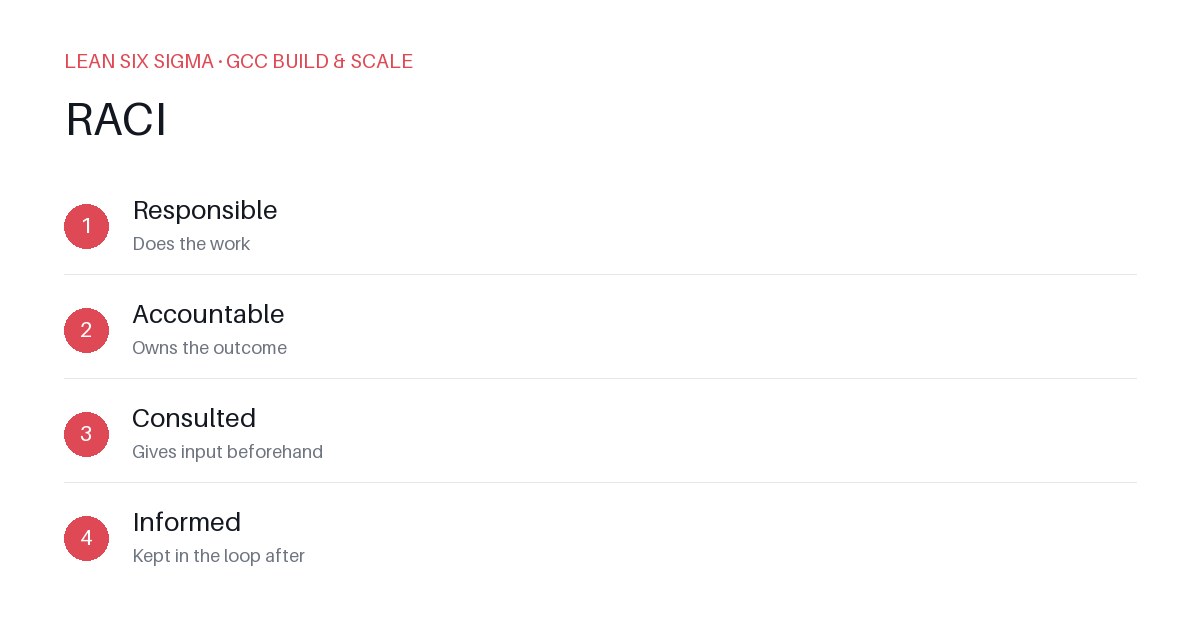
Downloadable templates
A practical walkthrough of applying RACI to real GCC build-and-scale work.
Why RACI Matters for GCC Teams
Scaling a Global Capability Center means standardizing work across sites, handoffs, and teams that have never worked together before. RACI gives you a shared vocabulary and a repeatable sequence for doing that. Without it, you risk duplicated efforts, unclear accountability, and delayed decisions — especially when geographically dispersed teams operate on different time zones and cultural norms. A well-structured RACI matrix doesn’t just assign roles; it aligns expectations, reduces friction, and creates transparency across cross-site workflows.
The RACI Sequence
-
Responsible — Does the work
This is the person or group actually executing the task. They are the ones who produce the deliverable and must have the authority and resources to do so. In a GCC context, this might be a developer in Bangalore, a tester in Hyderabad, or a PM in New York — depending on where the work is located. -
Accountable — Owns the outcome
Only one person should be accountable for each task. This person doesn’t necessarily do the work but has the authority to approve, reject, or escalate. They are the ultimate decision-maker when things go off track. For example, a Site Lead or Program Manager might be accountable for a deployment, even if engineers in multiple countries are responsible for testing and deploying it. -
Consulted — Gives input beforehand
These individuals are involved before the work begins or during key decision points. Their expertise is needed to ensure quality, compliance, or alignment. In GCC teams, this could include legal, security, compliance, or product owners who must sign off on changes before they’re implemented globally. -
Informed — Kept in the loop after
These people don’t need to act but should be updated on progress and outcomes. This ensures visibility and helps prevent silos. In a cross-site GCC, this might mean notifying regional leads, stakeholders in other countries, or executive sponsors so they’re aware of milestones, risks, or completed deliverables.
Applying It
Start small: pick one recurring pain point your GCC team hits every week, and walk it through these 4 steps before rolling the approach out more broadly. For instance, if release coordination is consistently delayed, map out who is responsible for testing, who is accountable for sign-off, who needs to be consulted for compliance, and who should be informed post-release.
Download the template below to run your first pass. Use it to document roles for 2–3 key processes, then review with your team to validate accuracy and adjust as needed. Over time, embed RACI into your project charters, sprint planning, and handoff protocols. This not only improves efficiency but also builds a culture of clarity and ownership across your Global Capability Center.
Comments
Be the first to comment on this post.
Sign in to leave a comment.