RACI Matrices for GCC Cross-Site Ownership
August 18, 2026
Like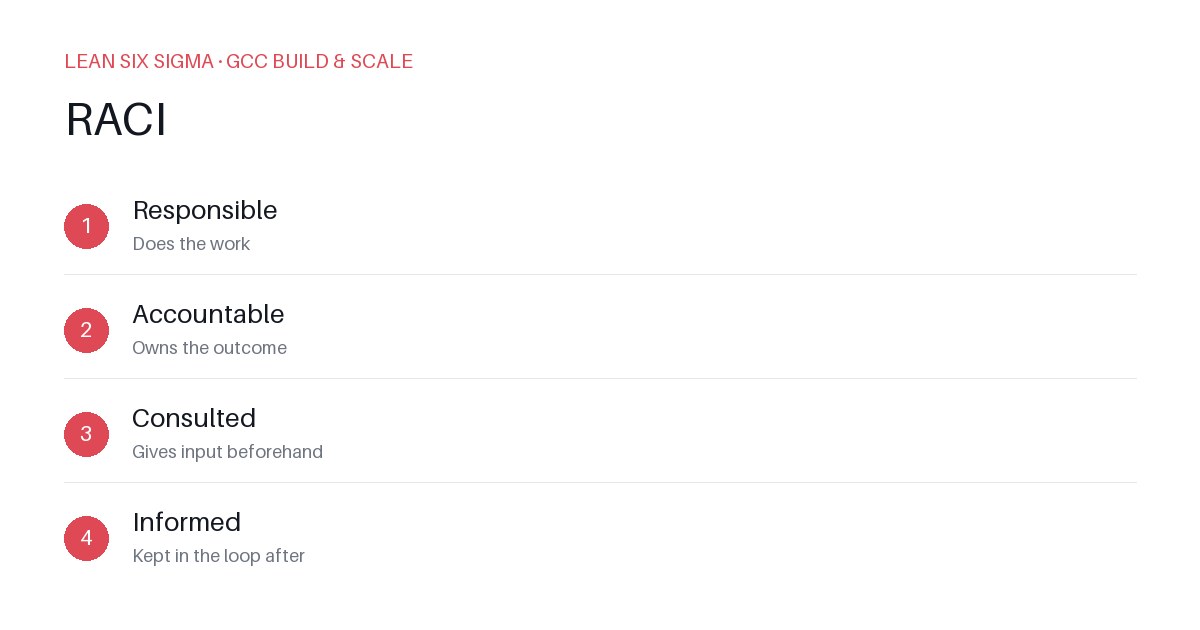
Downloadable templates
A practical walkthrough of applying RACI to real GCC build-and-scale work.
Why RACI Matters for GCC Teams
Scaling a Global Capability Center means standardizing work across sites, handoffs, and teams that have never worked together before. RACI gives you a shared vocabulary and a repeatable sequence for doing that. When you’re managing multiple geographies with different time zones, cultural norms, and tooling preferences, ambiguity becomes a bottleneck. A clear RACI matrix eliminates guesswork about who does what, who has the final say, and who needs to be looped in — reducing delays, preventing duplicated effort, and building trust across distributed teams.
The RACI Sequence
- Responsible — Does the work
- Accountable — Owns the outcome
- Consulted — Gives input beforehand
- Informed — Kept in the loop after
Each role serves a distinct purpose. The Responsible party executes the task, but they don’t necessarily have decision-making authority. The Accountable person is the single point of ownership — they ensure the work gets done and can approve or reject deliverables. Consulted stakeholders provide expertise or constraints before work begins, while Informed parties receive updates without needing to act. Confusing these roles — especially mixing up Responsible and Accountable — is the most common RACI mistake and leads to bottlenecks or misaligned expectations.
Applying It
Start small: pick one recurring pain point your GCC team hits every week, and walk it through these 4 steps before rolling the approach out more broadly. Download the template below to run your first pass.
For example, consider a routine process like “New Vendor Onboarding.” Without a RACI, you might find the IT team drafting security questions while Legal is still deciding on contract terms, and Procurement is waiting on both. By mapping it out:
- Responsible: Procurement Specialist (prepares vendor questionnaire and tracks submissions)
- Accountable: GCC Operations Lead (approves vendor list and signs off on compliance)
- Consulted: IT Security & Legal (review requirements and flag risks before work begins)
- Informed: Finance and Site Managers (notified once the vendor is approved and onboarded)
This simple mapping clarifies ownership, prevents parallel work, and ensures decisions happen in the right sequence.
Building a Living RACI
Don’t treat RACI as a one-time exercise. Revisit it quarterly or when processes change. Assign roles by function or project, not by title, to keep it flexible. Use color coding or icons in your template for quick visual scanning. And most importantly — socialize it. Walk through real examples in team meetings so everyone internalizes the logic. When RACI becomes part of your team’s operating rhythm, cross-site collaboration stops feeling like coordination overhead and starts feeling like a competitive advantage.
Comments
Be the first to comment on this post.
Sign in to leave a comment.