RACI Matrices for GCC Cross-Site Ownership
September 30, 2026
Like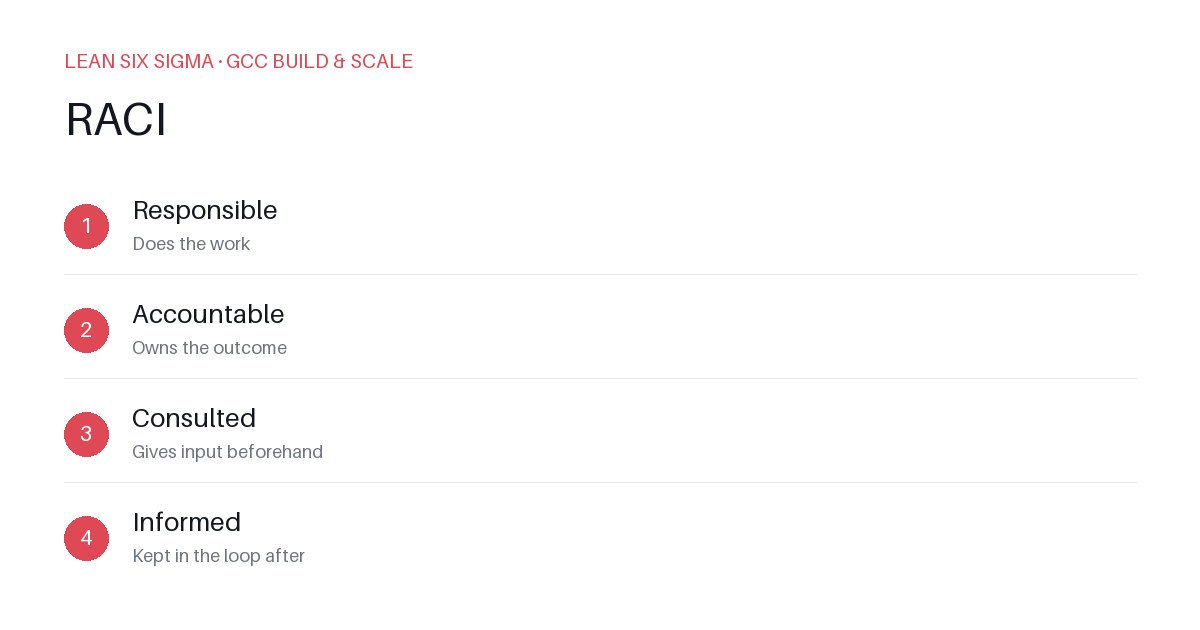
Downloadable templates
A practical walkthrough of applying RACI to real GCC build-and-scale work.
RACI Matrices for GCC Cross-Site Ownership
Why RACI Matters for GCC Teams
Scaling a Global Capability Center means standardizing work across sites, handoffs, and teams that have never worked together before. RACI gives you a shared vocabulary and a repeatable sequence for doing that. In practice, it prevents the “I thought you were handling that” cycle that slows down delivery, creates friction between locations, and erodes trust in the center’s ability to drive outcomes. When you map who does what, who has final say, who needs to be asked, and who just needs to be told, you cut through ambiguity and create a lightweight operating system that scales with your team.
The RACI Sequence
- Responsible — Does the work
- Accountable — Owns the outcome
- Consulted — Gives input beforehand
- Informed — Kept in the loop after
Each role serves a distinct purpose. The Responsible party executes the task or delivers the artifact. The Accountable party has the authority to approve or reject the output and is ultimately answerable for success. Consulted parties provide expertise, risk assessment, or alignment before decisions are locked. Informed parties receive updates after decisions are made so they can adjust their own work accordingly.
Applying It
Start small: pick one recurring pain point your GCC team hits every week, and walk it through these 4 steps before rolling the approach out more broadly. Download the template below to run your first pass.
Step 1: Identify the Work Stream
Choose a specific process that crosses site boundaries. Examples include:
- Onboarding a new analyst to the GCC
- Approving a vendor contract for a shared tool
- Rolling out a new reporting dashboard to multiple regions
- Resolving a data quality issue that impacts multiple teams
Write the end-to-end workflow in plain language. Break it into discrete steps: intake, review, approval, deployment, and closure.
Step 2: Assign Roles per Step
For each step, assign exactly one Responsible person, one Accountable person, one or more Consulted parties, and one or more Informed parties. Avoid splitting responsibility. If two people are both Responsible, neither is truly accountable. If no one is Consulted but decisions require expertise, you’re setting yourself up for rework.
Step 3: Validate with the Team
Share the draft matrix with the people involved. Ask:
- “Does this match how we actually work?”
- “Are we missing anyone who needs to be Consulted?”
- “Is the Accountable person the one with real decision-making power?”
Refine until consensus is reached. Document the final version in a living repository so it can be referenced during standups, reviews, and audits.
Step 4: Measure and Iterate
Track how often handoffs slip, how long approvals take, and how many rework cycles occur. If a step consistently delays delivery, revisit the roles. Maybe a Consulted party should be Informed instead, or maybe the Accountable person needs more authority to decide faster. RACI is not a one-time exercise; it’s a feedback loop that improves as your GCC matures.
Common Pitfalls to Avoid
- Multiple Accountable parties: This creates paralysis. Choose one owner per outcome.
- No Consulted step: Skipping input from subject matter experts leads to flawed decisions.
- Overloading Informed: Too many people in the loop slows communication. Keep it tight.
- Static matrices: Processes evolve. Review RACI quarterly or when scope changes.
Building Trust Through Clarity
When teams know exactly who does what, who decides, and who needs to be asked, handoffs become predictable. Disputes drop. Delivery accelerates. Most importantly, your GCC earns credibility as a center that delivers, not just one that designs. Start with one process, nail the roles, and scale the discipline.
Comments
Be the first to comment on this post.
Sign in to leave a comment.