RACI Matrices for GCC Cross-Site Ownership
October 3, 2026
Like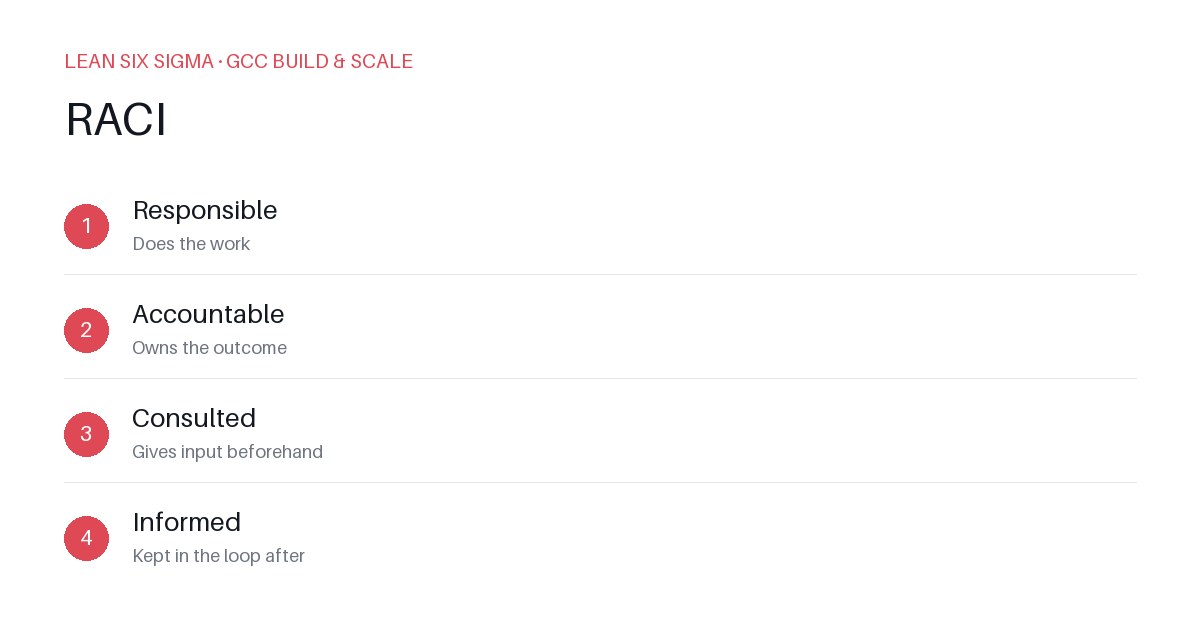
Downloadable templates
A practical walkthrough of applying RACI to real GCC build-and-scale work.
RACI Matrices for GCC Cross-Site Ownership
Why RACI Matters for GCC Teams
Scaling a Global Capability Center means standardizing work across sites, handoffs, and teams that have never worked together before. RACI gives you a shared vocabulary and a repeatable sequence for doing that. Without it, you’ll see duplicated effort, unclear decision rights, and blame-shifting when things go off track. With it, you create a lightweight operating system that travels with the work — not just the people.
The RACI Sequence
- Responsible — Does the work
- Accountable — Owns the outcome
- Consulted — Gives input beforehand
- Informed — Kept in the loop after
Each role serves a distinct purpose. The Responsible party executes the task. The Accountable party has the authority to say “yes” or “no” and is answerable for the result. The Consulted party provides expertise or constraints before the work begins. The Informed party receives updates after decisions or actions are taken. Confusing these roles — especially swapping Responsible and Accountable — is the most common RACI failure in GCC environments.
Applying It
Start small: pick one recurring pain point your GCC team hits every week, and walk it through these 4 steps before rolling the approach out more broadly. Download the template below to run your first pass.
Concrete Example: Cross-Site Release Readiness
Imagine your GCC team supports a global product launch. Every week, a release readiness review happens across three time zones. Historically, it’s been chaotic: some sites prepare, others don’t; feedback loops take days; and the final go/no-go decision is delayed.
Apply RACI to this process:
- Responsible: Local release engineers at each site who execute checklists, run tests, and document status.
- Accountable: GCC Program Manager who synthesizes inputs, resolves conflicts, and makes the final release decision.
- Consulted: Security, Compliance, and Legal leads who review risk factors before the release window opens.
- Informed: Product Owners, Customer Success leads, and regional managers who receive the final readiness report and any post-launch metrics.
By mapping these roles explicitly, you eliminate ambiguity. Local teams know who owns the decision. Global stakeholders know who to ask for input. Everyone knows when to act versus when to wait.
Building the Matrix
Use a simple table format. List processes or deliverables in rows, roles in columns, and mark each cell with R, A, C, or I. Follow these rules:
- Every task must have exactly one A.
- There can be multiple R’s, but never multiple A’s.
- C and I roles should be minimized to avoid decision paralysis.
- Review the matrix quarterly — as roles evolve, so should ownership.
Common Pitfalls to Avoid
- Overloading the Accountable role: If one person is A for everything, they become a bottleneck.
- Leaving out Consulted: Skipping expert input early leads to rework later.
- Treating Informed as a dumping ground: Only inform those whose work depends on the outcome.
- Never revisiting the matrix: RACI is a living artifact, not a one-time exercise.
Next Steps
Run your first RACI workshop with a cross-site team. Pick a process that causes friction. Map it. Share it. Adjust. Within weeks, you’ll see faster handoffs, clearer accountability, and fewer “who owns this?” conversations. That’s the real value of RACI in a GCC: not bureaucracy, but clarity at scale.
Comments
Be the first to comment on this post.
Sign in to leave a comment.