RACI Matrices for GCC Cross-Site Ownership
October 6, 2026
Like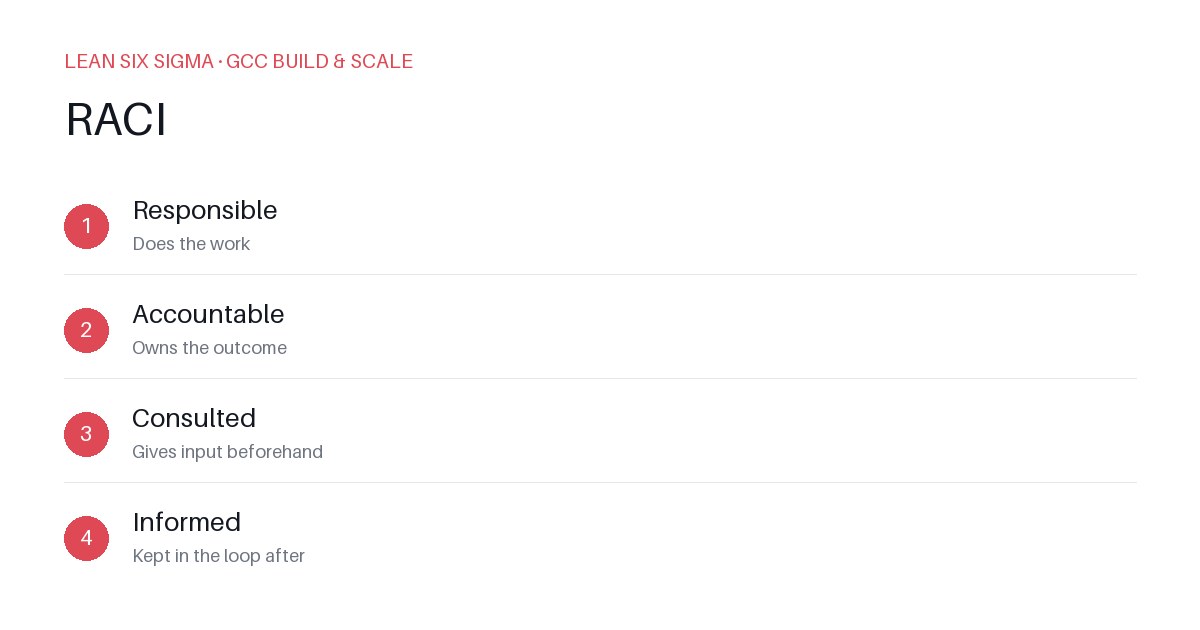
Downloadable templates
A practical walkthrough of applying RACI to real GCC build-and-scale work.
RACI Matrices for GCC Cross-Site Ownership
Why RACI Matters for GCC Teams
Scaling a Global Capability Center means standardizing work across sites, handoffs, and teams that have never worked together before. RACI gives you a shared vocabulary and a repeatable sequence for doing that. Without it, you risk duplicated effort, unclear decision rights, and bottlenecks when work crosses time zones or organizational boundaries.
The RACI Sequence
- Responsible — Does the work
- Accountable — Owns the outcome
- Consulted — Gives input beforehand
- Informed — Kept in the loop after
Applying It
Start small: pick one recurring pain point your GCC team hits every week, and walk it through these 4 steps before rolling the approach out more broadly. Download the template below to run your first pass.
Choosing the Right Process to Model
Not every task needs a full RACI matrix. Focus on processes that involve multiple sites, require approval gates, or frequently cause handoff delays. Examples include:
- Release approvals — Who tests, who signs off, who notifies stakeholders?
- Incident escalation — Who detects, who owns resolution, who is notified?
- Feature delivery — Who builds, who reviews, who releases, who communicates impact?
Map the process first, then assign roles. Avoid assigning multiple people to the same role in the same step — that creates ambiguity and slows execution.
Assigning Roles with Clarity
For each step in your process, explicitly define:
- Responsible: The person or team that actually performs the work. There should be only one Responsible per step.
- Accountable: The person who has final decision-making authority and answers for the outcome. There should be only one Accountable per step.
- Consulted: People whose input is needed before the step is completed. Their feedback may influence the work but doesn’t block it.
- Informed: People who need to be notified after the step is done. They don’t need to act, but they must stay aware.
Handling Cross-Site Complexity
When work spans multiple GCC sites, RACI helps clarify jurisdiction. For example:
- Responsible may be in Site A, but Accountable could be in Site B if Site B owns the product line.
- Consulted might include legal, compliance, or security teams in a different region.
- Informed could be leadership in both sites to ensure alignment.
Document these assignments visibly. Use a simple table or matrix tool that all sites can access. Review and update it as processes evolve.
Common Pitfalls to Avoid
- No Accountable: Everyone is responsible, but no one owns the outcome.
- Multiple Accountables: Conflicts arise when two people think they own the decision.
- Over-Consulting: Too many people in the Consulted role slows momentum.
- Ignoring Informed: Stakeholders are surprised after the fact, leading to rework or distrust.
Building RACI Into Your Operating Rhythm
Embed RACI reviews into your regular cadence:
- Weekly: Quick check on high-risk handoffs.
- Monthly: Update matrices as roles or processes change.
- Quarterly: Retrospective on where RACI helped or hindered delivery.
Treat RACI as a living artifact, not a one-time exercise. As your GCC scales, clarity in ownership becomes a competitive advantage — not just a compliance checkbox.
Comments
Be the first to comment on this post.
Sign in to leave a comment.