RACI Matrices for GCC Cross-Site Ownership
October 8, 2026
Like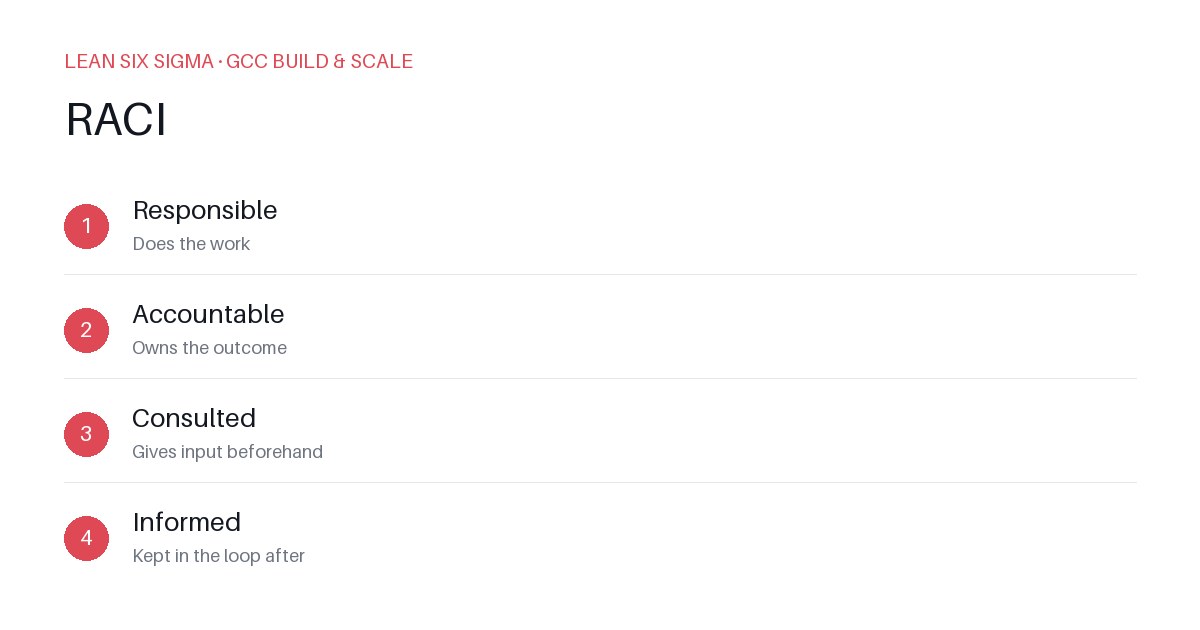
Downloadable templates
A practical walkthrough of applying RACI to real GCC build-and-scale work.
Why RACI Matters for GCC Teams
Scaling a Global Capability Center means standardizing work across sites, handoffs, and teams that have never worked together before. RACI gives you a shared vocabulary and a repeatable sequence for doing that. Without it, you’re left with ambiguous ownership, duplicated effort, and decisions that stall because no one knew who had the final say.
The RACI Sequence
- Responsible — Does the work
- Accountable — Owns the outcome
- Consulted — Gives input beforehand
- Informed — Kept in the loop after
Applying It
Start small: pick one recurring pain point your GCC team hits every week, and walk it through these 4 steps before rolling the approach out more broadly. Download the template below to run your first pass.
Concrete Example: Cross-Site Release Coordination
Consider a GCC managing software releases across three regional sites. Without RACI, you might see this pattern: the US team begins building the release package, the APAC team starts preparing documentation, and the EMEA team begins scheduling customer comms — all working in parallel but with no clear ownership of the final go/no-go decision.
Apply RACI:
- Responsible: US Release Engineering team (builds and tests the package)
- Accountable: GCC Program Manager (owns the release outcome and signs off)
- Consulted: APAC Documentation Lead and EMEA Comms Lead (provide input on timing and content)
- Informed: Regional Site Managers and Customer Success Leads (updated after the release goes live)
This simple shift eliminates overlap, clarifies who blocks what, and ensures that when a release is delayed, the accountable person knows exactly who to escalate to.
Why This Works for GCCs
Global Capability Centers thrive on standardization and predictability. RACI creates both. It turns informal handoffs into documented processes, reduces “who’s doing what?” meetings, and makes it easier to onboard new team members who can quickly understand their role in the workflow.
Next Steps
- Identify one recurring process your GCC struggles with — release coordination, vendor onboarding, or incident response are common starting points.
- Map out the key roles involved and assign R, A, C, or I for each step.
- Validate the matrix with stakeholders before formalizing it.
- Iterate quarterly as roles and processes evolve.
This post is too short for good SEO. Expand it to 400-600 words by adding concrete detail, examples, or steps relevant to its EXISTING topic — do not change its existing meaning or invent claims unrelated to it. Keep any existing Markdown headings and build on them; add more '## ' subheadings if useful. Output ONLY the full expanded Markdown content, nothing else.
Comments
Be the first to comment on this post.
Sign in to leave a comment.