RACI Matrices for GCC Cross-Site Ownership
October 11, 2026
Like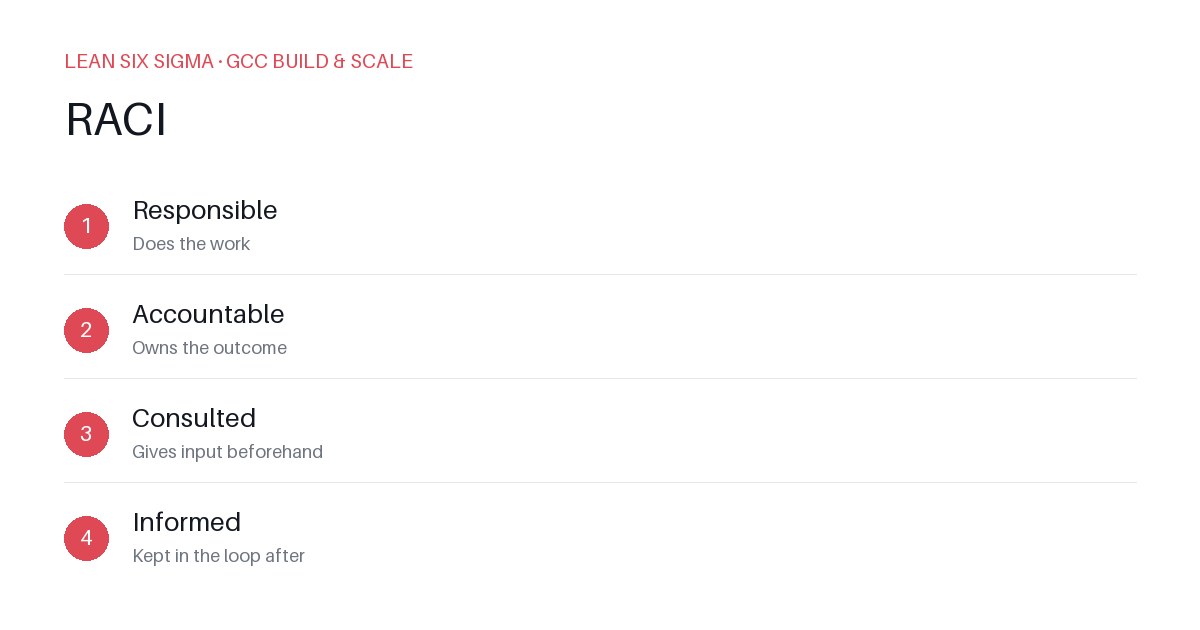
Downloadable templates
Use RACI matrices to eliminate ambiguity in cross-site GCC ownership and drive faster, leaner process execution.
Why RACI Matters in GCCs
Global Capability Centers (GCCs) thrive on clear accountability. Without it, decisions stall, work duplicates, and lean principles get buried in confusion. RACI matrices provide a simple, repeatable framework to define who is Responsible, Accountable, Consulted, and Informed for every critical activity across sites.
Setting Up Your RACI Framework
Start by mapping your GCC’s core processes — for example, a new onboarding workflow or a defect resolution process. List each activity row by row. Then, for each activity, assign roles:
- Responsible: The person or team that actually does the work.
- Accountable: The single owner who approves the outcome.
- Consulted: Those whose input is needed before the decision.
- Informed: People who need updates after the decision.
Use a spreadsheet or a visual tool like Miro or Confluence. Keep it simple — avoid overcomplicating with extra roles.
Applying RACI to Cross-Site Workflows
In a GCC, work often spans multiple locations. Consider a scenario where a defect is identified in Site A, analyzed in Site B, and resolved in Site C. Without RACI, you might find:
- Site A assigns the defect to Site B.
- Site B delays because they’re unsure if they’re accountable.
- Site C waits for approval that never comes.
A RACI matrix clarifies:
- Site B is Responsible for analysis.
- Site A is Accountable for the initial triage.
- Site C is Consulted for resolution steps.
- All sites are Informed of the final status.
This structure prevents handoff gaps and ensures each site knows its role.
Common Pitfalls and How to Avoid Them
- Multiple accountable roles: This creates confusion. Always assign one accountable person per activity.
- Overloading the Responsible role: Too many people doing the same task slows things down. Keep responsibilities focused.
- Ignoring Consulted inputs: Skipping key stakeholders leads to poor decisions. Involve them early.
Practical Steps to Implement RACI
- Identify critical processes: Start with high-impact, cross-site workflows.
- List roles and activities: Map who does what.
- Assign RACI codes: Use a clear, consistent format.
- Review and refine: Test the matrix with a pilot team. Adjust based on feedback.
- Embed in daily operations: Use RACI in stand-ups, project charters, and process documentation.
Leveraging RACI for Lean Six Sigma
RACI aligns well with lean principles by reducing waste from unclear ownership. It supports value stream mapping by highlighting bottlenecks and handoff delays. When combined with Six Sigma tools like DMAIC, RACI ensures that each phase has clear accountability, speeding up cycle times and improving quality.
Final Thoughts
RACI matrices are not a one-time exercise. They’re a living tool that evolves with your GCC. Regularly revisit your matrix, update roles as needed, and use it to drive continuous improvement. Clear ownership leads to faster, leaner, and more effective global operations.
Comments
Be the first to comment on this post.
Sign in to leave a comment.