RACI Matrices for GCC Cross-Site Ownership
October 16, 2026
Like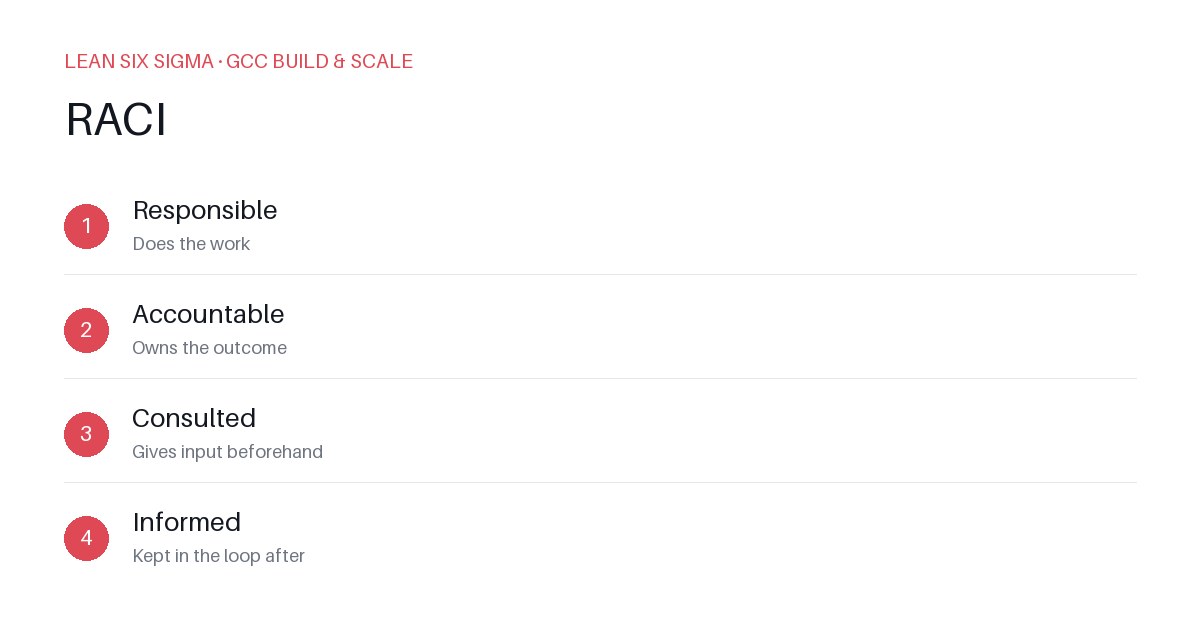
Downloadable templates
Eliminate handoff friction between GCC sites by defining clear RACI roles for shared processes and deliverables.
Why RACI Matters in Global Capability Centers
Global Capability Centers (GCCs) thrive on standardization, but they fracture when ownership gets ambiguous. When a process spans multiple sites—say, a shared QA framework rolling out from India to the US and UK—who owns the defect rate? Who approves the tooling? Who signs off on the release? Without a documented RACI matrix, you get duplicated efforts, delayed decisions, and blame games.
RACI isn’t just a governance checkbox. It’s a practical tool to map decision rights across geographies, reducing friction in cross-site workflows.
Defining RACI Roles for GCC Processes
Start by listing the key activities that span multiple GCC locations. Examples include:
- Process design and standardization
- Tooling procurement and deployment
- Performance metrics definition and reporting
- Training and enablement delivery
- Vendor management for shared services
For each activity, assign four roles:
- Responsible: The person or team that does the work.
- Accountable: The single owner who ensures completion and meets standards.
- Consulted: Those whose input is needed before decisions are made.
- Informed: Stakeholders who receive updates after decisions are finalized.
Example: For a shared defect tracking tool rollout:
- Responsible: IT implementation team at the hub site.
- Accountable: Process owner at the GCC center of excellence.
- Consulted: QA leads at each regional site.
- Informed: Regional managers and compliance teams.
Implementing RACI in Practice
-
Identify Cross-Site Workflows: Map processes that involve more than one GCC location. Focus on high-impact areas like change management, tooling, and performance tracking.
-
Assign Roles Clearly: Avoid vague labels like "team" or "stakeholders." Use specific roles or titles to prevent confusion.
-
Validate with Site Owners: Review the matrix with representatives from each GCC site. Get sign-off on who is responsible, accountable, consulted, and informed.
-
Document and Share: Store the RACI in a shared repository accessible to all GCC teams. Update it whenever processes or roles change.
-
Audit Quarterly: Check for drift. Are roles still accurate? Are there new bottlenecks? Adjust as needed.
Common Pitfalls to Avoid
- Multiple Accountables: Each activity must have one accountable person. Too many owners create paralysis.
- Ignoring Informed Roles: Stakeholders who aren’t kept in the loop can cause resistance later.
- Static Matrices: GCCs evolve. RACIs must be living documents, not one-time exercises.
Measuring Impact
Track these metrics to gauge RACI effectiveness:
- Reduction in cross-site decision latency
- Decrease in duplicated work across GCCs
- Improvement in process adoption rates
- Higher satisfaction scores in GCC collaboration surveys
A well-maintained RACI matrix turns cross-site ambiguity into coordinated execution. Start small, validate with site owners, and scale the practice across your GCC network.
Comments
Be the first to comment on this post.
Sign in to leave a comment.